

Marketing measurement is breaking under its own complexity
More tools, more channels, and more data have left many marketers struggling to connect activity to outcomes.
Spy on Any Website
Marketers have more data than ever, but a new report from Bitly suggests they still struggle to answer a basic question: What’s actually working?
According to Bitly’s “The Marketing Visibility Report,” the average marketing team now uses six different tools to measure performance. Yet only 18% of marketers say they have a clear view of what’s actually working.
Part of the problem is that marketing now happens everywhere.
The report, which surveyed more than 250 marketing professionals, found that 72% of marketers use organic social media, making it the most common channel in the marketing mix. Dedicated campaign landing pages, email campaigns, and paid social also rank among the most heavily used channels.
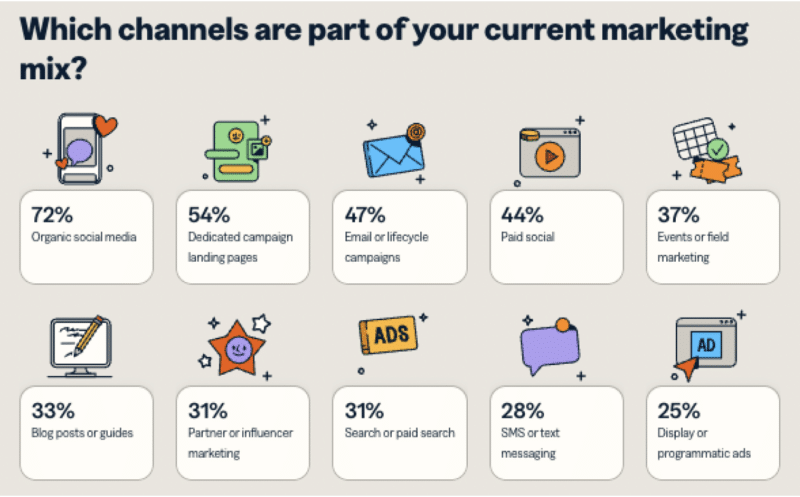
That creates a visibility challenge because every channel tells a different story. Social platforms generate engagement metrics almost instantly. Landing pages show conversions but often reveal little about what drove visitors there. Email connects brands to known audiences but frequently operates separately from other marketing systems.
The result is that marketers are trying to assemble a complete picture from a collection of disconnected signals.
More tools have not solved that problem. The report found that the most commonly used measurement platforms focus on individual channels, including social analytics, web analytics, email platforms, and CRM systems. Tools built specifically to connect performance across channels and tie activity to outcomes remain far less common.

That fragmentation shows up most clearly in the channels marketers rely on the most.
When asked where they experience the biggest visibility gaps, marketers ranked organic social media first, followed by dedicated campaign landing pages, paid social, search, and email campaigns.

The organic social result is particularly notable. It’s the channel used by nearly three-quarters of marketers, yet it is also the channel where visibility problems are most severe. The report argues that marketers can easily see activity on social platforms but often struggle to connect it to meaningful business outcomes.
Landing pages present a similar challenge. They sit close to conversion and often serve as a source of truth for campaign performance, but they rarely explain what influenced visitors before they arrived. Without that context, marketers know what happened but not necessarily why.
The report suggests the problem may get worse before it gets better. AI-generated answers, zero-click behavior, private sharing, and dark-funnel activity are creating even more interactions that marketers cannot easily track. At the same time, AI is accelerating campaign creation and optimization, increasing the volume of activity that teams need to understand.
In other words, marketers are not suffering from a lack of data. They are suffering from a lack of connection between the data they already have. The challenge is no longer collecting signals. It’s turning a growing pile of disconnected metrics into a clear view of what drives business results.
The full report can be found here. (No registration required)
The world’s most powerful SEO platform, purpose-built for Enterprise.
MarTech is owned by Semrush. We remain committed to providing high-quality coverage of marketing topics. Unless otherwise noted, this page’s content was written by either an employee or a paid contractor of Semrush Inc.

Constantine von Hoffman is senior editor of MarTech. A veteran journalist, Con has covered business, finance, marketing and tech for CBSNews.com, Brandweek, CMO, and Inc. He has been city editor of the Boston Herald, news producer at NPR, and has written for Harvard Business Review, Boston Magazine, Sierra, and many other publications. He has also been a professional stand-up comedian, given talks at anime and gaming conventions on everything from My Neighbor Totoro to the history of dice and boardgames, and is author of the magical realist novel John Henry the Revelator. He lives in Boston with his wife, Jennifer, and either too many or too few dogs.
View Author Profile
Add us as a preferred source on Google
Google's "preferred sources" feature allows users to customize their search results by selecting news outlets they want to see more often in the "Top Stories" section.
Add Martech NowRelated Articles

Advertisers plan to spend more, but slow activation and weak measurement can still cost networks money.
Read More
Companies are spending heavily on AI, but most agent projects are still short of full scale and many marketing teams can’t show clear financial value.
Read More
Faster service is part of AI’s promise. Customers aren't impressed when speed comes with unresolved problems and no easy way to reach a person.
Read More
AI agents are spreading across the GTM stack, but many teams lack the visibility and ownership needed to keep track of what they do.
Read MoreRelated Articles
Advertisers plan to spend more, but slow activation and weak measurement can still cost networks money.
Read More
Companies are spending heavily on AI, but most agent projects are still short of full scale and many marketing teams can’t show clear financial value.
Read More
Faster service is part of AI’s promise. Customers aren't impressed when speed comes with unresolved problems and no easy way to reach a person.
Read More
AI agents are spreading across the GTM stack, but many teams lack the visibility and ownership needed to keep track of what they do.
Read More