

The real impact of AI on budgets, stacks and teams
AI is replacing tools and reshaping budgets, but it’s also expanding stacks and increasing headcount.
Spy on Any Website
Forty-two percent of marketers say their budgets increased because of AI, and a third say it is also driving a significant rise in headcount, according to a new survey from Semrush. The study, “AI Myths Marketers Believed and What the Data Actually Shows,” found that the impact of AI is less about cutting costs and more about reshaping how marketing organizations invest and operate.
That shift is particularly clear in how budgets are changing.
AI has increased budgets for just under 42% of marketers, while only about 16% report decreases. Another 28% say it has had no meaningful impact so far, and a smaller group says it is still too early to tell. That says AI is not triggering widespread cost reduction. Instead, it is creating pressure to invest, experiment and expand capabilities.
The trend is even more obvious when you look at how budgets are being reallocated. More than 40% of marketers say AI has already driven major changes in where their money goes, with another 28% reporting smaller shifts. Even among those who have not made changes yet, many expect to within the next year. The direction is clear. AI is not sitting on top of existing strategies. It is actively reshaping them.

Martech stacks continue to grow
At the same time, marketing stacks are still growing, even as AI tools promise consolidation. About a third of marketers say their stack increased slightly over the past year, and another quarter says it grew significantly. Roughly the same share says it stayed flat. Very few report any meaningful reduction.
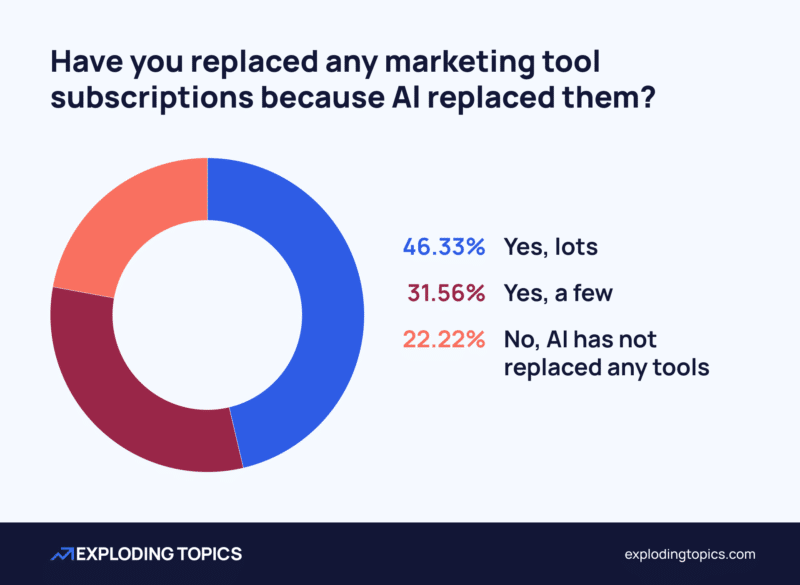
That might seem at odds with another finding. Nearly half of marketers say they have replaced lots of tools with AI, and another third say they have replaced at least a few. But the contradiction is more apparent than real. What is happening is substitution and expansion, not simplification. AI is replacing certain point solutions while also introducing entirely new capabilities that require additional tools, workflows and integration.
This dynamic is especially pronounced in organizations with larger budgets. Teams managing more than $500,000 are significantly more likely to have replaced a larger number of tools with AI. That suggests scale plays a role in how aggressively companies rethink their stack, and how quickly they can operationalize those changes.
AI isn’t shrinking marketing teams
Headcount trends reinforce the same pattern. About a third of teams report significant growth, with another quarter seeing smaller increases. Only a small percentage report any reduction. That runs counter to the idea that AI will shrink marketing teams. In practice, many organizations appear to be adding people to support new workflows, manage AI-driven processes and produce more output.
Variation in team size points to a deeper shift. AI is not replacing marketers so much as changing how work gets done. Some teams are using it to scale content and production with fewer people. Others are investing in more talent to take advantage of what AI makes possible.
What emerges from the data is a more nuanced picture than the common narrative. AI is not simply a cost-saving tool, nor is it a straightforward replacement for existing technology or talent. It is a force that is redistributing resources across budgets, tools and teams.
The marketers seeing the biggest changes are not necessarily the ones cutting the most. They are the ones reallocating fastest, experimenting most aggressively and building around AI as a core part of how marketing operates.
The world’s most powerful SEO platform, purpose-built for Enterprise.
That may be the most important takeaway. The impact of AI is not showing up as efficiency alone. It is showing up as acceleration.
Recommended Articles
Methodology
The survey is based on responses from 1,008 marketing budget decision-makers across the United States, spanning roles from marketing managers to CMOs, founders and executives. Respondents represented a wide range of budgets, from under $100,000 to over $10 million, with the largest share managing between $500,000 and $2 million. The sample was evenly split by gender and included participants from all major U.S. regions, offering a broad view of how AI is affecting marketing organizations today.
Read more on the survey here. (No registration required).
MarTech is owned by Semrush. We remain committed to providing high-quality coverage of marketing topics. Unless otherwise noted, this page’s content was written by either an employee or a paid contractor of Semrush Inc.

Constantine von Hoffman is senior editor of MarTech. A veteran journalist, Con has covered business, finance, marketing and tech for CBSNews.com, Brandweek, CMO, and Inc. He has been city editor of the Boston Herald, news producer at NPR, and has written for Harvard Business Review, Boston Magazine, Sierra, and many other publications. He has also been a professional stand-up comedian, given talks at anime and gaming conventions on everything from My Neighbor Totoro to the history of dice and boardgames, and is author of the magical realist novel John Henry the Revelator. He lives in Boston with his wife, Jennifer, and either too many or too few dogs.
View Author Profile
Add us as a preferred source on Google
Google's "preferred sources" feature allows users to customize their search results by selecting news outlets they want to see more often in the "Top Stories" section.
Add Martech NowRelated Articles

Marketing artificial intelligence (AI)
12 minutes readYour AI agents may follow instructions perfectly — and still get things wrong. The problem could lie in the documents they rely on.
Read More
Cheaper clicks and more leads can look like wins while qualified pipeline stalls. Uncover the tradeoffs behind your performance numbers.
Read More
Clicks, visits, and engagement scores show what buyers did. Better marketing starts with understanding what they’re trying to accomplish.
Read More
Junior roles face an unprecedented AI squeeze. Here is how to build structured apprenticeships to preserve the supply of marketing talent.
Read MoreRelated Articles
Marketing artificial intelligence (AI)
12 minutes readYour AI agents may follow instructions perfectly — and still get things wrong. The problem could lie in the documents they rely on.
Read More
Cheaper clicks and more leads can look like wins while qualified pipeline stalls. Uncover the tradeoffs behind your performance numbers.
Read More
Clicks, visits, and engagement scores show what buyers did. Better marketing starts with understanding what they’re trying to accomplish.
Read More
Junior roles face an unprecedented AI squeeze. Here is how to build structured apprenticeships to preserve the supply of marketing talent.
Read More