

Operationalizing generative AI for marketing impact
Turn AI adoption into a strategic marketing advantage with streamlined workflows, connected systems, clear roles and measurable results.
Spy on Any Website
Marketing is undergoing a structural shift — not only in how content is created, but in how campaigns are orchestrated, insights generated, operations managed and outputs governed. At the center of this change is generative AI.
For senior marketing leaders, the question has moved beyond “Should we use AI?” to “How do we scale it responsibly, align it with business outcomes and keep teams focused and efficient?”
The genAI martech stack
The genAI stack has evolved beyond simple prompt-based tools for writing or design. AI capabilities are deeply embedded within the broader marketing ecosystem, powering:
- Dynamic campaign orchestration.
- CRM decision intelligence.
- Content personalization.
- Audience segmentation.
- Media optimization.
- Operational automation.
These AI layers are no longer isolated add-ons. They are foundational to how marketing teams:
- Prioritize leads.
- Refine targeting strategies.
- Generate tailored messaging in real time.
- Automate workflows across the entire customer lifecycle.
What the cloud did for IT and digital did for brand, AI is now doing for marketing — pushing execution and coordination toward full-process augmentation. This requires a rethink of tools, talent, process design and governance.
Dig deeper: Why active sponsorship is the only way to make AI work
Map processes before you integrate tools
It’s tempting to drop AI tools into your stack and hope they add value. But without a clear operational blueprint, AI will amplify inefficiencies rather than fix them. Before any integration, identify which workflows are ready for automation and which ones need to be redesigned from the ground up.
Use the AI-readiness workflow matrix below to evaluate and prioritize high-volume, rule-based processes.
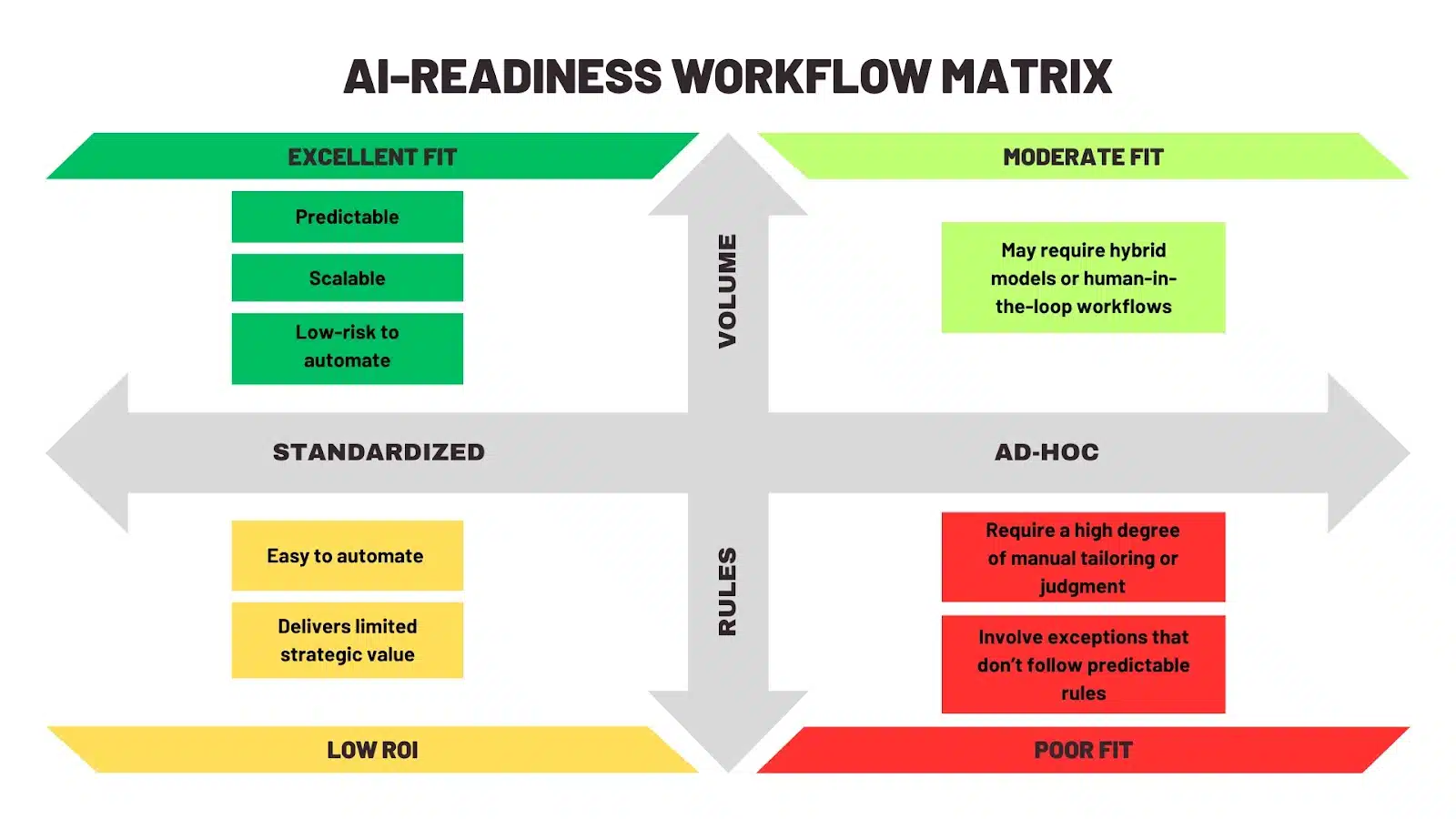
Ideal candidates for AI augmentation
- Lead scoring and routing: Train AI on historical win/loss patterns and behavioral data.
- Content personalization: Dynamically adapt headlines, CTAs and copy based on firmographic or behavioral signals.
- Campaign QA: Use AI to check for broken links, CTA coverage, tone consistency and compliance.
- Form routing and field enrichment: Auto-populate CRM fields or route leads based on AI-enriched firmographic insights.
AI adds value when it’s aligned with well-understood, repeatable workflows. Otherwise, it introduces risk and inconsistency.
Recommended Articles

Redesigning the org chart for AI-augmented execution
Rolling out AI tools without clarifying roles is a recipe for confusion. Teams won’t know who owns what, how outputs are QA’d or what skills to develop.
As generative AI transforms workflows, redefining team responsibilities is key. The goal isn’t to replace people with AI, but to elevate the value of human work by shifting roles from task execution to orchestration, oversight and strategic input.
The chart below outlines how some core marketing functions are evolving in AI-augmented environments.
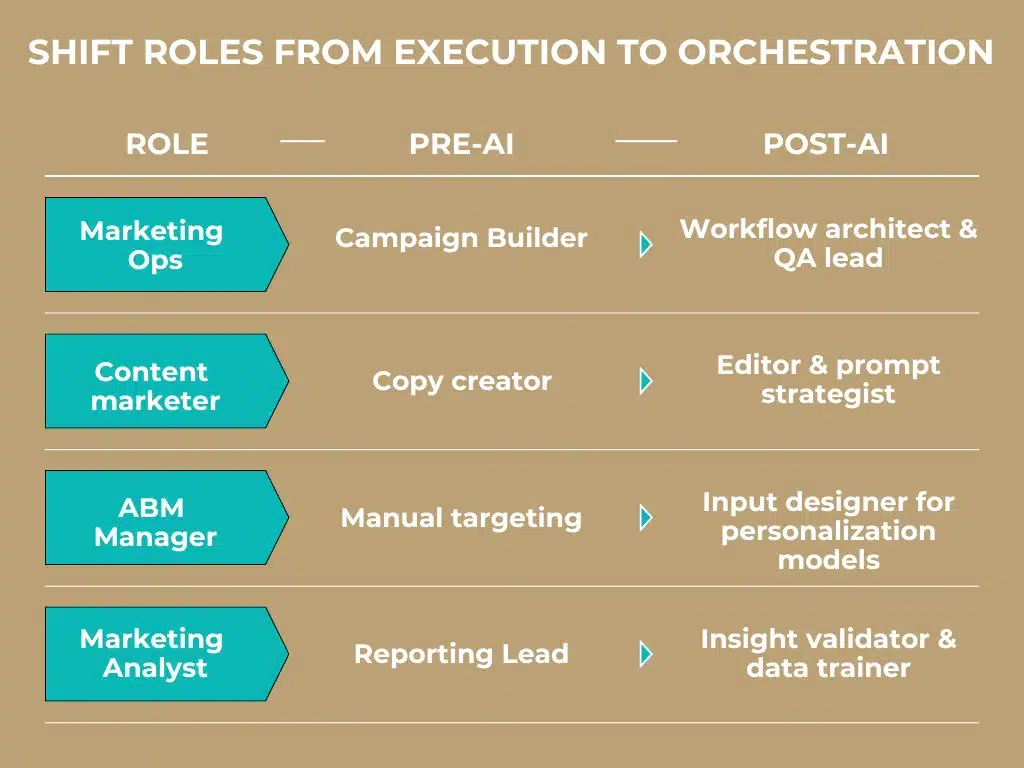
Some orgs are also creating entirely new roles designed to operationalize AI with accountability, creativity and consistency across systems:
- Marketing operations AI engineer: Architects and implements internal AI tools and connects them to key workflows and platforms.
- AI QA analyst: Owns output validation to ensure brand tone, factual accuracy and regulatory compliance.
- Prompt librarian: Curates and governs prompt frameworks, ensuring reuse, consistency and performance optimization.
- AI ops manager: Oversees AI tool usage across teams, manages vendor integrations, enforces governance and ensures adoption benchmarks are met.
These roles are essential components of an AI-first marketing team. In earlier martech waves, functions like demand gen, analytics and automation evolved into specialized disciplines. Today, new AI-focused roles signal the same professionalization within marketing operations.
Dig deeper: Scaling AI starts with people, not technology
Integrating AI into your martech infrastructure
AI tools can’t live in a silo. Integrating AI directly into your martech infrastructure ensures that insights and outputs are actionable, traceable and aligned with broader GTM strategies.
When AI models sit outside your CRM, MAP, CDP and analytics layers, teams waste time duplicating work or second-guessing recommendations. This is where technical marketing leadership becomes critical. AI must enhance, not fragment, the martech stack.
Focus areas for integration
- CRM integration: Ensure AI outputs (e.g., lead scores, summaries, predictions) feed directly into contact records and sales workflows.
- MAP integration: Use AI to dynamically trigger emails, adjust nurture streams or create variants based on real-time behavior.
- CDP/BI layers: Combine AI-generated insights with behavioral and transactional data for better segmentation and personalization.
- Compliance and data flows: Ensure AI tools don’t disrupt existing privacy policies, especially in HIPAA, GDPR or SOC2-regulated environments.
Governing AI use
Without governance, generative AI introduces operational and reputational risks, including:
- Hallucinated claims.
- Off‑brand messaging.
- Inconsistent tone.
- Compliance gaps.
Establishing effective AI oversight means setting clear expectations, minimizing risk and enabling scale. AI governance should function as a dynamic system that enables innovation while keeping the brand, legal exposure and data integrity in check. That includes:
- Designing approval workflows for new tools.
- Defining boundaries around AI-generated content.
- Implementing transparent accountability mechanisms across teams.
Key governance mechanisms
- AI acceptable use policy: Clarifies what types of tools and outputs are permitted.
- Content QA guidelines: Defines what must be reviewed by humans and when.
- Attribution protocols: Establishes when/how to disclose AI involvement in customer-facing content.
- Usage logs: Tracks who used what tools, when and what outputs were published.
Consider forming a cross-functional AI Governance Council that includes representatives from marketing, legal, compliance and ops to review new tools, evaluate risks and evolve policy.
Dig deeper: Marketing gains from AI begin with governance
Measurement and performance
Traditional attribution frameworks fall short when applied to AI-driven marketing, since generative models influence revenue throughout the funnel and deliver both direct and indirect benefits.
According to recent research:
- Organizations deeply invested in marketing AI see 10-20% higher campaign ROI compared to peers.
- An impressive $3.70 return for every $1 invested in AI, a 2024 IDC study showed. Industry leaders are seeing returns up to $10.30.
- However, only a fraction of marketers can meaningfully quantify AI’s impact. For instance, just 49% say they can actually measure ROI on their AI investments.
To bridge this gap, start with baselines, run controlled pilots and iterate. The key is consistent, repeatable measurement.
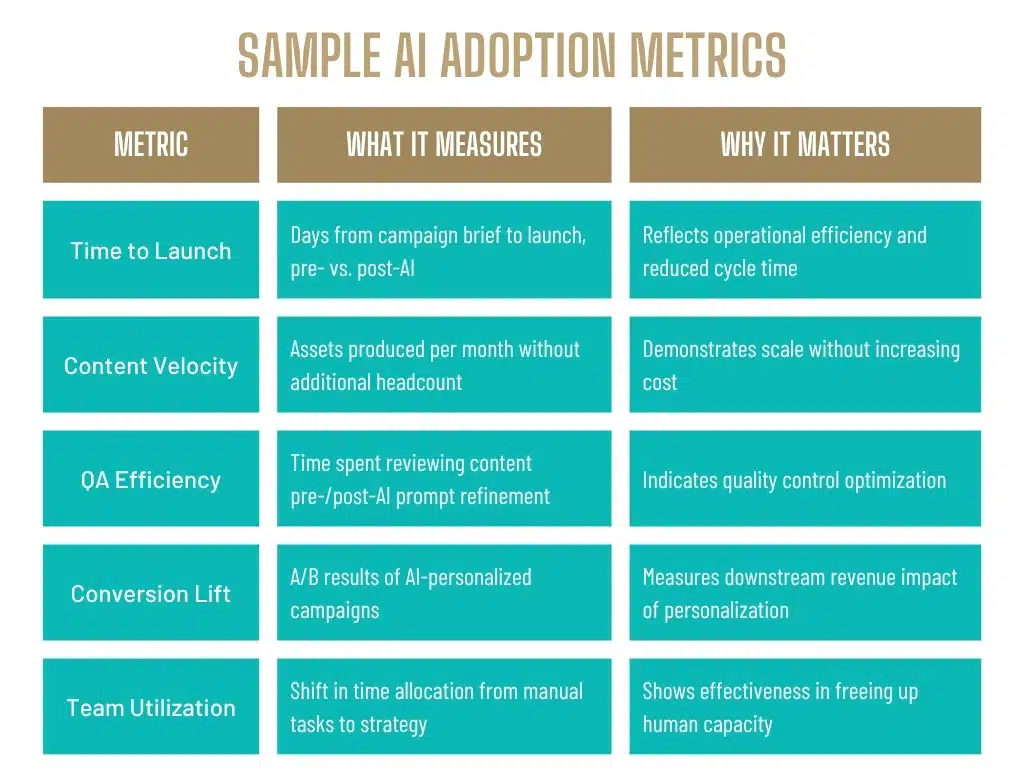
Driving adoption without overload
AI transformation isn’t just technical — it’s cultural. Many AI initiatives fail because teams resist change. Implementing frameworks like Kotter’s 8-step model helps anchor AI transformation in purpose, urgency and alignment. That means:
- Building guiding coalitions.
- Generating early wins.
- Embedding continuous learning across the organization.
To reduce transformation fatigue, senior leaders must create AI champions, offer role-specific training and set up feedback loops. These efforts increase trust in AI systems, boost adoption rates and ensure teams feel supported rather than replaced.
Dig deeper: Is your marketing team AI-ready? 8 steps to strategic AI adoption
GenAI is a strategic mandate
Generative AI has dramatically changed how we work. As marketing leaders, our role is to ensure it’s implemented strategically. Done right, you’ll build a more agile, efficient and future-ready marketing team.
If you wait too long to get a handle on AI, you’ll end up with a patchwork stack, a burned-out team and marketing outputs you can’t stand behind. Let’s build trusting systems for our teams, create space for strategic work again and lead the next evolution of marketing.
Contributing authors are invited to create content for MarTech and are chosen for their expertise and contribution to the martech community. Our contributors work under the oversight of the editorial staff and contributions are checked for quality and relevance to our readers. MarTech is owned by Semrush. Contributor was not asked to make any direct or indirect mentions of Semrush. The opinions they express are their own.


Add us as a preferred source on Google
Google's "preferred sources" feature allows users to customize their search results by selecting news outlets they want to see more often in the "Top Stories" section.
Add Martech NowRelated Articles
B2B buyers are growing more risk-averse. Here is how to restructure engineering and pitches around modular API integration models.
Read More
Disconnected systems create missed work and hours of admin. The real measure of martech productivity is how much work the stack eliminates.
Read More
Marketing artificial intelligence (AI)
22 minutes readNielsen’s DoubleVerify deal helps verification as AI takes on more media decisions, raising new questions about trust and transparency.
Read More
Marketing can produce more with AI, but every new capability creates work to govern, integrate, measure, and maintain. That’s where AI debt builds.
Read MoreRelated Articles
B2B buyers are growing more risk-averse. Here is how to restructure engineering and pitches around modular API integration models.
Read More
Disconnected systems create missed work and hours of admin. The real measure of martech productivity is how much work the stack eliminates.
Read More
Marketing artificial intelligence (AI)
22 minutes readNielsen’s DoubleVerify deal helps verification as AI takes on more media decisions, raising new questions about trust and transparency.
Read More
Marketing can produce more with AI, but every new capability creates work to govern, integrate, measure, and maintain. That’s where AI debt builds.
Read More