

5 ways AI changed marketing strategy in just one year
New data reveals how AI is reshaping everything from buyer behavior to marketing operations—and why last year’s strategies won’t cut it anymore.
Spy on Any Website
What a difference a year makes, especially when it comes to artificial intelligence. Scott Brinker and Frans Riemersma released their “Martech for 2026” report yesterday and the differences between it and the 2025 edition say a lot about how AI and marketing have evolved over the last 12 months.
Here are five key changes in how AI agents are being used and understood across the marketing landscape.
1. From efficiency to growth
Last year, most marketers focused on squeezing more out of their teams and tools. That made sense — AI was new, and the easiest wins were around productivity. Tools for content ideation (used by 69%) and copywriting (62%) were among the most common applications.
Dig deeper: Three actions you must take to thrive in the agentic era of marketing
Today, the bar is higher. Efficiency is taken for granted. Now the focus is on growth — using AI to drive innovation, unlock new revenue streams and create differentiation. Instead of “do more with less,” it’s “do more with more.” As the 2026 report puts it: “More is not better — better is better.” In other words, it’s not about how much AI you use — it’s about what you do with it.
2. From competing platforms to AI-empowered buyers
In last year’s report, the main disruption was inside marketing: established vendors vs. upstart AI-native tools, or the challenge of managing ever-expanding martech stacks.
This year, the main disruption is outside of marketing’s control: The consumer use of tools like ChatGPT, Claude and Gemini for research and buying decisions is turning everything upside down. Half of all consumers already use AI-powered search, putting as much as 50% of traditional search traffic at risk. That’s an enormous power shift.
To respond, marketers are beginning to embrace optimizing content for AI engines. Whether you call it AEO for AI engine optimization or GEO for generative engine, it means applying relevant schema types — such as Product, FAQPage, Review and Article — that make details like features, use cases and customer ratings easier for AI to extract and display in results. It’s still early, but the trend is clear: SEO alone won’t get you seen anymore.
3. From replacement to augmentation
There was a lot of noise last year about AI replacing martech as we know it. Would AI agents “eat SaaS”? Would traditional platforms become obsolete?
Turns out, not so much. The data from 2026 shows that most companies are using AI to augment what they already have — not to rip and replace it. In fact, 85.4% of respondents said they’re using AI to enhance existing tools, and just 30.1% reported replacing any major parts of their stack.
Dig deeper: How MOps and CreativeOps can align to unlock operational excellence
What’s emerging is a hybrid model: traditional, rules-based software paired with AI that can reason, generate and adapt. That blend of deterministic and probabilistic systems is fast becoming the new standard.
4. From data collection to data quality
In 2025, the most significant data challenge was getting access to it. Marketers were all about setting up cloud data warehouses, centralizing information and building a universal data layer.
Now, it’s about ensuring that the data is actually useful. The biggest hurdle in 2026? Poor data quality. More than half of marketers reported struggling with missing, outdated, or inconsistent data. And when AI agents rely on that data to deliver insights, quality matters more than ever.
To solve this, marketers are leaning into Context Engineering to ensure AI gets the right inputs at the right time. That includes connecting CRM and CDP data, tapping into DAMs and CMSs and enriching insights with both internal and external signals. Without reliable context, even the smartest AI can get things wrong.
5. From keeping systems running to driving business impact
AI may be changing the role of marketing operations faster than anything else. MOps now has strategic responsibilities in addition to managing tools and ensuring campaigns run on time.
In 2026, MOps teams are becoming “business value engineers.” That means translating AI’s potential into outcomes that matter — like top-line growth, customer expansion and strategic insights. It’s a mix of technical know-how, cross-functional collaboration and the ability to turn data into direction.
The bottom line
In just a year, marketing has gone from “how do we use this?” to “how do we lead with this?” And expectations for marketing teams are rising accordingly.
AI is now a new layer in how marketing operates. That means rethinking how stacks are built, customer journeys shaped and teams create value. Like it or not, marketing is becoming the leading change agent for organizations. The rewards and challenges are enormous.
MarTech is owned by Semrush. We remain committed to providing high-quality coverage of marketing topics. Unless otherwise noted, this page’s content was written by either an employee or a paid contractor of Semrush Inc.

Constantine von Hoffman is senior editor of MarTech. A veteran journalist, Con has covered business, finance, marketing and tech for CBSNews.com, Brandweek, CMO, and Inc. He has been city editor of the Boston Herald, news producer at NPR, and has written for Harvard Business Review, Boston Magazine, Sierra, and many other publications. He has also been a professional stand-up comedian, given talks at anime and gaming conventions on everything from My Neighbor Totoro to the history of dice and boardgames, and is author of the magical realist novel John Henry the Revelator. He lives in Boston with his wife, Jennifer, and either too many or too few dogs.
View Author Profile
Add us as a preferred source on Google
Google's "preferred sources" feature allows users to customize their search results by selecting news outlets they want to see more often in the "Top Stories" section.
Add Martech NowRelated Articles

Teams built around autonomy, experimentation, and cross-functional work can turn AI’s speed into faster campaigns without adding headcount.
Read More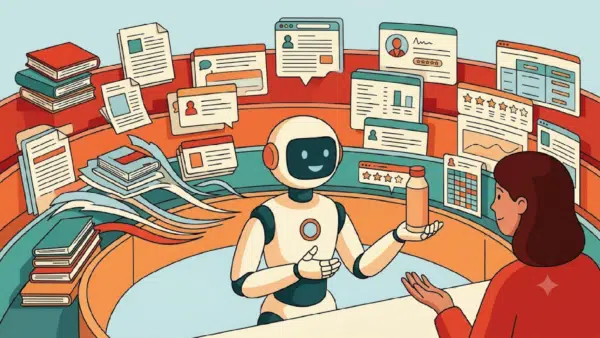
Nearly 60% of Gemini’s local citations point to business websites, but recommendations can change dramatically when using identical searches.
Read More
Marketing artificial intelligence (AI)
27 minutes readSeismic and Highspot's merger creates a bigger GTM platform, but how useful will it be to customers with disconnected data and processes?
Read More
Being included in an AI answer isn't the same as being chosen. Here's what determines the difference.
Read MoreRelated Articles
Teams built around autonomy, experimentation, and cross-functional work can turn AI’s speed into faster campaigns without adding headcount.
Read More
Nearly 60% of Gemini’s local citations point to business websites, but recommendations can change dramatically when using identical searches.
Read More
Marketing artificial intelligence (AI)
27 minutes readSeismic and Highspot's merger creates a bigger GTM platform, but how useful will it be to customers with disconnected data and processes?
Read More
Being included in an AI answer isn't the same as being chosen. Here's what determines the difference.
Read More