

How to use CRM segmentation to drive holiday repeat purchases
Use a CRM recency ladder to prioritize customer segments and coordinate holiday campaigns across email and paid media.
Spy on Any Website
The holiday season is an opportunity to re-engage lapsed customers and drive repeat purchases. With shoppers switching between brands and looking for deals, segmenting your CRM by customer recency can help you reach past buyers with relevant messages and offers at the right time.
Deloitte forecasts holiday sales growth of 4.0% to 4.8% in 2026, with online sales rising 7.5% to 8.4%. Natalie Martini, who leads Deloitte’s U.S. retail and consumer products practice, notes that shoppers across income groups are switching between brands and retailers and using promotions to control spending.
The world’s most powerful SEO platform, purpose-built for Enterprise.
Build your recency ladder
RFM — recency, frequency, and monetary value — has been used for decades. Recency is the most important of the three factors. The more recently someone purchased from you, the more likely they are to buy again. Divide your CRM system into four levels, each with a specific role this season.

The two most recent groups remain always-on, but their messaging differs.
Give every rung a job
Include customers from the last nine months in your campaigns throughout the year. Add them to paid social as custom audiences and send purchase data back through Meta’s Conversions API. CAPI and CRM targeting help Meta find high-value users, especially as Q4 ad prices rise.
The holidays give you a unique window to reach drifting and dormant customers. Winning back customers is tough in March, but in November, they’re already shopping and paying attention. Repeat purchases can account for 5% to 30% of a brand’s sales, and lapsed customers are among the best sources of repeat buyers.
One message is rarely enough to re-engage someone. Lapsed customers need to hear from you several times over a few weeks and through different channels. Rotate your lapsed lists. Keep the recent groups active all season, and schedule the lapsed groups around key moments, so you don’t use the same CRM list in every campaign.
- For email, both recent groups should receive your usual schedule. For drifting customers, schedule five well-timed emails. For example, updates on what’s new in early November, a Black Friday preview, Black Friday (Nov. 27), Cyber Monday (Nov. 30), and a shipping reminder in mid-December. Dormant customers should get no more than three emails.
- For paid digital, both recent groups should remain always-on through the year. For drifting customers, plan three holiday campaigns each lasting at least a week. For dormant customers, plan one multiweek campaign from mid-November through Cyber Monday week. This concentrates marketing on dormant customers when urgency is highest. Digital video and connected TV can also be effective retargeting channels for CRM segments.
Paid media doesn’t have the same deliverability risks, so use it more with your oldest customers. Emailing the dormant group requires extra care around deliverability. Old addresses can bounce, some may be spam traps, and people who’ve forgotten you are more likely to mark your emails as spam. Too many of these signals in one week can cause emails to your best customers to land in spam folders, right when you need them most. Check the dormant list before sending, keep batches small, and try to send before the Black Friday rush.
Recommended Articles


Match the message to the rung
Recent customers are familiar with your brand, so focus on what’s new, personalized messages, loyalty rewards, and repeat offers. Lapsed customers need a reason to pay attention again, so start with what’s new and follow up with an offer.
Deloitte economist Akrur Barua expects online sales to grow as shoppers use digital tools to research and compare before buying. Lapsed customers comparing options are a strong audience for your new updates.
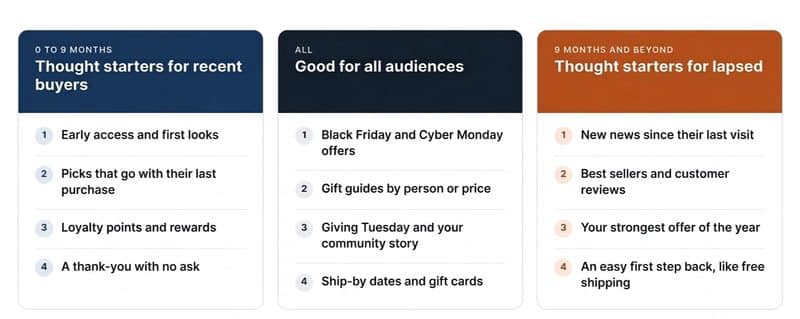
Pay attention to where you offer discounts. Your best recent customers respond well to recognition, and many would have purchased anyway. Reserve your biggest discounts for the lapsed groups, where it can influence behavior and help protect your margins elsewhere.
Your recent customers are gift-givers, too. Martini notes that shoppers still care deeply about making the holidays special for friends and family. A customer who loves your brand is your best introduction to everyone on their gift list, so give them gift guides and gift cards early.
Start this month
Deloitte defines the holiday season as November through January, and your plan should follow the same timeline. Any customer you gain in November will be a recent customer by January and a strong candidate for a repeat purchase.
October is the ideal time to start. Pull your CRM, sort it into the four groups, clean up the dormant email list, and prepare your new updates. Customers who’ve already chosen you are your best chance for a successful holiday season and a strong start to the new year.
Contributing authors are invited to create content for MarTech and are chosen for their expertise and contribution to the martech community. Our contributors work under the oversight of the editorial staff and contributions are checked for quality and relevance to our readers. MarTech is owned by Semrush. Contributor was not asked to make any direct or indirect mentions of Semrush. The opinions they express are their own.

After leading digital growth for brands like Tempur-Pedic, Build-A-Bear, La Quinta, and American Airlines, he founded Poppe Marketing. Poppe helps companies unlock growth through digital media, CRM, and loyalty. Poppe Marketing builds agile marketing teams composed of deep subject-matter experts, enabling brands to pivot quickly, execute with precision, and grow efficiently, with data at the core.
Ed’s clients describe him as a strategic partner and servant leader who blends big-brand experience with hands-on execution to drive measurable results.
Outside of Poppe Marketing, Ed supports early childhood education as a board member of Flance Early Childhood Center in St. Louis.

Add us as a preferred source on Google
Google's "preferred sources" feature allows users to customize their search results by selecting news outlets they want to see more often in the "Top Stories" section.
Add Martech NowRelated Articles
Marketing artificial intelligence (AI)
11 minutes readCustomer preferences, purchase decisions, and even checkout are moving beyond brands' control. Here's what you can still influence — and how.
Read More
Holiday sales could grow even as consumers trade down, stretch purchases across the season, and use discounts to stock up on essentials.
Read More
AI search engines are rewriting the rules of retail. Here is how to keep your brand visible when algorithms replace human shoppers.
Read More
The agency isn't banning personalized pricing, but sellers may have to explain when and how customer data affects prices.
Read MoreRelated Articles
Marketing artificial intelligence (AI)
11 minutes readCustomer preferences, purchase decisions, and even checkout are moving beyond brands' control. Here's what you can still influence — and how.
Read More
Holiday sales could grow even as consumers trade down, stretch purchases across the season, and use discounts to stock up on essentials.
Read More
AI search engines are rewriting the rules of retail. Here is how to keep your brand visible when algorithms replace human shoppers.
Read More
The agency isn't banning personalized pricing, but sellers may have to explain when and how customer data affects prices.
Read More