

75% of marketers say their measurement systems are falling short
Marketers are shifting from patching legacy models to rebuilding measurement around speed, strategy and trust — and AI is at the center of it.
Spy on Any Website
Three out of four marketers say their current approaches to measurement — including attribution, incrementality and media mix modeling — aren’t delivering the speed, accuracy or trust they need. That’s the top finding from the “State of Data 2026” report by the IAB and BWG Global. Further proof, if any was needed, that marketing leaders under pressure to prove ROI are using systems built for a different era.
Fragmented data, outdated models and long feedback loops are making it harder to connect media spend to business outcomes. Billions of dollars in investment are being made with incomplete information, often based on models that can’t account for where consumers actually spend time. And with privacy changes and signal loss accelerating, the cracks are widening.
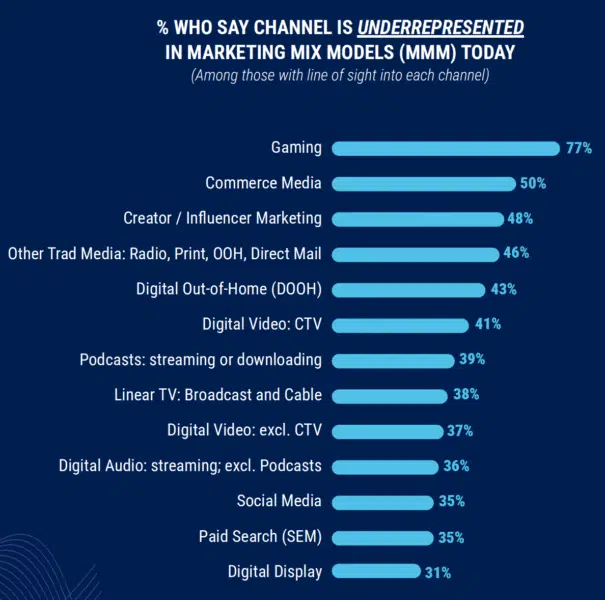
The report reveals a mismatch between legacy measurement tools and where attention is actually going. For example, 77% of marketers say gaming is underrepresented in their marketing mix models. Commerce media (50%) and the creator economy (48%) are also significantly overlooked. That kind of underrepresentation leads to underinvestment in the channels where consumers are most engaged.
Meanwhile, teams are spending more time stitching together siloed data than generating insights from it. Measurement workflows are still largely manual and slow. The result: missed opportunities, misallocated budgets and marketing plans that don’t match real behavior.
AI’s role in fixing what’s broken
Amid all the dysfunction, marketers are hopeful that AI can bring meaningful change — not just to automate tasks, but to rethink how measurement works.
According to the report, AI is expected to unlock $26.3 billion in media investment value by making measurement faster, more adaptive and more strategic. The shift is already underway in three key areas:
- Speed and frequency: Marketers expect to move from annual or quarterly model updates to monthly, weekly or even real-time feedback loops. Incrementality testing, which has traditionally been run a few times per year, is shifting to an always-on experimentation model.
- Strategy over spreadsheets: As AI takes over routine data tasks like classification and cleaning, teams anticipate redirecting time toward higher-value work. The report estimates this shift will drive $6.2 billion in productivity gains as marketers spend more time interpreting results and less time wrangling data.
- More access to advanced tools: AI is helping democratize complex techniques like multi-touch attribution and cross-channel lift analysis. These models have historically been reserved for advanced teams with the technical skills to manage them. With AI, more marketers can tap into sophisticated insights without having to build the infrastructure from scratch.
About half of buy-side marketers are already scaling AI within their measurement programs. Many others are in early-stage testing or proof-of-concept phases. Unsurprisingly, analytics teams are furthest ahead. They’re more than twice as likely as planning teams to be deploying AI-based workflows — largely because they already work with machine learning models and large datasets.
Dig deeper: 3 incrementality testing mistakes — and how to avoid them
That gap is narrowing. More than 70% of teams that haven’t yet scaled AI say they expect to do so by 2027.
What’s slowing adoption
While excitement around AI is high, trust remains a major issue. Half of marketers anticipate legal, privacy or accuracy challenges in the next two years. One of the biggest concerns is the “black box” problem — when AI-driven insights can’t be explained or traced.
Risk tolerance also varies by role. Executives are focused on cost, ethics and workforce impact. Practitioners are more worried about execution details — ownership, model governance and making AI work within existing workflows.
To manage these concerns, marketers are turning to contracts. About 37% of buy-side teams say they’ve already added AI-related language to partner agreements, covering areas like transparency, security and governance. That number is expected to double in the next two years, signaling that AI accountability is quickly moving from theory to practice.
Recommended Articles

What marketers should do next
The IAB’s report outlines a clear action plan for marketers who want to modernize their measurement strategy without introducing unnecessary risk.
Push for standardization and oversight
Shared industry standards — such as those being developed by IAB’s Project Eidos — can help ensure consistency and transparency across partners. Internally, marketers need to formalize human review processes, especially when AI is involved in budget or strategy recommendations.
Dig deeper: Consumers want less digital, more real world from brands in 2026
Modernize measurement methods
- For incrementality, replace one-off tests with a calendar-based approach and use AI to monitor when retesting is needed.
- For attribution, commit to regular model rebuilds and use AI to reconcile conflicting data signals.
- For MMM, validate input data before modeling, and ensure the inclusion of channels that are often overlooked but increasingly important, like CTV and retail media.
Break down the silos
Rather than treating attribution, incrementality and MMM as separate models, marketers should use AI to cross-reference outputs. Divergences between models can flag deeper issues and help teams converge on a more unified view of what’s really driving performance.
The shift is happening — with or without you
The measurement status quo is no longer sustainable. Marketers can’t afford to rely on systems that underrepresent key channels, delay insights or lack transparency. AI offers a way forward — but not as a layer on top of broken processes. To fully realize its value, marketers need to rebuild their measurement frameworks with clarity, accountability and adaptability at the core.
MarTech is owned by Semrush. We remain committed to providing high-quality coverage of marketing topics. Unless otherwise noted, this page’s content was written by either an employee or a paid contractor of Semrush Inc.

Constantine von Hoffman is senior editor of MarTech. A veteran journalist, Con has covered business, finance, marketing and tech for CBSNews.com, Brandweek, CMO, and Inc. He has been city editor of the Boston Herald, news producer at NPR, and has written for Harvard Business Review, Boston Magazine, Sierra, and many other publications. He has also been a professional stand-up comedian, given talks at anime and gaming conventions on everything from My Neighbor Totoro to the history of dice and boardgames, and is author of the magical realist novel John Henry the Revelator. He lives in Boston with his wife, Jennifer, and either too many or too few dogs.
View Author Profile
Add us as a preferred source on Google
Google's "preferred sources" feature allows users to customize their search results by selecting news outlets they want to see more often in the "Top Stories" section.
Add Martech NowRelated Articles

Google’s Scenario Planner gives you a no-code way to turn Marketing Mix Model insights into budget and ROI decisions.
Read More
Marketing artificial intelligence (AI)
5 minutes readAs AI becomes the front door to discovery, Google and OpenAI are taking very different paths to embed advertising into the experience.
Read More
OpenAI thinks ads in conversations are more valuable than clicks, but marketers have big questions about data, attribution and whether the price is worth it.
Read MoreRelated Articles
Google’s Scenario Planner gives you a no-code way to turn Marketing Mix Model insights into budget and ROI decisions.
Read More
Marketing artificial intelligence (AI)
5 minutes readAs AI becomes the front door to discovery, Google and OpenAI are taking very different paths to embed advertising into the experience.
Read More
OpenAI thinks ads in conversations are more valuable than clicks, but marketers have big questions about data, attribution and whether the price is worth it.
Read More