

JLINC launches an open consent-managing protocol
Under this approach, a user manages permissions to personal data via Information Sharing Agreements with vendors.
Spy on Any Website
 There’s a lot of consent being given these days, and there are a lot of solutions to manage that consent.
A new open protocol called JLINC offers another choice. Developed over the last three years, the protocol was launched May 25, the day that the consent-requiring General Data Protection Regulation (GDPR) went into effect. A beta version of the platform is scheduled for launch later this year.
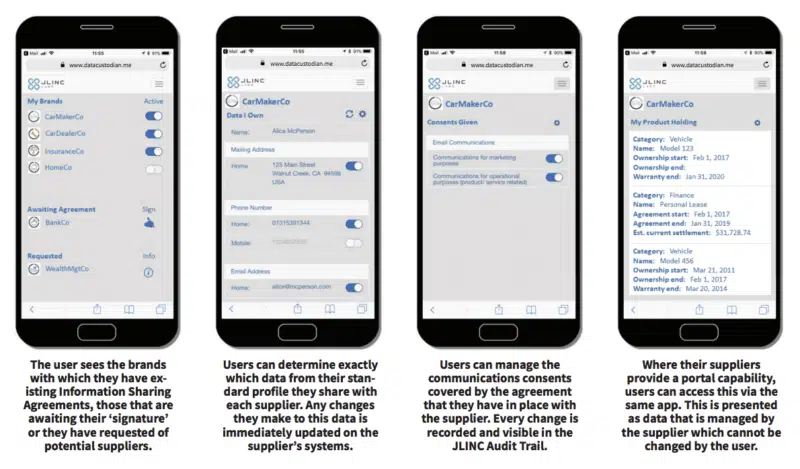
The basic idea is that users set up and manage their permissions under agreements with vendors called Information Sharing Agreements (ISAs), which define how the user’s personal data can be used. The ISAs, which live in a JLINC cloud, contain a permissions profile that’s either applied to all vendors or specific to each vendor.
Michael Leifer, JLINC Labs Chief Strategy Officer, described JLINC to me as a “digital notary service,” and he contrasted it to the way vendors store and manage users’ permission profiles in their own solutions. In a blog post, he wrote:
There’s a lot of consent being given these days, and there are a lot of solutions to manage that consent.
A new open protocol called JLINC offers another choice. Developed over the last three years, the protocol was launched May 25, the day that the consent-requiring General Data Protection Regulation (GDPR) went into effect. A beta version of the platform is scheduled for launch later this year.
The basic idea is that users set up and manage their permissions under agreements with vendors called Information Sharing Agreements (ISAs), which define how the user’s personal data can be used. The ISAs, which live in a JLINC cloud, contain a permissions profile that’s either applied to all vendors or specific to each vendor.
Michael Leifer, JLINC Labs Chief Strategy Officer, described JLINC to me as a “digital notary service,” and he contrasted it to the way vendors store and manage users’ permission profiles in their own solutions. In a blog post, he wrote:
… every last one of these so-called solutions were designed from the vantage point of the company — and how it would benefit them — and not from the perspective of the individual, making an easy way for the individual to manage their data permissions across all brands and systems. In the current field, there are an [enormous] number of siloed solutions offered by tech companies that brands have spent billions upon. For every one of those, the companies are collectively putting the heavy lifting on the individual, imposing upon each person to invest a valuable amount of time to register with each of their systems. AND, if the individual wants to see the cumulative information they have granted access to, across all of those separate systems, they have to download their information from each brand’s database and compare that information in some way on their own. Yeah. Like THAT’s going to happen.But JLINC also seems to require a lot of user effort. You manage your preferences via a website or a mobile app, which are both in the works, plus receipts and new ISAs are issued every time you make a change. The receipts can be tracked on a ledger, such as one provided by a blockchain solution. Consumers can also invite vendors to send them ISAs via the web or mobile app.
Contributing authors are invited to create content for MarTech and are chosen for their expertise and contribution to the martech community. Our contributors work under the oversight of the editorial staff and contributions are checked for quality and relevance to our readers. MarTech is owned by Semrush. Contributor was not asked to make any direct or indirect mentions of Semrush. The opinions they express are their own.

Barry Levine covers marketing technology for Third Door Media. Previously, he covered this space as a Senior Writer for VentureBeat, and he has written about these and other tech subjects for such publications as CMSWire and NewsFactor. He founded and led the web site/unit at PBS station Thirteen/WNET; worked as an online Senior Producer/writer for Viacom; created a successful interactive game, PLAY IT BY EAR: The First CD Game; founded and led an independent film showcase, CENTER SCREEN, based at Harvard and M.I.T.; and served over five years as a consultant to the M.I.T. Media Lab. You can find him at LinkedIn, and on Twitter at xBarryLevine.
View Author Profile
Add us as a preferred source on Google
Google's "preferred sources" feature allows users to customize their search results by selecting news outlets they want to see more often in the "Top Stories" section.
Add Martech NowRelated Articles

The MAP once moved leads toward sales. Three emerging models now center customer context and what happens next.
Read More
Autonomous marketing agents promise massive labor savings, but ballooning API fees and middleware costs can easily break your technology budget.
Read More
Disconnected systems create missed work and hours of admin. The real measure of martech productivity is how much work the stack eliminates.
Read More
Not every change in a marketing metric deserves a response. Marketers need to separate temporary fluctuations from signals worth acting on.
Read MoreRelated Articles
The MAP once moved leads toward sales. Three emerging models now center customer context and what happens next.
Read More
Autonomous marketing agents promise massive labor savings, but ballooning API fees and middleware costs can easily break your technology budget.
Read More
Disconnected systems create missed work and hours of admin. The real measure of martech productivity is how much work the stack eliminates.
Read More
Not every change in a marketing metric deserves a response. Marketers need to separate temporary fluctuations from signals worth acting on.
Read More