

Here’s a data-driven strategy for better understanding use cases
What makes identifying use cases so difficult has much to do with generic and disjointed experiences.
Spy on Any Website
Use cases show brands how consumers interact with their products and services. They highlight the individual experiences of customers so companies can better connect with them.
Unfortunately, it’s often difficult to organize and manage use cases, especially in large organizations.
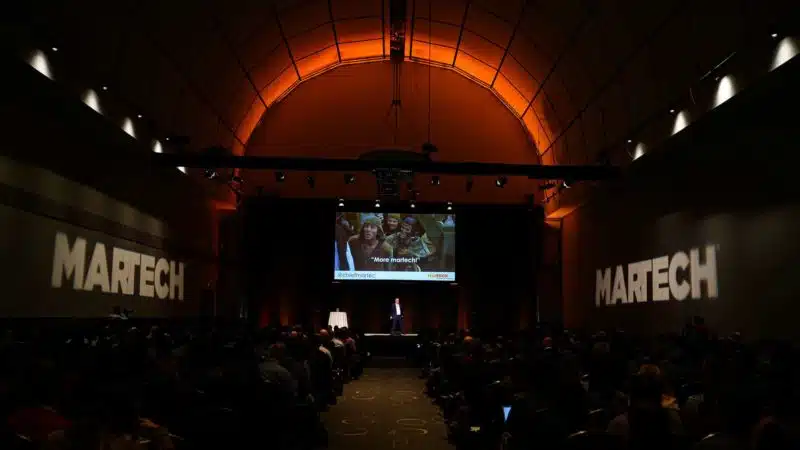
“Now a lot of companies that we talked to struggle with where to begin in terms of how to prioritize and even identify what their use cases are,” said Karen Wood, Senior Director, Product Marketing at Acquia, in her MarTech presentation. “So, we always recommend starting to look at use cases in the realm of how would that impact the end consumer.”
She added, “So rather than thinking about the different teams in the different brands that are leveraging the use cases, what is the experience going to be like for the end consumer?”
Watch the full presentation from MarTech here (free registration required)
What makes identifying use cases so difficult has much to do with generic and disjointed experiences, says Wood. Multiple departments, channels, and teams often lead to siloed consumer experiences.
“So, rather than thinking about it as the consumer flows through the journey across many different experiences, it’s really each individual siloed team or department that’s powering the discrete and unique experiences,” said Wood. “Our recommendation as we talk about use cases is to think about it cohesively across teams across touchpoints, and really what it’s like for that consumer at the receiving end.”
Take the data journey
Wood identifies three phases marketers should follow to take their data capabilities from analysis to full personalization.
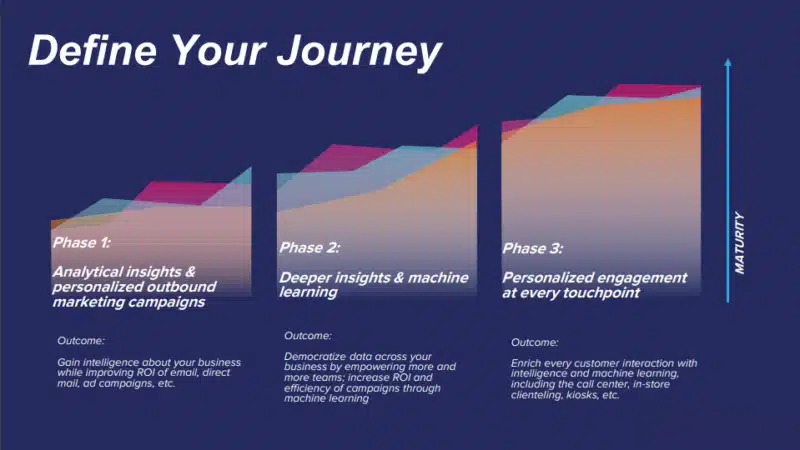
- Phase 1: Using analytical insights and personalized marketing campaigns to give consumers information about your business.
- Phase 2: Gaining deeper insights from CDP platforms, which allows teams across the board to increase ROI.
- Phase 3: Providing personalized engagement at each customer touchpoint.
“Personalized digital experiences, experiences that are driven by trusted data that engage seamlessly with one another, that address use cases that your customers care about, those experiences can drive meaningful results for your business,” said Christopher Cummings of Precisely in a separate MarTech session. “Brands across the board need to strengthen their customer engagement channels.”
Contributing authors are invited to create content for MarTech and are chosen for their expertise and contribution to the martech community. Our contributors work under the oversight of the editorial staff and contributions are checked for quality and relevance to our readers. MarTech is owned by Semrush. Contributor was not asked to make any direct or indirect mentions of Semrush. The opinions they express are their own.

Corey Patterson is an Editor for MarTech and Search Engine Land. With a background in SEO, content marketing, and journalism, he covers SEO and PPC to help marketers improve their campaigns.
View Author Profile
Add us as a preferred source on Google
Google's "preferred sources" feature allows users to customize their search results by selecting news outlets they want to see more often in the "Top Stories" section.
Add Martech NowRelated Articles

As performance pressures mount, the future of marketing success lies in transforming your data foundation into a strategic AI-powered engine for growth.
Read More
Trying to navigating the shifts in the CDP market can feel dizzying. Here's what we learned from last week's agentic CDP news.
Read More
AI agents that execute on the next best action are all the rage in CDP circles these days.
Read More
After weeks of speculation, Databricks entered the martech space with an agentic CDP built for an agentic era of marketing and shopping.
Read MoreRelated Articles
As performance pressures mount, the future of marketing success lies in transforming your data foundation into a strategic AI-powered engine for growth.
Read More
Trying to navigating the shifts in the CDP market can feel dizzying. Here's what we learned from last week's agentic CDP news.
Read More
AI agents that execute on the next best action are all the rage in CDP circles these days.
Read More
After weeks of speculation, Databricks entered the martech space with an agentic CDP built for an agentic era of marketing and shopping.
Read More