

Can DAMs keep up as content demands outgrow workflows?
New MarTech research shows that as asset volume and personalization increase, DAMs' focus must shift to content management at scale.
Spy on Any Website
The bottleneck in content operations isn’t content creation. Research from the latest MarTech Intelligence Report on DAM platforms found that as asset volume, personalization demands, and channel complexity continue to climb, the chokepoint is likely in the systems required to manage, adapt, and distribute content at scale.
Let’s start with content volume, because it’s at the root of everything else. Seventy-eight percent of marketers say they need more personalized content than they can currently produce, and 65% struggle to produce timely, personalized content for all their segments, according to Salesforce’s “State of Marketing report, Tenth Edition.”
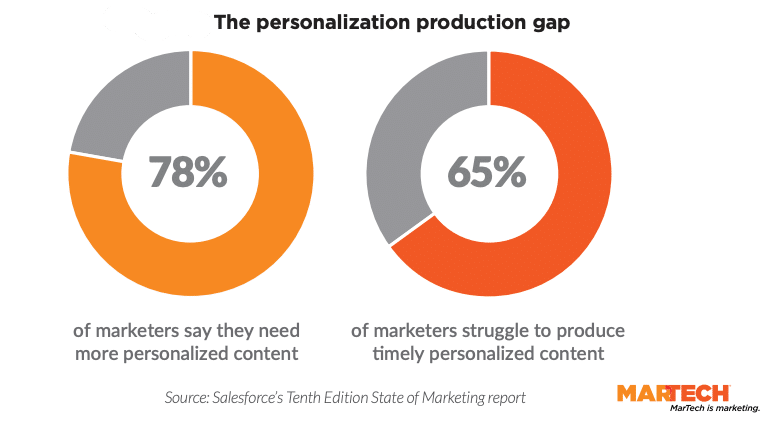
Those numbers reflect a genuine production bottleneck — but they also point to where a well-configured DAM platform pays for itself. A single campaign that once required a handful of asset variants now routinely requires dozens or hundreds. The organizations handling that volume well have the right infrastructure in place. Those that aren’t yet are the ones feeling the squeeze.
Video is accelerating this shift. One of the more striking data points I came across was from MediaValet’s 2026 DAM Trends Report: video adoption inside DAM platforms jumped from 68% to 83% in a single year.

That’s a fast move, and vendors have kept pace. Platforms are now built with video-specific capabilities, such as automated transcription, multilingual captioning, copyright detection, and reuse recommendation engines that surface existing footage before teams commission new production, with direct implications for both budget and speed to market.
AI is doing more of the heavy lifting
On the operational side, AI is removing much of the friction from DAM workflows. Data from Bynder’s “State of DAM 2026” shows that 62% of organizations have already moved beyond early-stage AI adoption in their DAM — and the platforms that are scaling it effectively are seeing real returns.
The world’s most powerful SEO platform, purpose-built for Enterprise.
The most significant shift is the increasing use of agentic AI. It goes beyond auto-tagging and smart cropping to handle more complex, multistep work — detecting off-brand content at scale, generating hyper-personalized asset variants, managing approval routing, and resolving rights conflicts.
These systems also help ensure images and videos comply with emerging SEO and GEO standards, helping brands be found by their customers. I explored this in more depth in the companion podcast for the report, and it’s worth a listen if you want to understand what’s actually possible right now, not just what’s coming.
That said, AI doesn’t mean hands-off. Nine in 10 respondents to a Bynder/Censuswide survey said human oversight is essential to safeguarding brand identity when AI-generated content is involved. The good news is that leading platforms are building that oversight in, with content credentials support, AI-generation flagging, and audit trail capabilities that give teams visibility without slowing everything down.

A growing market means more good options
The DAM market is projected to grow from $7.73 billion in 2025 to $31.99 billion by 2034 at a 15.26% compound annual growth rate, according to IMARC Group. That growth is bringing investment, competition, and capability expansion across the board — which is good news for buyers.
The landscape is worth understanding before you start evaluating, though. Pure-play DAM vendors, broader marketing suites with embedded DAM capabilities, and adjacent platforms entering the space each have distinct strengths. And since organizations use an average of 2.5 DAM platforms in parallel, according to Gartner’s “2025 Magic Quadrant for DAM Platforms,” there’s a real opportunity for consolidation if you go in with the right questions.
Recommended Articles
Where to start
The report is designed to make that evaluation process straightforward. If you’re trying to figure out what any of this means for your specific situation, the custom chatbot built for this report is a good first stop — you can ask it questions about your use case and get answers grounded in the research.
The full PDF and all of the accompanying interactive assets are available here. Download the report, check out the podcast for a deeper dive on AI and the vendor landscape, and use the chatbot to get personalized guidance on what to look for in your next DAM evaluation.
MarTech is owned by Semrush. We remain committed to providing high-quality coverage of marketing topics. Unless otherwise noted, this page’s content was written by either an employee or a paid contractor of Semrush Inc.

Pamela Parker is Research Director at Third Door Media's Content Studio, where she produces MarTech Intelligence Reports and other in-depth content for digital marketers in conjunction with Search Engine Land and MarTech. Prior to taking on this role at TDM, she served as Content Manager, Senior Editor and Executive Features Editor. Parker is a well-respected authority on digital marketing, having reported and written on the subject since its beginning. She's a former managing editor of ClickZ and has also worked on the business side helping independent publishers monetize their sites at Federated Media Publishing. Parker earned a master's degree in journalism from Columbia University.
View Author Profile
Add us as a preferred source on Google
Google's "preferred sources" feature allows users to customize their search results by selecting news outlets they want to see more often in the "Top Stories" section.
Add Martech NowRelated Articles
Orange Logic SVP Misti Vogt tells us why old ways of managing digital assets are failing, and why the future of content operations belongs to agentic systems.
Read More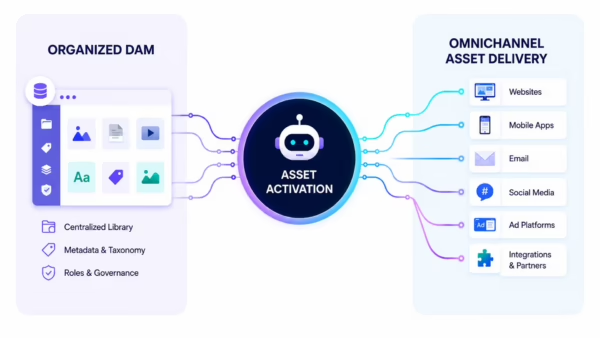
Digital asset management (DAM)
6 minutes readCentralized, tagged, governed. And still slow. Here's what your DAM was never designed to do.
Read More
Rules-based automation is reaching its limits, making DAM a critical source of context for AI-powered content workflows.
Read More
Erica Gunn, CMO of Canto, joins us to discuss how AI is both a problem and a solution for marketers drowning in content.
Read MoreRelated Articles
Orange Logic SVP Misti Vogt tells us why old ways of managing digital assets are failing, and why the future of content operations belongs to agentic systems.
Read More
Digital asset management (DAM)
6 minutes readCentralized, tagged, governed. And still slow. Here's what your DAM was never designed to do.
Read More
Rules-based automation is reaching its limits, making DAM a critical source of context for AI-powered content workflows.
Read More
Erica Gunn, CMO of Canto, joins us to discuss how AI is both a problem and a solution for marketers drowning in content.
Read More