

AI speeds marketing production, but measurement lags
AI is accelerating marketing production, but most teams still measure clicks instead of business outcomes, limiting their ability to prove AI's impact.
Spy on Any Website
AI is speeding up marketing production. Measurement hasn’t kept pace.
Marketers are 68% more likely to measure email and landing page performance by click-through rate than by revenue or pipeline influenced, according to a new report from marketing production platform Knak. The finding exposes a gap between adopting AI and measuring its business impact.

Only 29% of respondents rated their organizations as advanced AI adopters. That group was more likely to use AI agents to build and code emails and landing pages, conduct brand and compliance checks, and handle translation and localization. Other respondents were more likely to use AI for first drafts of email and landing page copy, or to generate images.
Even among organizations further along with AI adoption, measuring business impact remains a challenge.
One in three marketers said they consistently meet or exceed performance targets for email and landing page campaigns. Meanwhile, 69% measure click-through rates, compared with 41% tracking revenue or pipeline influence.
Clicks help teams diagnose campaign performance. They do not show whether the marketing-generated pipeline influenced an opportunity or contributed to revenue.
According to the report, most enterprise marketing automation and CRM platforms can connect email engagement with opportunity records. The challenge is not necessarily access to the data, but building the processes and reporting needed to use it.
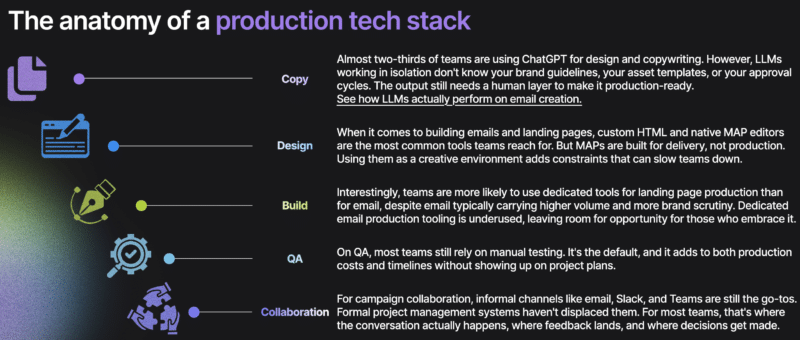
Adoption is not the differentiator
AI use is already widespread. Execution is becoming the dividing line.
Respondents who rated their organizations as advanced AI adopters were more likely to use structured project management tools and native approval workflows. They were also more willing to buy a dedicated tool when they identified a capability gap rather than force an existing platform to handle the work.

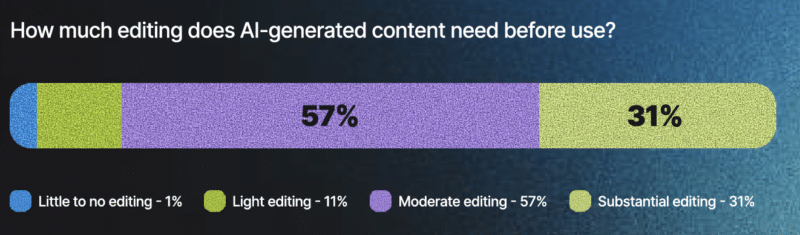
At the same time, 88% of respondents said AI-generated marketing content still requires moderate or substantial editing before it can be used. AI may accelerate production, but it has not removed the need for review, governance, and human judgment.
The question is no longer whether to adopt AI. It is whether their workflows, governance, and measurement practices are mature enough to turn faster production into better business results.
Methodology: Datalily conducted the research through Centiment on behalf of Knak. The survey included 333 marketing decision-makers in the U.S., U.K., and Canada, including Knak customers. The survey ran from April 29 to May 18, 2026. Respondents worked at companies with at least $50 million in annual revenue, sent at least five marketing emails per month, and used an enterprise marketing automation platform.
The report can be downloaded here. (Registration required.)
MarTech is owned by Semrush. We remain committed to providing high-quality coverage of marketing topics. Unless otherwise noted, this page’s content was written by either an employee or a paid contractor of Semrush Inc.

Constantine von Hoffman is senior editor of MarTech. A veteran journalist, Con has covered business, finance, marketing and tech for CBSNews.com, Brandweek, CMO, and Inc. He has been city editor of the Boston Herald, news producer at NPR, and has written for Harvard Business Review, Boston Magazine, Sierra, and many other publications. He has also been a professional stand-up comedian, given talks at anime and gaming conventions on everything from My Neighbor Totoro to the history of dice and boardgames, and is author of the magical realist novel John Henry the Revelator. He lives in Boston with his wife, Jennifer, and either too many or too few dogs.
View Author Profile
Add us as a preferred source on Google
Google's "preferred sources" feature allows users to customize their search results by selecting news outlets they want to see more often in the "Top Stories" section.
Add Martech NowRelated Articles

Useful offers are common. Meaningful recognition is not, and consumers are quick to walk when brands ask for too much without a clear reason.
Read More
Advertisers plan to spend more, but slow activation and weak measurement can still cost networks money.
Read More
Companies are spending heavily on AI, but most agent projects are still short of full scale and many marketing teams can’t show clear financial value.
Read More
Faster service is part of AI’s promise. Customers aren't impressed when speed comes with unresolved problems and no easy way to reach a person.
Read MoreRelated Articles
Useful offers are common. Meaningful recognition is not, and consumers are quick to walk when brands ask for too much without a clear reason.
Read More
Advertisers plan to spend more, but slow activation and weak measurement can still cost networks money.
Read More
Companies are spending heavily on AI, but most agent projects are still short of full scale and many marketing teams can’t show clear financial value.
Read More
Faster service is part of AI’s promise. Customers aren't impressed when speed comes with unresolved problems and no easy way to reach a person.
Read More