

Why AI is making DAM more important than ever
Rules-based automation is reaching its limits, making DAM a critical source of context for AI-powered content workflows.
Spy on Any Website
For years, marketers treated automation as the answer to growing content demands. Build enough rules into your workflows, and the system could handle the rest. AI is proving that’s not true.
According to Bynder’s “State of DAM Report 2026,” 93% of enterprise organizations face content challenges that their existing rules-based automation can’t solve. The biggest problems aren’t publishing content faster. They’re detecting off-brand assets, governing AI-generated content, producing personalized content at scale, and managing increasingly complex workflows.
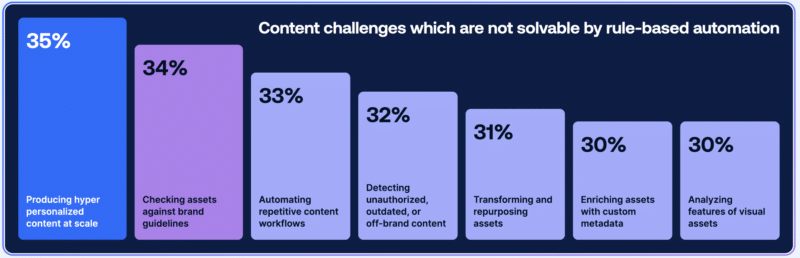
Rule-based automation works fine in anticipated scenarios. However, AI doesn’t do well following rules. It likes to add things as it goes along, imagining that it knows what you “really” want. So marketers have gone from “Yay, look at all the content AI can create,” to “What has it done, this time?”

Security is now marketers’ biggest concern when using AI in content operations, followed by legal and regulatory compliance, and inaccurate or hallucinated outputs. Respondents also cited concerns about inconsistent brand content and scaling AI without creating new workflow bottlenecks.
Those concerns reach beyond DAM. Every marketing organization is trying to balance faster content production with copyright compliance, brand governance, privacy requirements, and growing scrutiny of AI-generated content. As AI becomes embedded throughout marketing operations, governance is becoming part of everyday campaign execution rather than a final review step.
Humans remain responsible for the final decision
Across brand governance, metadata management, content quality, and adapting assets for different channels, the most common workflow combines AI with human approval. Roughly 40% to 44% of respondents said automation performs the work while people make the final decision. Another 31% to 35% rely on mixed workflows that combine automation and manual review throughout the process.

Rather than replacing people, AI is taking over repetitive work, allowing marketers to focus on judgment, governance, and accountability.
The findings also point to a broader lesson. AI works best when it has access to well-organized content, consistent metadata, clear brand guidelines, and defined approval processes. Without that context, even sophisticated AI has trouble making reliable decisions.
That’s why many organizations are treating their DAM platform as the foundation for AI governance. Instead of simply storing assets, these systems are becoming the place where AI can access the rules, permissions, and context needed to support content creation, review, and distribution at scale.
Marketing has spent the past two decades automating repetitive tasks. AI is moving the conversation in a different direction. The challenge is no longer how much work can be automated. It’s deciding where automation should end and human judgment should begin.
Bynder’s “State of DAM Report 2026” is available for download here. (Registration required.)
The world’s most powerful SEO platform, purpose-built for Enterprise.
MarTech is owned by Semrush. We remain committed to providing high-quality coverage of marketing topics. Unless otherwise noted, this page’s content was written by either an employee or a paid contractor of Semrush Inc.

Constantine von Hoffman is senior editor of MarTech. A veteran journalist, Con has covered business, finance, marketing and tech for CBSNews.com, Brandweek, CMO, and Inc. He has been city editor of the Boston Herald, news producer at NPR, and has written for Harvard Business Review, Boston Magazine, Sierra, and many other publications. He has also been a professional stand-up comedian, given talks at anime and gaming conventions on everything from My Neighbor Totoro to the history of dice and boardgames, and is author of the magical realist novel John Henry the Revelator. He lives in Boston with his wife, Jennifer, and either too many or too few dogs.
View Author Profile
Add us as a preferred source on Google
Google's "preferred sources" feature allows users to customize their search results by selecting news outlets they want to see more often in the "Top Stories" section.
Add Martech NowRelated Articles

Companies are spending heavily on AI, but most agent projects are still short of full scale and many marketing teams can’t show clear financial value.
Read More
Faster service is part of AI’s promise. Customers aren't impressed when speed comes with unresolved problems and no easy way to reach a person.
Read More
AI agents are spreading across the GTM stack, but many teams lack the visibility and ownership needed to keep track of what they do.
Read More
Nearly 81% of consumers who use chatbots for online shopping have decided against a purchase based on AI guidance.
Read MoreRelated Articles
Companies are spending heavily on AI, but most agent projects are still short of full scale and many marketing teams can’t show clear financial value.
Read More
Faster service is part of AI’s promise. Customers aren't impressed when speed comes with unresolved problems and no easy way to reach a person.
Read More
AI agents are spreading across the GTM stack, but many teams lack the visibility and ownership needed to keep track of what they do.
Read More
Nearly 81% of consumers who use chatbots for online shopping have decided against a purchase based on AI guidance.
Read More