

The risks of optimizing SEO for AI over users
Chasing AI visibility can lead to generic content, weaker differentiation, and declining trust. Here's what deserves your attention.
Spy on Any Website
As marketers chase citations and visibility in AI search, some are repeating an old SEO mistake: optimizing for search systems rather than the people who use them.
From keyword stuffing to content farms and scaled link-building schemes, SEO has a history of tactics that delivered short-term visibility but little lasting value. Today’s fixation on AI visibility risks following the same pattern.
AI search visibility matters, but it shouldn’t come at the expense of useful, original content. Google continues to emphasize creating valuable content for users and warns against tactics such as scaled content abuse.
Rather than chasing every new AI optimization hack, focus on what has always made SEO valuable: serving users better than anyone else. That’s the foundation of human-first SEO.
The role of human expertise in AI-assisted SEO
Much of the online conversation treats AI as a threat to SEO. But AI is a tool, and its value depends on how it’s used.
Research from Graphite found that 86% of high-ranking pages in Google Search were written by humans, compared with 14% generated by AI. AI-generated pages also tended to rank lower than human-authored content.
Research from iPullRank reinforces the importance of human judgment. When researchers removed evidence from real SEO scenarios, many AI models still confidently provided a diagnosis rather than acknowledging they lacked enough information. AI can accelerate workflows, but human experts remain essential for validation and decision-making.
The pages winning in search tend to include elements AI can’t independently produce:
- Original experiences.
- Unique industry insights.
- Opinions and viewpoints.
- Proprietary data.
- Expert analysis.
- Real use cases.
Use AI to accelerate research, prepare briefs, organize ideas, and transcribe interviews while letting human expertise provide the substance.
The world’s most powerful SEO platform, purpose-built for Enterprise.
4 reasons why originality matters more now
The biggest risk of AI-generated content is that it becomes indistinguishable from other content. Sameness will limit your organic growth.
1. Algorithms are built to filter sameness out
Search engines have spent years fighting low-value, repetitive content. The pace of Google’s algorithm updates this year continues to reinforce that battle.
Google repeatedly encourages content creators and brands to create non-commodity content that adds value through firsthand experience, expert insight, and unique perspectives. If the content you’re creating can be summarized within the current top five results, you’re already losing.

2. AI systems don’t need to cite common knowledge
Some marketers assume that publishing more content increases the chances of being cited. In reality, AI systems will blend common information without citing every source.
If your blog posts are repeating information that already exists, with no added insight or perspective, what incentive is there for an AI system to reference it? Or include it within its training data?
Originality will increase your content’s citation potential. Repetition will do the opposite.
3. Humans reward differentiation
Even in an AI-first world, humans are still making buying decisions. Searchers click when they want more depth or proof, whether it’s on ChatGPT or a Google AI Overview.
Some may disagree with me, but I don’t believe the click economy is disappearing. I think it’s changing. AI can answer straightforward questions exceptionally well, so yes, you may lose the click on those queries. But when searchers are closer to a decision, they want context, examples, and real-world application, and that’s when they click through to seek human expertise.
Differentiation creates curiosity. Curiosity creates the click.
4. Consumers are growing skeptical of generic AI
According to Gartner, 65% of consumers believe brands produce too much AI-generated content in their marketing materials. Even more alarming, 57% say this content has made them less trusting of brand messaging overall.
When every article sounds the same and every social post follows a similar pattern, consumer trust erodes. Today’s consumers don’t want a perfectly crafted message. They want evidence, proof, and the confidence that a real person is standing behind the information. Research from the Harris Poll, presented by Quad, shows that 80% of Americans say brands that feel human and imperfect stick with them more than AI-generated perfection.
Consumers increasingly assume content is AI-generated until proven otherwise. That means that authenticity has become a real differentiator.
So, how can we prevent repeating the same patterns?
Recommended Articles


Introducing human-first SEO
The future of SEO is human-first. It’s what SEO should be and always has been.
Early SEO saw the listicle craze, with authors listing their own brands as No. 1 or No. 2. Then search engines evolved, and it no longer worked. This story is repeating itself with AI search. Anthropic’s usage policy already includes policies against deceptive campaigns and artificial activity.
Stop chasing every “new” GEO/AEO/AIO hack. History has shown brands and marketers that these may provide a short-term boost, but in the long run, they can hurt both your visibility and your brand’s reputation.
Instead, go back to tried-and-true, human-first SEO built upon these four pillars.
- Experience: Provide firsthand knowledge that AI models cannot manufacture. Share your brand’s lessons learned, implementation challenges, successes, and real-world observations.
- Opinion: Take a position. Not every piece of content needs to be controversial, but valuable content usually requires interpretation. Readers want insights that explain what happened and why it matters.
- Proof: Support your claims with original data, whether that’s customer stories, internal research, experiments, or other evidence.
- Identity: Real people build trust. Showcase your experts. Strong bios, professional histories, research, speaking engagements, and community involvement all create authority signals that neither machines nor users can easily ignore.
Interestingly, these four pillars mirror what Google has consistently encouraged for years and now includes in its AI optimization guide.
Human-first SEO use cases
Replace scaled AI content with expert content
Although it’s tempting, especially when you see it working for others, remember that using AI to produce hundreds of pages modeled after a competitor or other source will likely deliver short-lived results and hurt you in the long term. Why? Because competitors and other sites can create the same content just as easily.
Meanwhile, marketing teams that invest in expert reviews, SME insights, and unique data earn visibility and keep it.
Everything enterprise teams need to grow visibility across search and AI.
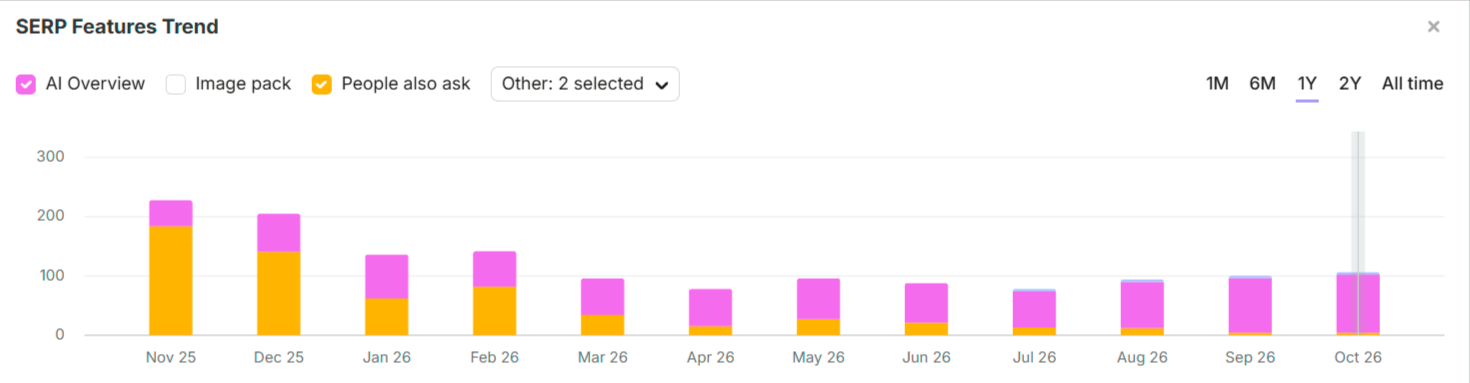
One of my B2B supplier clients and I watched a competitor publish more than 300 AI-generated how-to guides over a few months. As many of us have seen, this resulted in increased visibility for some time.
Citations began to decline, rankings dropped, and organic visibility started to disappear. Within six months, this competitor had seen its strategy rise and fall. To stop the bleeding, this competitor removed all AI-generated content.
Instead of following their lead, our SEO strategies held their course, with blog posts that spoke directly to customers’ common issues and questions and by incorporating their team into the discovery process.
Rewrite generic manufacturer product descriptions
Many ecommerce sites still rely too heavily on descriptions provided by the manufacturers. Even when those descriptions are well written, how do you stand out if other sellers are using the same copy?
Fortunately, human-first content can solve this problem. Add any of the following to help your product pages stand out from the rest.
- Actual customer questions and answers.
- Use cases.
- Results from your own product testing.
- Comparisons.
- Real customer stories and reviews.
These elements and others like them provide value that generic product descriptions cannot.
Reframe your ‘how-to’ and ‘what is’ content
SaaS companies are frequent offenders of publishing large volumes of “what is” and “how-to” content that is similar to many others. The real content opportunity lies within their product teams, implementation specialists, customer success managers, and other internal teams.
Instead of a how-to article, develop content based on insights from your development and implementation teams, including common challenges they’ve faced, issues they’ve worked through with customers, and integrations that work best. Those types of insights are difficult to replicate and highly valuable to your buyers.
Each of these examples comes back to the same question: What can you say that no one else can? The checklist below can help you answer that.
The human-first SEO checklist
Use these strategies to shift your SEO program toward a human-first approach.
- Run a content quality review. Ask yourself if AI could create the same content from current top-ranking pages. If yes, then you’re at risk of not appearing.
- Create an expert content workflow. Use AI for transcription, structure, and outlines, but source the substance from your subject matter experts.
- Build a presence beyond your website. You and your team must be visible outside of your website to earn trust.
- Adjust your KPIs. Focus on share of voice, branded search, and citations. The attribution funnel has changed, and traffic source and rankings can’t be your priority.
- Make your SMEs visible through bylines, bios, LinkedIn activity, podcasts, guest writing, conferences, and more. All of these provide authority and trust signals for your brand.
- Invest in original data, whether that be surveys you conduct or internal datasets you compile.
The new competitive advantage: Being human
The more AI-generated content that exists, the more valuable human expertise becomes. When everyone can create content faster, speed ceases to be a competitive advantage.
SEO has never been about who can publish the most content. Success belongs to the brands whose content contributes something others can’t.
- Real experience.
- Real opinions.
- Real proof.
- Real people.
Search engines are rewarding these. AI systems rely on them. Users are actively looking for them. The irony of SEO is that the more advanced AI platforms become, the more important human-first thinking is.
That’s why SEO success shouldn’t be defined by who uses AI the most. It should be defined by who stays unmistakably human.
Contributing authors are invited to create content for MarTech and are chosen for their expertise and contribution to the martech community. Our contributors work under the oversight of the editorial staff and contributions are checked for quality and relevance to our readers. MarTech is owned by Semrush. Contributor was not asked to make any direct or indirect mentions of Semrush. The opinions they express are their own.
With over 23 years of experience in SEO, back when Google was just a rumor, Andrea began her career optimizing websites for Yahoo, Ask Jeeves, AltaVista, and others. Now, as the Director of SEO at Sure Oak, she helps brands stay visible on all channels of organic search - Google & LLMs. Based in Wisconsin, she’s a plant-loving, campfire-enjoying mom of two. And of course, a diehard Green Bay Packers fan.
View Author Profile
Add us as a preferred source on Google
Google's "preferred sources" feature allows users to customize their search results by selecting news outlets they want to see more often in the "Top Stories" section.
Add Martech NowRelated Articles
Confusing navigation, vague claims, and missing evidence cost you buyers. See how cognitive-load testing helps identify and address these barriers.
Read More
Before overhauling your SEO strategy, look at branded search, high-intent visits, and pipeline data to see whether there's actually a problem.
Read More
ChatGPT visitors converted at a higher rate, but Google organic still drove 27 times as many conversions as all LLMs combined.
Read More
Longer, more personal queries reveal the needs, trade-offs, and situations behind intent — giving marketers a richer view of what customers want.
Read MoreRelated Articles
Confusing navigation, vague claims, and missing evidence cost you buyers. See how cognitive-load testing helps identify and address these barriers.
Read More
Before overhauling your SEO strategy, look at branded search, high-intent visits, and pipeline data to see whether there's actually a problem.
Read More
ChatGPT visitors converted at a higher rate, but Google organic still drove 27 times as many conversions as all LLMs combined.
Read More
Longer, more personal queries reveal the needs, trade-offs, and situations behind intent — giving marketers a richer view of what customers want.
Read More