

AI content can rank, but quality still decides winners
Semrush’s study shows AI content is already competing in search, but performance still comes down to execution, not the tool.
Spy on Any Website
AI content is not hurting your search rankings, but it is not giving you an automatic edge either.
That is the central takeaway from Semrush’s “Does AI content rank well in search?” study, which examines how AI content performs across a wide range of real-world search results. The findings challenge both extremes of the debate, showing that AI is neither penalized outright nor guaranteed to succeed.
Instead, AI content is being evaluated the same way as any other content. Search engines continue to prioritize usefulness, relevance and clarity, regardless of how the content was created.
For marketers, this shifts the conversation away from whether to use AI and toward how it is used within a broader content strategy.
The study shows AI-generated pages appearing throughout search results, including on the first page for many queries. What matters is not authorship but outcome. Content that aligns with search intent and provides clear value can compete, regardless of whether AI was involved in its creation.
This creates a more level playing field than many marketers expected. AI is not a shortcut, but it is also not a disadvantage when used effectively. The practical implication is that AI content must meet the same standards as any other content to perform well.

Content quality continues to determine ranking outcomes
The study reinforces that ranking performance is still driven by execution.
Search engines evaluate whether content answers the user’s query, presents information clearly and delivers a useful experience. These signals have not changed with the introduction of AI-assisted content creation.
AI can accelerate production, but it does not inherently improve depth, accuracy or originality. That still requires deliberate effort, particularly in competitive search environments.
The SEO toolkit you know, plus the AI visibility data you need.

Hybrid workflows produce stronger results
The most effective use of AI requires human input. High-performing teams use AI to generate drafts, outlines or initial structures, then refine and enhance that content through editing and subject matter expertise.
This approach balances speed with quality. As a result, teams can scale content production without sacrificing performance.
The increase in content volume makes it harder to be noticed. With many pieces of content covering similar ground, differentiation is essential. However, it needs to be done with a clear structure, stronger insights and better alignment. Differentiation for differentiation’s sake is not the way to go. For example, Hunter Thompson’s gonzo writing style always stands out, but it is far from what an AI thinks is coherent.
Recommended Articles

AI is changing production speed, not ranking rules
The study highlights a key distinction between production and performance.
AI significantly reduces the time required to create content, but it does not alter the underlying principles of how search rankings work. Search engines continue to prioritize content that effectively meets user needs.
This creates a gap between expectation and reality for some teams. Faster output does not automatically translate into better rankings. Instead, it amplifies existing strengths and weaknesses in content strategy.
For marketers, the takeaway is practical. AI supports SEO performance when it is used to improve workflows and enhance content quality. It is not a replacement for strategy or editorial judgment. Teams that focus on execution, clarity and relevance are more likely to see results. Execution still determines performance.
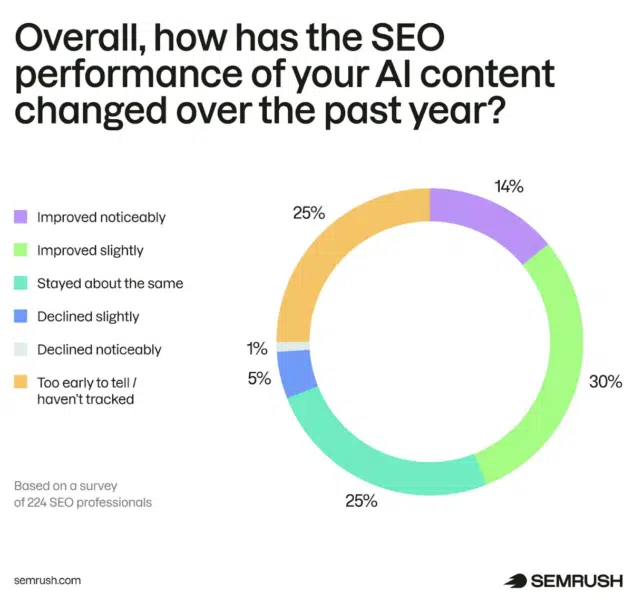
About the data: The analysis examined 42,000 blog pages from 200,000 URLs tied to 20,000 keywords, using GPTZero to classify content. It also includes a survey of 224 SEO professionals working in content and search.
The study. Does AI content rank well in search? [Survey + Data study]
MarTech is owned by Semrush. We remain committed to providing high-quality coverage of marketing topics. Unless otherwise noted, this page’s content was written by either an employee or a paid contractor of Semrush Inc.

Constantine von Hoffman is senior editor of MarTech. A veteran journalist, Con has covered business, finance, marketing and tech for CBSNews.com, Brandweek, CMO, and Inc. He has been city editor of the Boston Herald, news producer at NPR, and has written for Harvard Business Review, Boston Magazine, Sierra, and many other publications. He has also been a professional stand-up comedian, given talks at anime and gaming conventions on everything from My Neighbor Totoro to the history of dice and boardgames, and is author of the magical realist novel John Henry the Revelator. He lives in Boston with his wife, Jennifer, and either too many or too few dogs.
View Author Profile
Add us as a preferred source on Google
Google's "preferred sources" feature allows users to customize their search results by selecting news outlets they want to see more often in the "Top Stories" section.
Add Martech NowRelated Articles
As AI agents start shortlisting vendors, structured, machine-readable content will determine which brands even get considered.
Read More
Website traffic is losing ground as the primary success metric while AI visibility and lead quality take center stage.
Read More
Marketing artificial intelligence (AI)
7 minutes readThe challenge is no longer collecting information, but making organizational knowledge accessible when decisions happen.
Read More
Learn how to turn internal expertise into content that stands out in a sea of AI generated sameness.
Read MoreRelated Articles
As AI agents start shortlisting vendors, structured, machine-readable content will determine which brands even get considered.
Read More
Website traffic is losing ground as the primary success metric while AI visibility and lead quality take center stage.
Read More
Marketing artificial intelligence (AI)
7 minutes readThe challenge is no longer collecting information, but making organizational knowledge accessible when decisions happen.
Read More
Learn how to turn internal expertise into content that stands out in a sea of AI generated sameness.
Read More