

B2B services in AI search: Increase visibility in AI answers
Your next client may find you through AI. Learn how B2B firms can earn mentions, citations, and recommendations in ChatGPT, Gemini, and Google AI Mode.
Your next client just asked AI who to hire. In seconds, it recommended five firms. You may or may not be on that list. The reality in B2B services right now is that buyers are using AI to map the market, compare firms, and build their shortlist before they ever reach out.
The firms that show up in those answers set the standard. The ones that don’t may never hear from the buyer at all.

That visibility isn’t random.
In this guide we’ll break down how tools like Google AI Mode and ChatGPT surface firms based on specific signals. We’ll teach you how to understand and feed the LLMs those signals so your brand is the one showing up in AI answers.
The SEO toolkit you know, plus the AI visibility data you need.

The 3 types of AI visibility in B2B professional services
There are three ways for B2B service brands to show up in AI search:
- Brand mentions: Your name appears in an answer, which boosts awareness and category association
- Citations: Your content is used to explain a topic, which builds credibility
- Recommendations: You’re included as a provider to consider, which drives buyer evaluation (and potential leads)
Each one serves a different purpose in how buyers build trust.
Your goal is to appear in all three.
Type 1: Brand mentions
A brand mention is when AI includes your name in its answer. It’s a strong signal that AI recognises you as relevant to the topic.
For example, if you ask ChatGPT, “Do I need a lawyer to start an LLC?” The response would mention service businesses like LegalZoom and Incfile. These mentions are simply to make the point that people often use services to start an LLC — they’re not specific recommendations from ChatGPT.

But AI mentions can be more than just name-drops. Sometimes the tool will add short qualifiers — such as what you’re known for, who you serve, or what you’re good at.
For example, when asking Gemini, “What are examples of B2B marketing agencies that companies often work with?” Its answer included brief qualifying statements, such as:
- Highly regarded for combining PR, demand generation, and branding
- Known for deep expertise in complex industries
- A massive global player that focuses on data-driven performance marketing
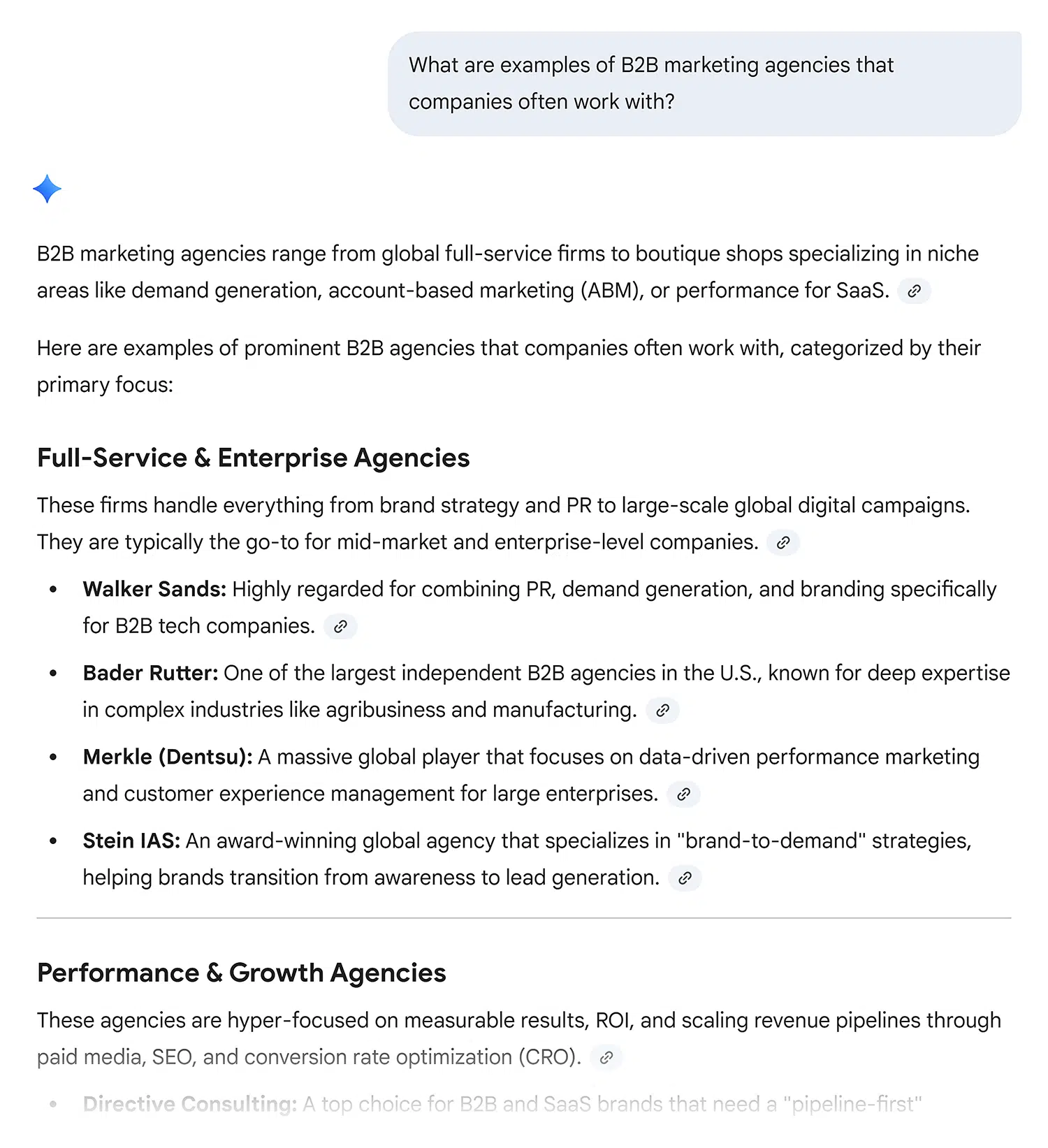
Each one creates a different impression and frames how the buyer understands your brand.
That’s why at this stage, your priority is to make sure the “judgment” AI attaches to your name is accurate (and aligned with the type of buyer you want to attract).
One way to gauge how AI understands and positions your brand is with tools like the Semrush AI Visibility Toolkit. You can see the phrases and attributes different AI models associate with your brand, and how those differ from the ones they use for your competitors.

Type 2: Citations
A citation is when AI uses your content to help explain its answer.
For example, when asking Google AI Mode, “What approaches do mid-market companies use to improve operational efficiency?” The response cited market trends and industry guides from websites for firms that do consulting.

How citations appear depends on the large language model (LLM) you’re using. They may show up inline, as footnotes, or in a sidebar.

But no matter the format, they’re the closest thing AI search has to Google’s blue links.
The key difference is that their real value isn’t the traffic they might drive to your site. It’s influence. When AI cites your content, you’re shaping the buyer’s mental map of the category:
- How problems are defined
- What solutions exist
- How to evaluate services like yours
That’s a huge advantage when buyers start comparing options because you’re framing how they think.
So, what can you do to get AI to cite you?
Create content that AI can use at every stage of the decision journey. The table below outlines what to publish at each stage.
| Stage | Buyer question | Types of content AI can cite |
| Awareness | What’s the problem? Why does it matter? | Trend reports, industry analysis, problem definition guides, “state of category” content |
| Consideration | How do people solve this? What solutions exist? | Methods and frameworks overviews, comparison guides, “how to choose solution” content |
| Evaluation | Does this work for me? What’s the process? Who should I talk to? | Case studies, process documentation, ICP-specific guides, outcome benchmarks, client results |
Type 3: Recommendations
Recommendations are when AI suggests you for a specific need. This happens when the AI trusts that your company is legitimate and is a good fit.
For example, prompting ChatGPT with, “Best operations consulting firms for private equity portfolio companies” returned a list of firms, all presented as viable options.
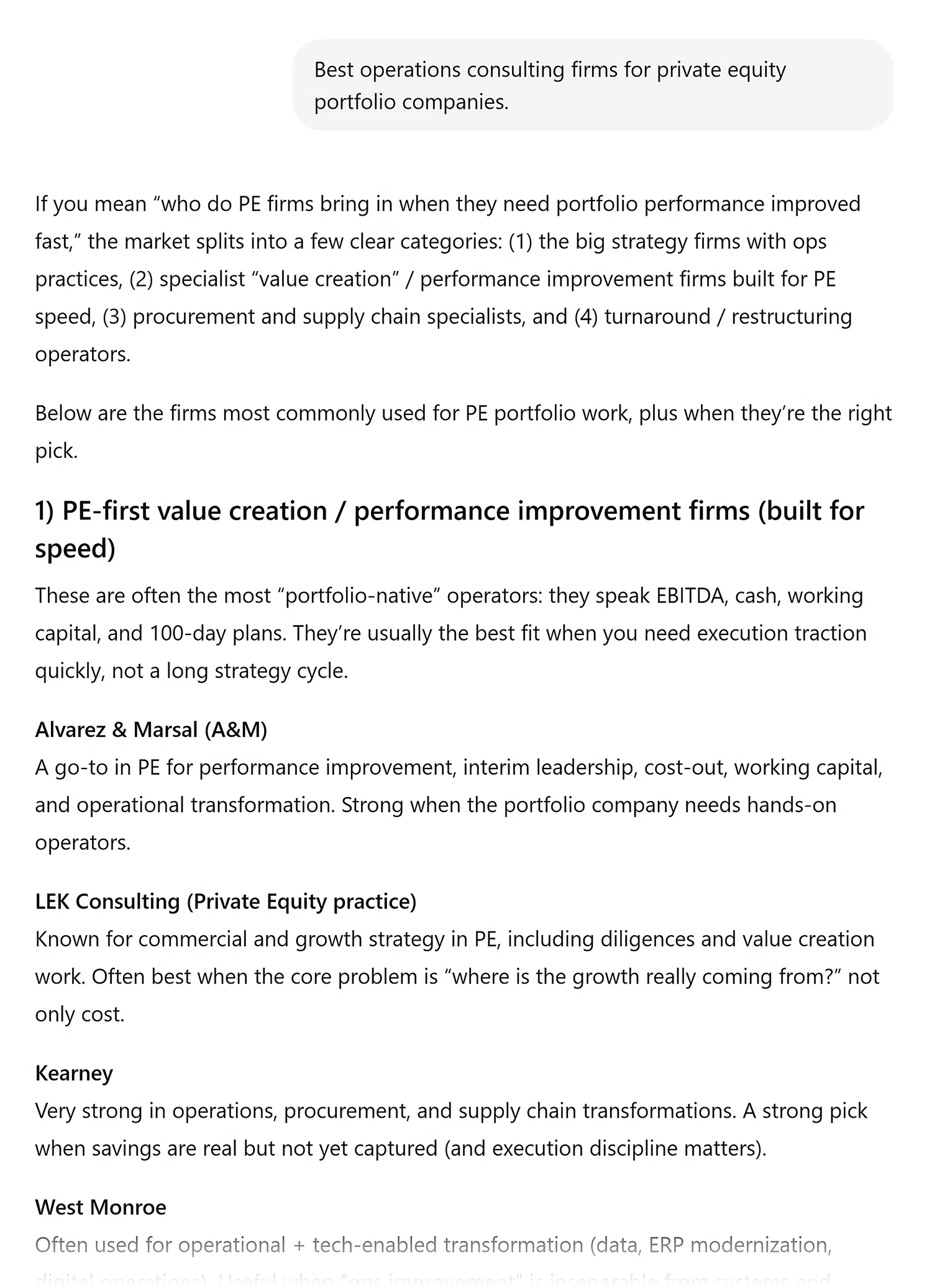
It then segmented the list by specific needs, like rapid EBITDA improvement:

That’s how powerful B2B service recommendations are in AI search: They influence the shortlist buyers walk away with.
With this in mind, what do you need to do?
Optimize to show up for high-intent queries. These are the moments when a B2B service buyer is actively deciding who to talk to.
These queries usually include terms like:
- Best
- Top
- Recommended
The user might also specify an industry or use case (like private equity or a specific company size).
In SEO terms, these are commercial and transactional search intents.

And yes, you can influence whether you appear in these recommendations. It all comes down to how AI builds confidence in your brand.
How AI chooses which B2B professional service firms to surface
AI looks for signals that increase its confidence. To get that, it looks for corroboration (i.e., there’s enough evidence online that proves your credibility and market fit).
How confident the AI can be that your brand is worth mentioning, citing, or recommending depends on two conditions:
- Consensus: Other sources back you up
- Consistency: Your narrative is the same everywhere
Consensus
Consensus is when AI sees your business mentioned in multiple credible places.
In B2B professional services, consensus usually comes from:
- Editorial and industry publications
- Directories and review platforms
- Partner mentions
- Community discussions
- Analyst-style lists and “best of” roundups
Here’s an example of what that might look like for a real B2B services brand (ThoughtWorks):

These sources provide AI with data to increase its confidence.
So, your job is to build a presence everywhere that consensus forms.
If you’re not sure where, run five to 10 prompts that mirror your buyer’s behavior, such as:
- Best [service] for [industry]
- Top firms for [specific use case]
- Alternatives to [big brand]
Then, watch which sites keep appearing in the supporting sources and citations.

Those are the places where AI learns which businesses are credible, and which ones it should recommend.
Related reading: Why HubSpot is winning at AI visibility in B2B SaaS
Consistency
Consistency is when every mention of your business tells the same narrative. It’s how AI verifies the facts about you by comparing what it finds in various sources, and checking whether your story holds.
When the facts align, the model’s confidence goes up. When they don’t, confidence drops.

The problem is that getting your story aligned is harder than it sounds, especially as your business evolves. Positioning can change. Old blog posts don’t get updated. And archived PDFs don’t get deleted.
So you could easily end up with a homepage that says you serve enterprise ecommerce brands doing $50M+ in revenue. But an old PDF — that no human has opened in years but AI can still access — says, “We specialize in working with bootstrapped founders.”
To an AI, that’s conflicting data. Which means it might:
- Guess (and potentially guess the wrong one)
- Hedge and skip you entirely
- Include you in a list with a caveat attached
Not ideal. So what do you do?
Make data hygiene a priority.
Ensure that there is no conflicting info about your business (or as close to none as you can manage). Not just on your website, but everywhere AI might look.

One way to manage this is to create a shared messaging document that Marketing, Sales, and Leadership all agree on. It should define your:
- Positioning and ICP
- Services and scope
- Results you deliver
- Company profile
- Pricing approach
- Engagement models
Everyone can then refer to this document whenever they describe the business online. And of course, audit your existing content to identify and remove conflicting information.
Recommended Articles



Types of content that dominate AI search for B2B services
The Semrush AI Visibility Index shows clear patterns in what AI cites for B2B firms. Understanding these patterns can help you create the right content and send the right signals to ensure your brand shows up too.
Editorial and “best of” content
Editorial and “best of” content refers to curated content that categorizes service providers. Think lists like “best agencies” or “top consultancies.” Like these:

You’ll find them on industry blogs, niche review sites, and market-specific publications. Sites like Forbes, LinkedIn, and TechRadar top the list for these in terms of citations.

These listicles usually group businesses by categories like service type, budget range, or industry focus.
This format is valuable to generative engines like ChatGPT and Google AI Mode because it gives the AI a ready-made map of the market, such as who does what, for whom, and at what level.
For example, querying ChatGPT with “best cybersecurity firms for healthcare companies”:

Returns cited articles such as:
- Top 12 Client-Rated End-to-End Healthcare Cybersecurity Vendors (Access Newswire)
- Top 10 Cybersecurity Companies in Healthcare (Cyber Magazine)
- The 8 Best Cyber Security Firms for Medical Device Companies 2025 (Fuel Your Digital)

In short, AI uses these editorial sources to decide which services to mention.
This means that getting included in the right “best of” lists increases the odds that AI will recommend you.
How do you get included?
Start by identifying the roundup articles AI is already citing in your category. Do this by running a search on any generative engine. Like this:

Then, pitch those publications with a clear explanation of why your firm is a strong fit.
Review and directory signals
Review and directory signals act as independent verification for AI. This is where AI checks what you say about yourself against what others say about you.
These signals help AI validate things like:
- What services you provide
- What you’re known for (and what you’re not)
- How clients experience working with you
Common sources AI draws from include platforms like Clutch, Better Business Bureau, and Trustpilot.

For example, when asking Perplexity, “Is Legalzoom legit?” it referenced sources like Consumer Affairs, Trustpilot, and SiteJabber.

What’s the takeaway?
You need to claim and optimize your profiles on review platforms.
The obvious ones include Clutch, G2, and Capterra. Plus, any niche directories your ideal customers use.
Clutch often tops ChatGPT and AI Mode citations, so make sure you’ve got a presence there. Here’s an example of what that looks like on Clutch:

Next, build a review capture system you can run consistently, so you’re not relying on a few one-off reviews.
And finally, pay attention to sentiment and recurring themes. If the same negative pattern keeps showing up, don’t try to bury it. Either fix the underlying issue if it’s inherent to your positioning. Or address it in the review platforms.
Your goal isn’t to look flawless; it’s to be accurately represented for the customers you want to serve.
Credibility and proof content
Credibility and proof content backs up what you claim. It gives AI concrete evidence to rely on (rather than forcing it to infer credibility from positioning language alone).
This includes assets like:
- Case studies
- Process and framework documentation
- Whitepapers
- Benchmarks or industry reports
- Thought leadership content
For example, IT service provider *instinctools has a dedicated section on their site that explains their approach. It includes different pages covering their delivery framework, corporate social responsibility, partnership programs, and more.
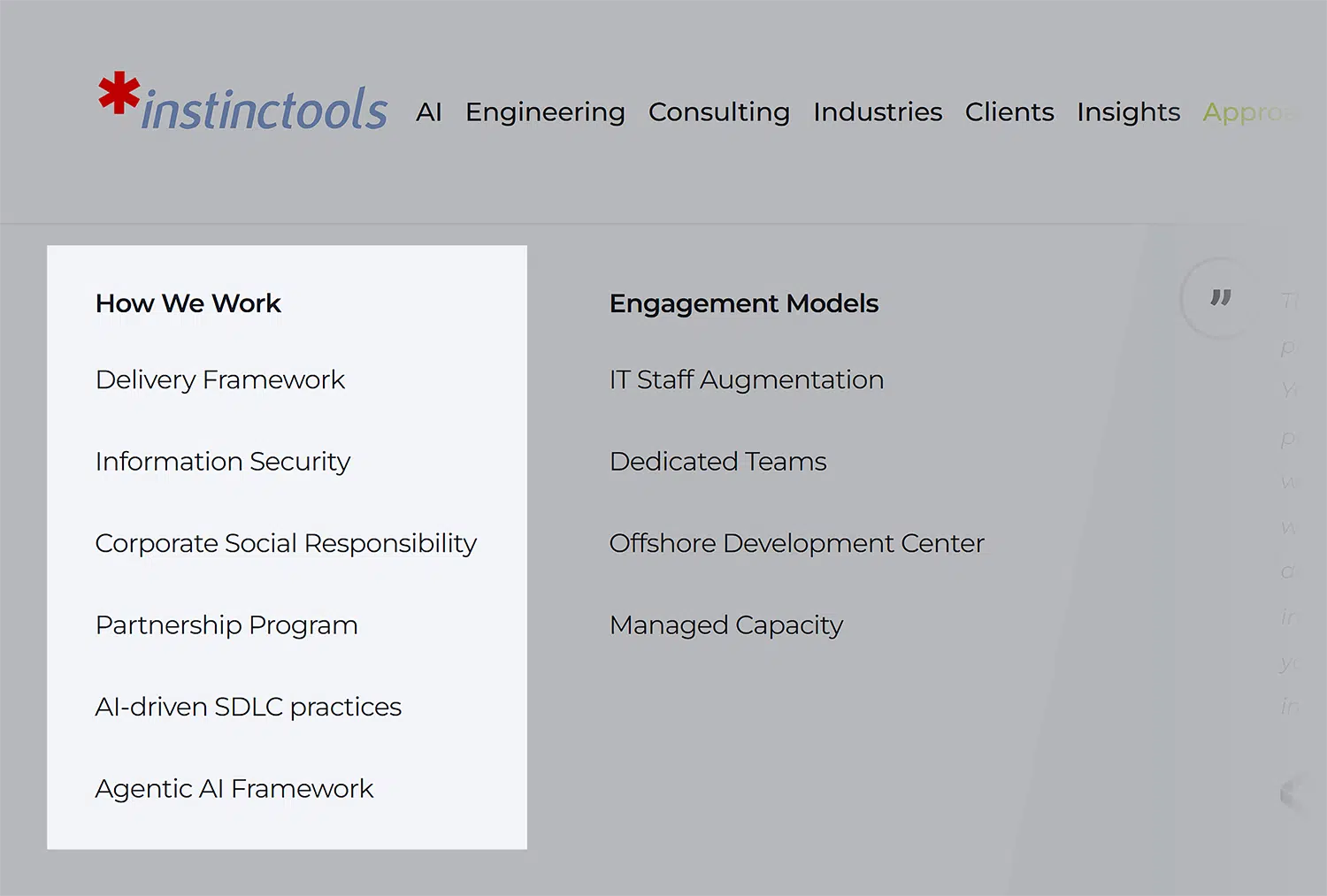
Each of these pages contains concrete credibility and proof signals that increase trust, for both AI and humans. Like these:

The good thing about these types of content is that they give AI the raw material it needs to accurately describe your expertise (and substantiate your capabilities).
That’s why, when buyers ask questions to reduce perceived risk, AI is able to address questions like:
- Does this work for companies like mine?
- What does the process look like?
- What outcomes do firms in my industry get?
For example, when asking Google AI Mode, “How does *instinctools work and is it legit?” the response cited pages from *instinctools’ website, including their service pages, about us, and review pages.

That illustrates the opportunity for you.
This type of proof content is largely within your control. These are assets you can plan for and build into your digital marketing strategy.
A strong starting point is building clear, outcome-driven case studies.
UX/UI design company Fireart does this well by maintaining a dedicated case study section on their site, with a large library of AI-accessible examples. Each one clearly documents their work, expertise, and results.

Finally, when creating these types of content, be specific, because you want AI to have concrete facts it can use. Use clear steps, defined phases, and real numbers wherever possible.
What this means for B2B professional services firms
AI tools turn what was once hours or days of research time into a conversation that can take minutes — all by analyzing patterns from an enormous range of inputs.
Once you understand how those patterns form, you can influence the outcome. Here are five things you can do to start winning the AI search game:
Specialize relentlessly
User queries in AI tools are typically more specific and longer than traditional searches. For example, the following level of query detail is now very normal:
“Best SEO agency for enterprise B2C ecommerce brands generating $50M+ in annual revenue.”
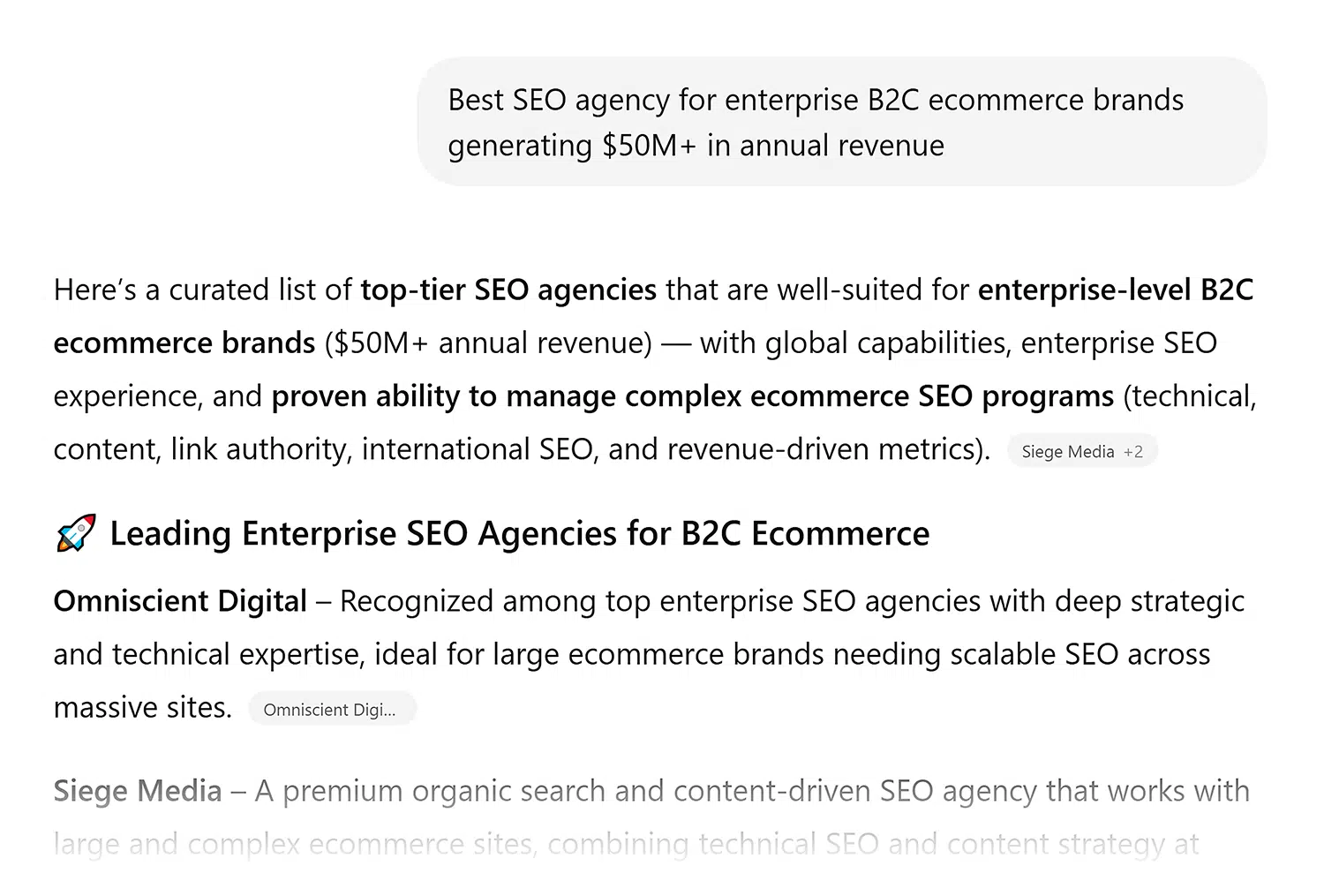
When a query is that specific, AI has to find a match (or matches) for that very well-defined context. So, if your messaging is equally specific — and consistently repeated — AI has a much easier time recognizing you as a good fit.
A good example is WebFX.
WebFX is clear about what they do best: revenue-driven digital marketing. They reinforce that focus all over their site:
- On their homepage
- In navigation and service pages
- In third-party review profile descriptions
- In case studies that lead with revenue outcomes

Plus, they repeat the same messaging wherever they appear. Like this:

That does two things: First, it makes clear what WebFX is best at. And second, it reinforces that message wherever AI looks.
As a result, when revenue comes up in the context of digital marketing agencies, AI often includes WebFX.

So your next step is clear. First, decide what you specialize in:
- Who you serve
- Which problems you solve best
- What outcomes you’re known for
Then make sure that specialization shows up consistently everywhere.
That repetition turns it into a stable signal AI can recognize and trust.
Boost social proof and credibility signals
Make it easy for AI to trust your business. Do this by ensuring there is social proof and credibility signals wherever AI is likely to look. That helps the AI confirm that you work with real clients and deliver real outcomes.
It also makes it easier for AI to rule out concerns around legitimacy or credibility.

So, here’s what you can do:
Start with your website. It should make the evidence behind your claims easy to see. That includes:
- Client logos and recognizable brands: This signals who already trusts you
- Testimonials with real context: This shouldn’t just be praise, but real situations and results
- Concrete numbers: These should show revenue impact, time saved, costs reduced, or risks avoided

Next, make sure the same story appears outside your site. Like your profiles on platforms like G2, Google Business Profile, and the Better Business Bureau.
And don’t just claim these profiles and walk away. Fill them out fully. Use descriptions, categories, and feature sections to state what you do and what you’re best at.
Here’s an example of how LinkedIn lead generation agency, Cleverly, boosts social proof on-site and off-site.
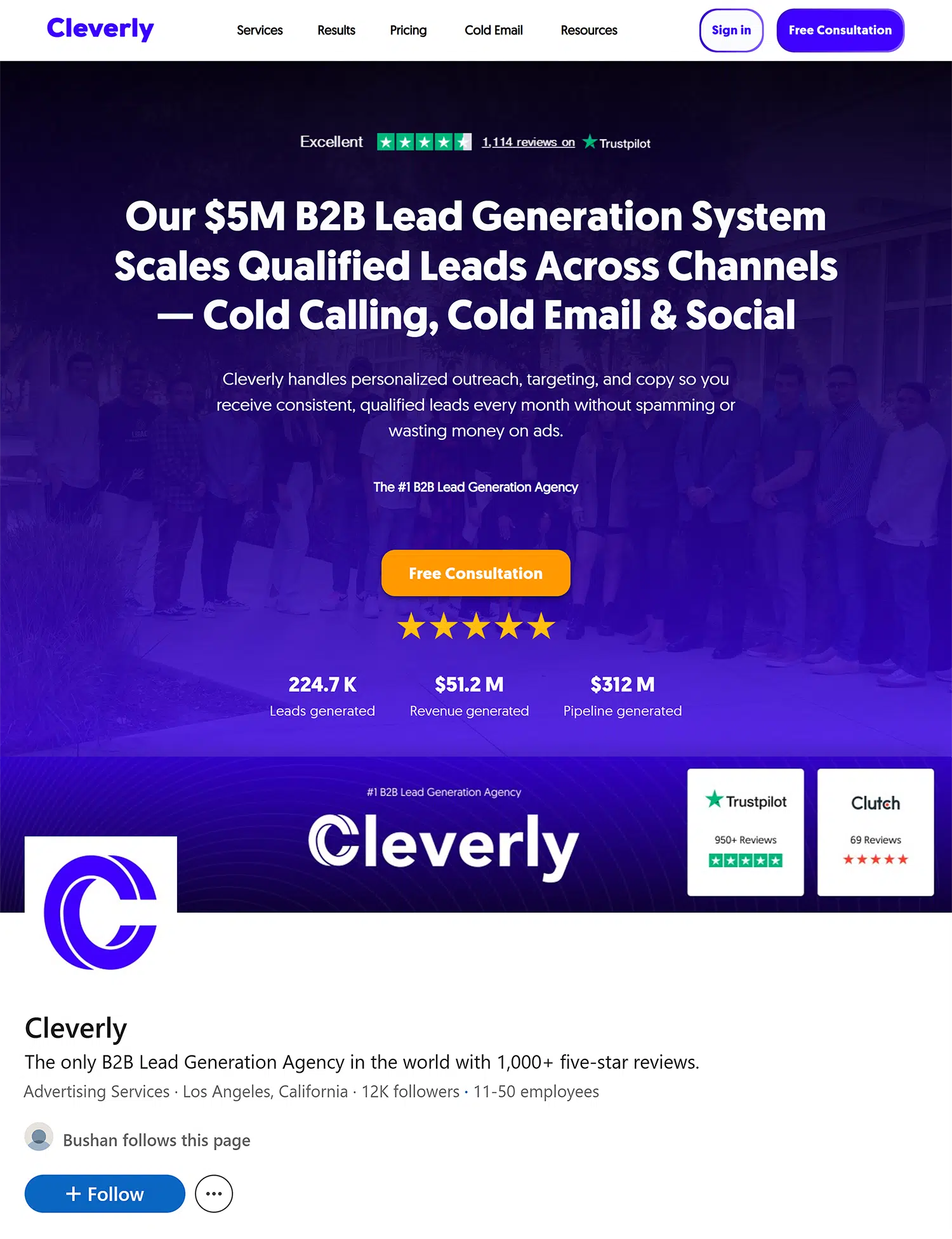
Also: be deliberate about review collection. Ask for them during moments where it makes sense, such as:
- After a successful delivery
- After a measurable win
- At the end of a strong engagement
And, when you ask, avoid the generic “Can you leave us a review?” request. Instead, ask for details that reinforce your stories, positioning, and claims.
For example:
“We’d appreciate it if you could share how we helped improve [specific outcome] for your [specific company]. It would be helpful to mention the situation you were in and the result you saw.”
Reviews with this prompt encourage the inclusion of specific details that serve as great credibility signals.

Finally, show up where conversations already happen. Participate in discussion forums like Reddit or Quora. Or be active in niche communities, such as StreetEasy for real estate or Discourse for marketing.

Be transparent about who you are, add helpful context, and answer questions honestly. A simple “I work at [Company], here’s some additional context…” goes a long way.

Un-gate your company knowledge
You want AI to accurately understand HOW your business works. So, give it access to content that explains that.
This doesn’t mean giving everything away for free or eliminating gated content entirely. It means being intentional about what AI can access to understand your business.
WebFX does this well.
They’ve built a large public footprint around how they work. They publish videos explaining:
- How they approach social media
- How they market for manufacturers
- How their strategies connect back to revenue

On their about page, they outline their approach to digital marketing and their proprietary technology:

They also maintain a knowledge base covering tactics, strategy, and execution.
All of that gives AI context. That is, enough material to understand what WebFX does, how they think, and where they’re different.
Here are some examples of content you can un-gate now.
- Industry trend reports and market analysis
- Educational guides for solving problems in your category
- Case studies
- Webinar and workshop recordings
- Tool explainers or software walkthroughs (if you have proprietary technology)
- Help centers

Finally, structure your content so AI can easily parse it.
Use clear headings, explicit steps, and defined terms. All written in plain conversational language. These all help remove ambiguity.
Further reading: If you want a deeper walkthrough on how to structure content that way, our AI optimization guide goes into more detail.
Rebuild your sales process
If a lead found you through AI search, your sales calls need to adapt to reflect that journey. These leads aren’t starting from zero. AI has already told them:
- Who you are
- How you compare to alternatives
- Whether you’re a good fit for their needs
This means a full pitch designed for an uninformed audience can feel redundant.
Instead, start with their AI-shaped assumptions about your brand and services.
Here’s how to make sure your salespeople are ready for that.
First, add a question like “How did you hear about us?” to your lead form or pre-call questionnaire.

If they mention any AI tool, use a slightly different sales call script. Then, early in the call, figure out what they already believe.
Ask questions to establish:
- What AI has already said about your services and ideal customer fit
- Which competitors or alternatives were mentioned alongside you
- What assumptions were articulated
Once you know the narrative they’re bringing, start there. Confirm what’s true, clarify what’s still not clear, and gently correct anything inaccurate.
Expand your measurement model
As more early-stage research happens inside LLMs, traditional top-of-funnel signals disappear. Or at least become harder to see.
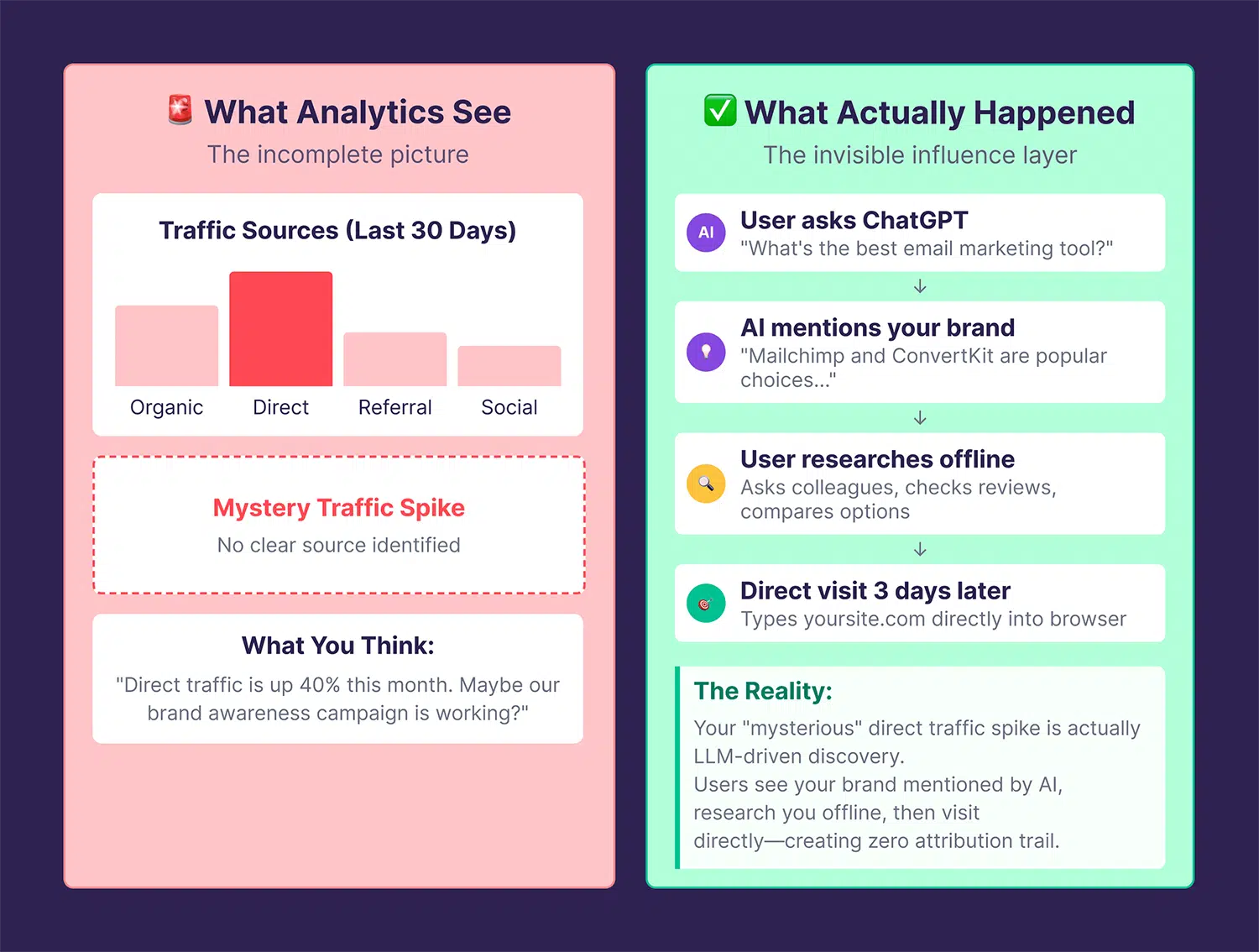
That doesn’t mean there’s nothing to measure. It just means the indicators look different.
Instead of clicks, you can track:
- How often your brand is cited, mentioned, or recommended in AI queries
- The context and quality of those mentions
- How sentiment shifts over time

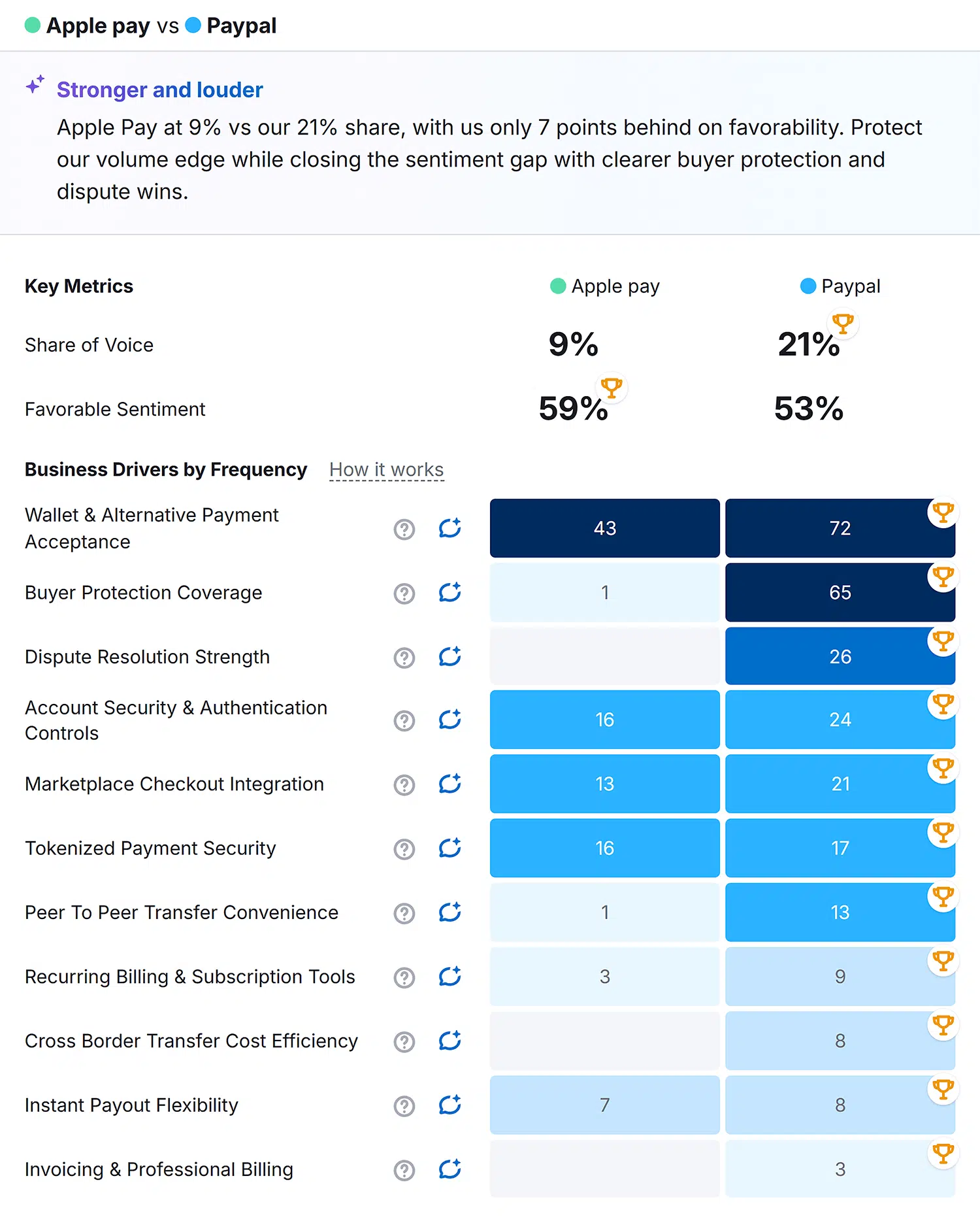
AI SEO tools like Semrush can help here.
Look to the Narrative Drivers section, which surfaces the core stories AI has formed about your brand — along with the sources reinforcing each one.
AI search is changing B2B, but you’re not powerless
You know what signals matter. And the types of content to create.
Get started by focusing on the platforms your buyers hang out on. Build consensus around who you serve and what you do best. Then make it consistent everywhere AI looks.
Track, optimize, and win in Google and AI search from one platform.
Do that, and you increase the odds of AI mentioning you when B2B buyers search.
Want to make sure you’re starting with a solid foundation of who your target audience is? Read up on aligning ICPs and personas.