

Why HubSpot is winning at AI visibility in B2B SaaS
HubSpot dominates AI-powered search visibility. Learn how its strategy, content, and authority make it a standout B2B SaaS leader in the AI era of SEO.
You can rank at the top of a Google search engine results page (SERP) and still be invisible in AI search. That’s the bad news from the 2025 AI Visibility Index Study by Semrush Enterprise.
The good news? AI visibility isn’t accidental—it’s engineered. HubSpot proves this with a strategy that surfaces the brand in AI-driven answers more often than many of its largest B2B SaaS competitors.
HubSpot demonstrates what it takes to perform well in both stages of AI visibility:
- Discovery: Review, forum, and community discussions that mention the brand
- Authority: Structured, factual content that supports discussions about the brand
Being strong in both areas isn’t easy, but HubSpot proves it’s possible. That’s why the brand stands out as a prime example of how to compete in this new channel for online visibility.
In this article, we’ll define what the AI Visibility Index is and highlight the most relevant study findings for B2B SaaS brands—including how HubSpot surpasses larger competitors like Salesforce and Adobe. Finally, we’ll reverse engineer HubSpot’s success into a four-part framework that you can use to safeguard your brand’s reputation and grow its visibility across AI answer engines.
What is the AI Visibility Index?
The AI Visibility Index is Semrush’s benchmark for how often and how prominently brands appear in AI-generated search results.
To build this index, Semrush tracked 2,500 non-branded prompts across five industries—business and professional services, digital technology and software, consumer electronics, fashion and apparel, and finance—and captured how answers surfaced in ChatGPT and Google AI Mode.
The AI Visibility Index measures three core metrics:
- Brand mentions: How frequently a brand name appears in AI answers.
- Citations and sources: Which websites are cited as references in AI answers.
- Share of voice (SOV): A weighted score that combines mention frequency and order. For example, 100% SOV would mean a brand was mentioned first in every response.
The index also ranks brands by SOV in AI-generated answers for each industry, weighting ChatGPT 80% and Google AI Mode 20% to align with user adoption rates.
The key takeaway from this study? SEO success doesn’t equal AI visibility.
The study confirms that high Google rankings don’t guarantee visibility in ChatGPT or Google AI Mode. Instead, AI models use a two-stage process:
- Discovery: Which brands people are talking about (and how) in user-generated content (UGC) like reviews, forum conversations, and social media posts
- Authority: Whether AI can confirm details via factual sources like Wikipedia, support docs, or the brand’s website content
In other words, AI first surfaces brands that people already discuss in online spaces. Then, it validates these mentions with structured, factual content—the kind of material it can safely cite.
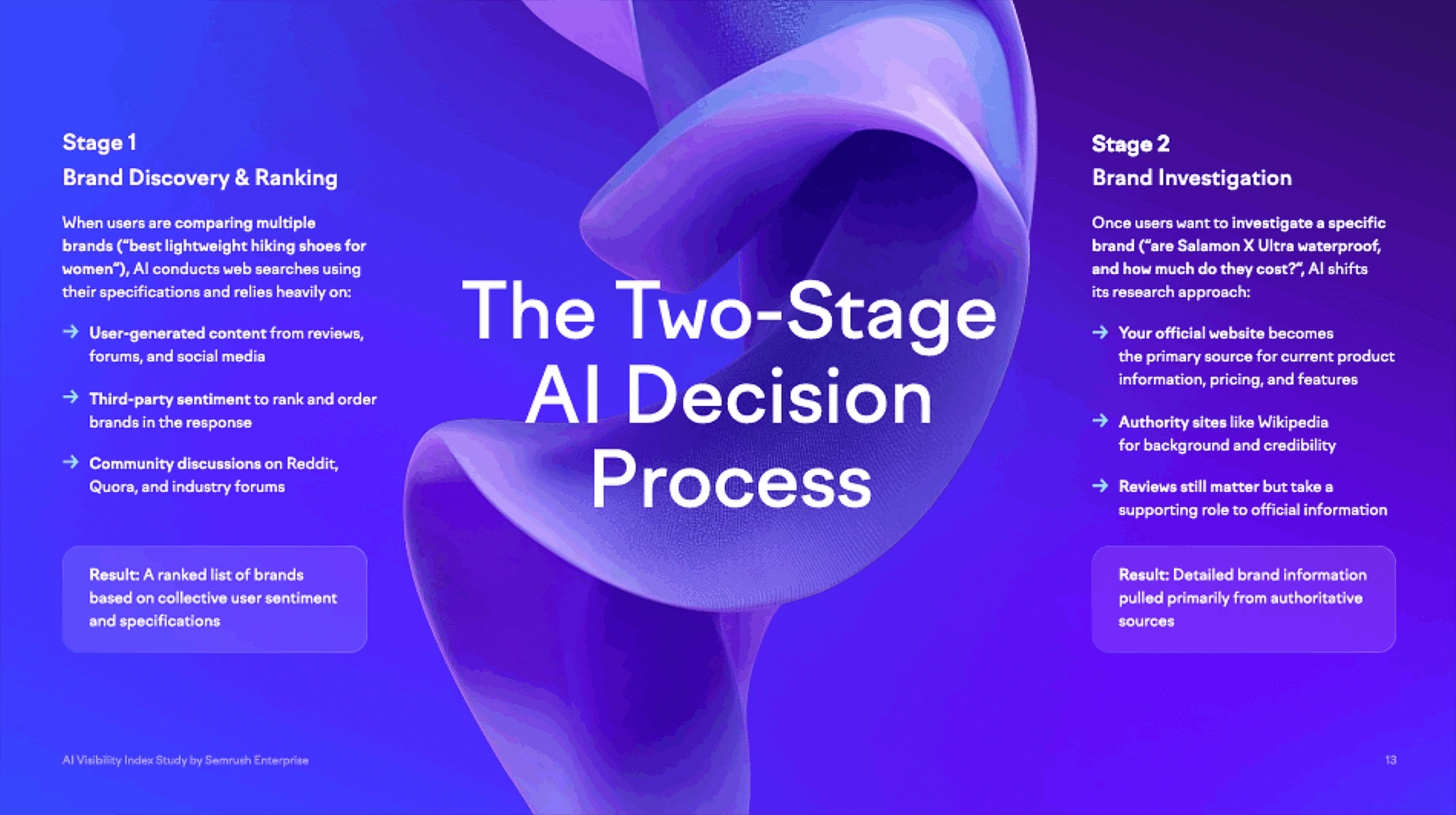
However, the two stages require distinct layers of visibility:
- Mentions reflect popularity and discovery
- Citations reflect authority and trust
In practice, AI often favors community-driven information over first-party marketing content.
For example, the study shows that Reddit threads and Wikipedia pages consistently outrank brand-owned websites as trusted sources across industries. In fact, Microsoft.com was cited far less often than Reddit threads about its products.
Even Apple.com appeared less frequently than Wikipedia. And when Apple.com content was cited, AI engines cited support forum threads rather than product pages.
In addition, structured data, crawlable pricing pages, and third-party validation weigh more heavily in AI models’ decisions than organic rankings—which may help with discovery, but don’t drive visibility.
The takeaway? To appear in AI answers, brands need both community-driven mentions and authoritative, structured content.
Your Attribution Model is Missing 40% of Brand Discovery
✓ Track brand mentions across all AI search platforms in real-time
✓ Connect AI-driven discovery to your existing analytics
✓ Measure sentiment and accuracy of every AI mention
Enterprise-grade AI tracking. Finally.
Recommended Articles


HubSpot is winning at AI visibility
HubSpot ranks third in the business and professional services vertical of Semrush’s AI Visibility Index. The brand has 15.4% SOV, behind Google (23.22%) and Zoho (16.7%).
More importantly, it ranks ahead of larger peers like Salesforce and Adobe, which have much broader product portfolios.
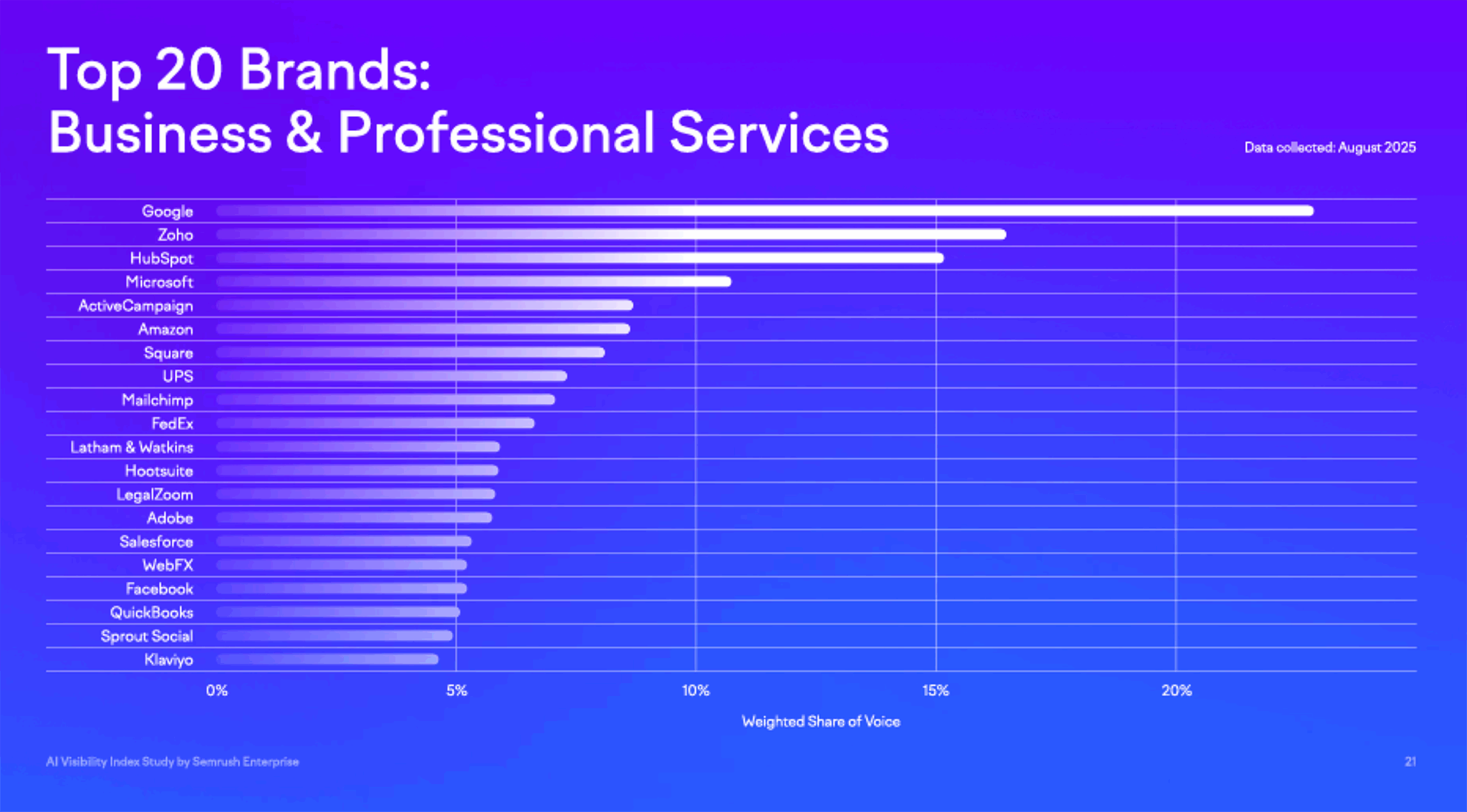
This means across hundreds of non-branded prompts, HubSpot is mentioned frequently and early in ChatGPT and Google AI Mode responses. This signals both discoverability and authority in AI results.
Two dynamics from the study explain why this is happening in B2B SaaS:
- Brand diversity is high. AI responses tend to list multiple viable options (often about five brands per query), rather than just one or two winners. This creates room for mid-market leaders to earn visibility if they align with the sources AI trusts.
- Marketing automation peers cluster together in AI-driven answers. Zoho, HubSpot, ActiveCampaign, Mailchimp, Hootsuite, and Klaviyo often appear together. This reflects shared trust signals across reviews, community discussions, and citation-friendly product information.
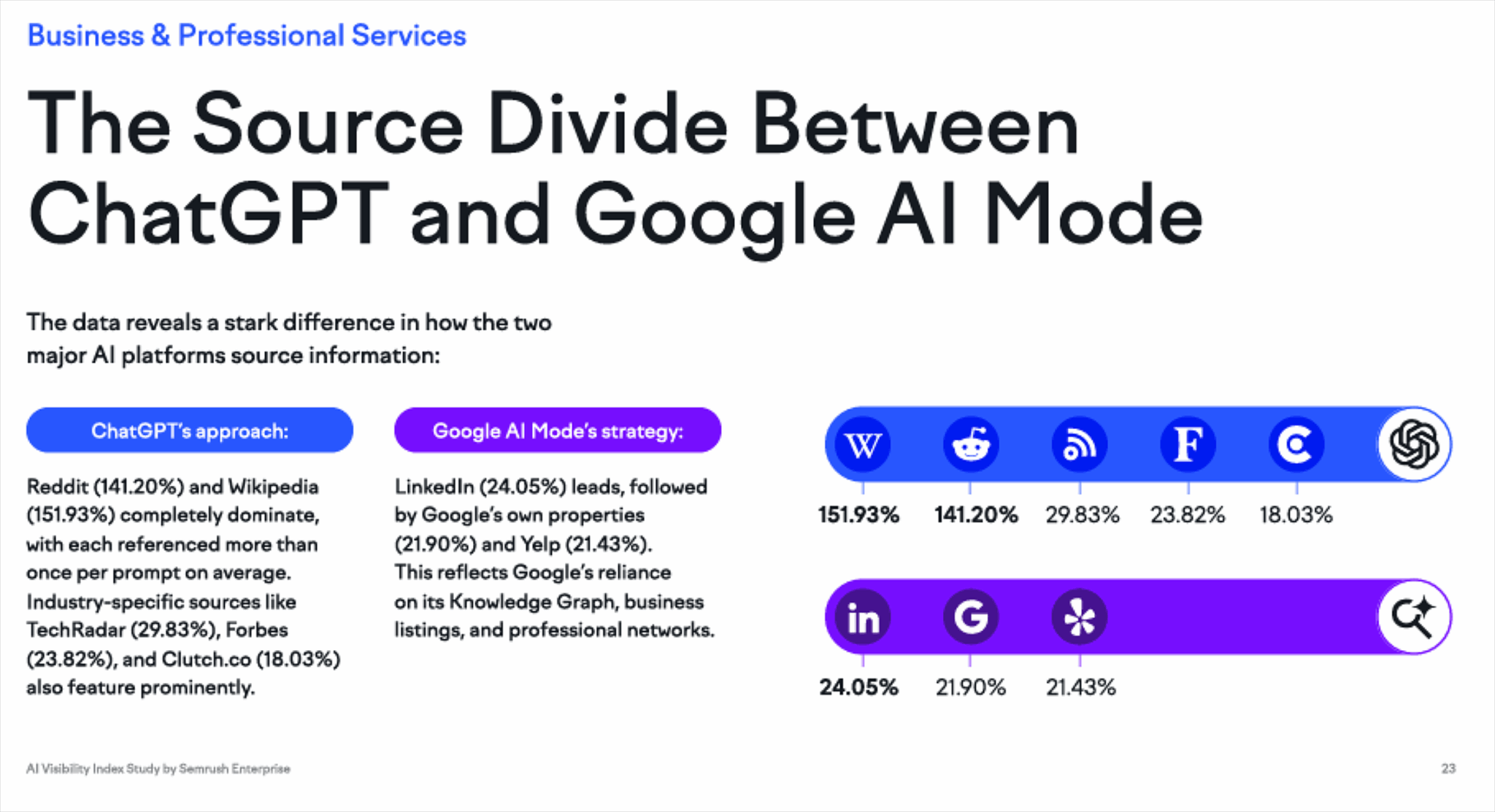
HubSpot’s performance is balanced across both ecosystems. This includes the community-driven surfaces (e.g., Reddit, Wikipedia, tech media) that ChatGPT leans on and the professional and owned pages (e.g., LinkedIn, Google properties, Yelp) that Google AI Mode skews toward.
The Semrush dataset shows that these ecosystems don’t behave the same. In fact, there’s only 32% overlap between what ChatGPT and Google AI Mode cite and mention. That’s why brands must optimize for both instead of assuming one will cover the other.
Here’s what this means for SaaS leaders: HubSpot’s edge isn’t about scale alone.
It’s about sending consistent signals and generating enough community validation to be discovered (via mentions) and trusted (via citations) across both AI models.
Why HubSpot excels at AI visibility
HubSpot’s edge comes from stacking the right signals across two layers of AI decision making (discovery and trust) and doing it across two different ecosystems (ChatGPT and Google AI Mode). Here’s the playbook the company uses.
Two-stage AI visibility is discovery and authority
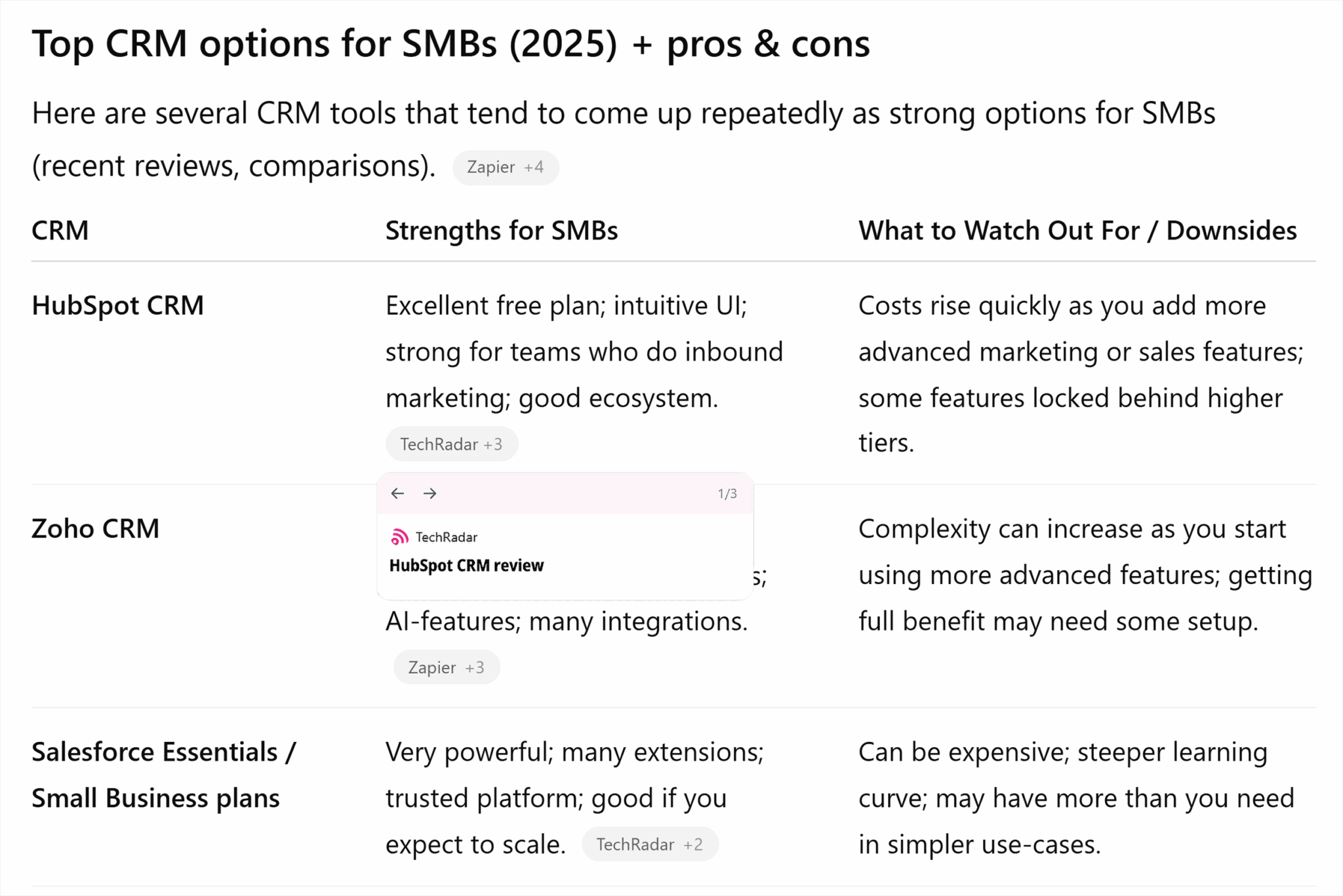
Current and prospective users frequently discuss HubSpot as they compare marketing, sales, and CRM tools. The brand often appears in Reddit threads, G2 and Capterra reviews, listicles, and explainers.
During the discovery stage, these public reviews and peer discussions act as social proof of HubSpot’s popularity. This signals to AI models that HubSpot is reliably safe to name in relevant responses.
HubSpot backs this visibility with structured, product-aligned pages that AI models can cite—including pricing, features, documentation, FAQs, and fact-dense blog content. During the authority stage, AI models use these pages to verify mentions and cite them as sources.
Here’s why this matters: Few brands win both stages of AI visibility. Across verticals, between three and 27 of the 100 most mentioned brands are also top sources. HubSpot’s advantage comes from deliberately optimizing for both.
Drivers of mentions vs. citations in AI visibility
| Layer | Primary drivers | Applications |
| Discovery (mentions) | Reddit, Wikipedia, G2, Capterra, listicles, social chatter | Encourage reviews, participate in relevant subreddits, supply neutral comparison data, earn media |
| Authority (citations) | Structured pricing and features, crawlable FAQs and docs, statistic-rich blog posts, schema | Publish transparent pricing, add product and FAQ schema, update authoritative content |
Content authority requires clusters, pruning, and historical optimization
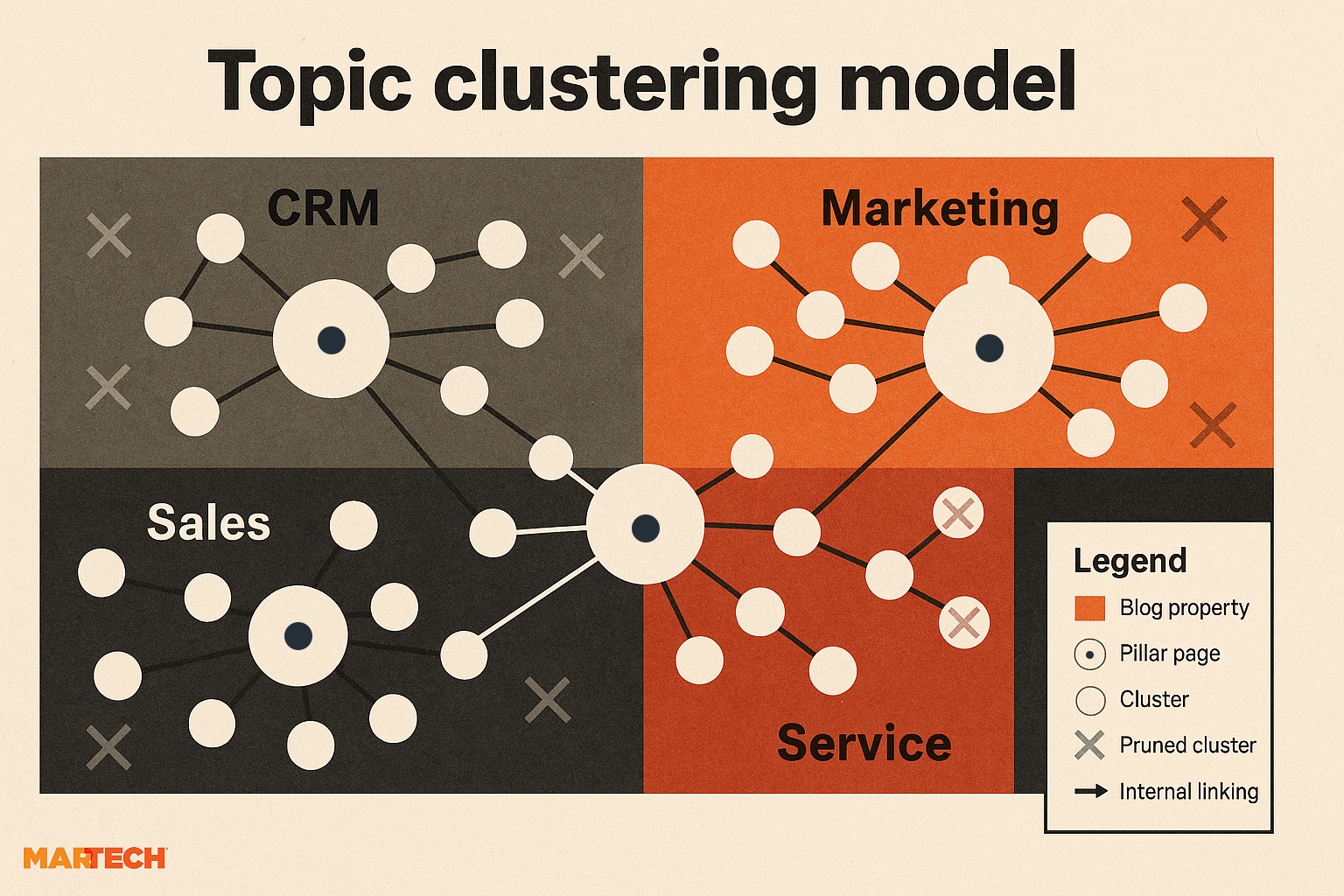
HubSpot’s content strategy makes it easier for large language models (LLMs) and traditional search engines alike to recognize its brand and products as entities. This positions HubSpot as an authority on topics that align with its core platform: CRM, marketing, sales, and service.
To support this approach, HubSpot organizes its blog into four distinct properties, one per core topic.
Each property has a unique set of pillar pages that focus on broad topics and their related content clusters. The pillar pages and content clusters are interconnected with links. This helps AI models understand how the topics relate to each other semantically.
To strengthen its content clusters, HubSpot’s content team doesn’t just produce new blog posts.
Instead, the company’s writers spend 50–80% of their writing time refreshing content that has historically performed well. This includes incorporating first-hand experience, fresh data, and expert quotes into existing content. Which ensures it remains relevant to its audience and performs even better across AI platforms and in traditional search results.
By taking care to preserve canonical URLs when updating a piece of content, HubSpot ensures LLMs and search engines still recognize it as an authoritative source worth citing.
Additionally, by pruning irrelevant, low-performing, and off-topic content clusters, HubSpot positions itself as a trusted authority on CRM, marketing, sales, and service. This increases the likelihood that LLMs will consider the content trustworthy—and mention and cite it as a trusted source.
HubSpot content tactics that earn LLMs’ trust
| Tactics | Why LLMs trust it |
| Pruned, product-aligned clusters | Clear topical focus means higher entity confidence |
| Frequent content refreshes | Recency and stability lower hallucination risk |
| Experience Soup (lived experience, data, and POV) | Unique, quotable angles that don’t read like generic AI filler |
| Neutral, fact-forward tone | Safer to cite inside an AI answer |
Dig deeper: Writing for SEO: How to write snippet-friendly content that wins in Google and LLMs
Platform-specific optimization
ChatGPT and Google AI Mode cite sources from two different digital ecosystems. HubSpot’s AI search optimization strategy considers both..
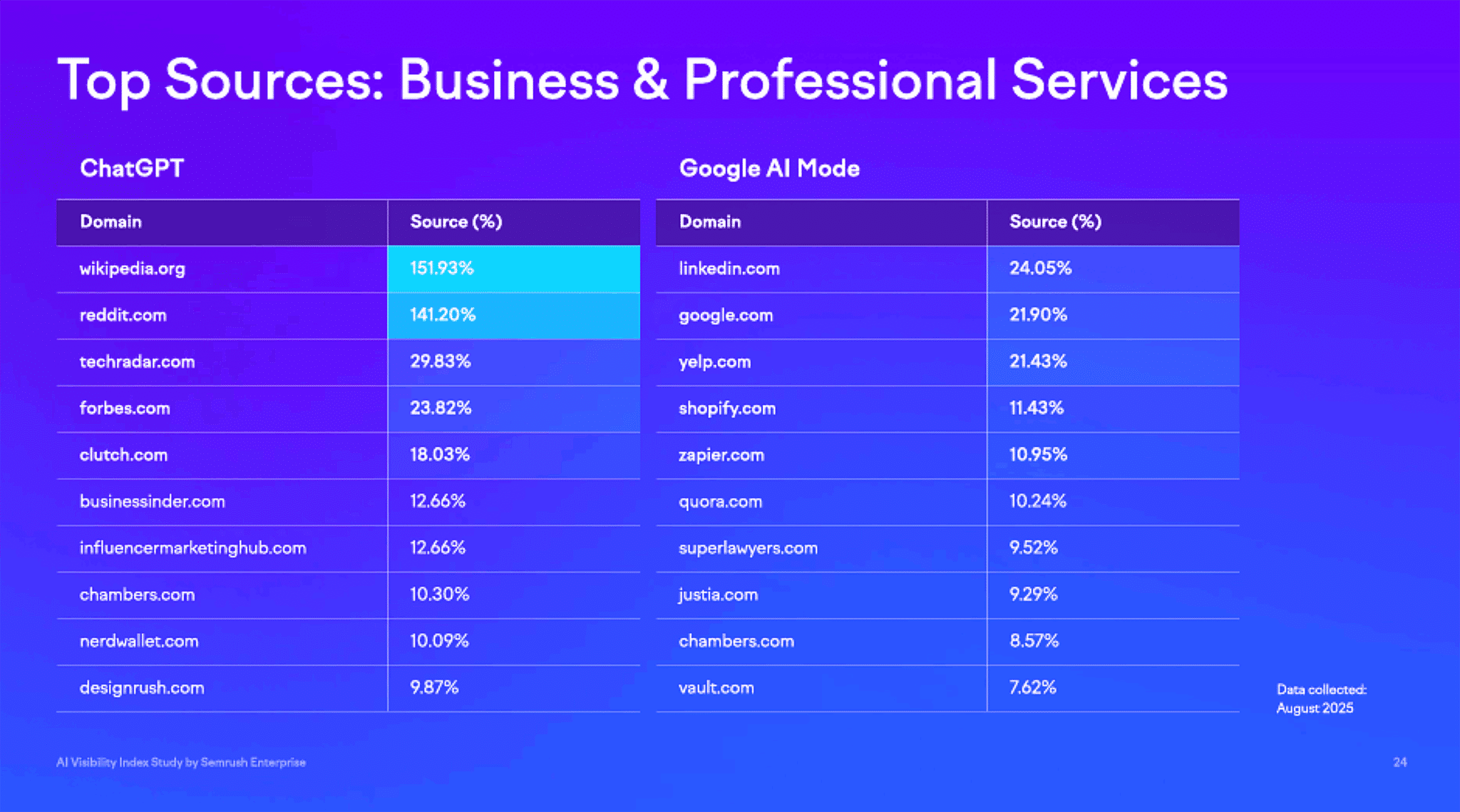
With ChatGPT, community-generated content like Reddit and Wikipedia and industry-specific sources like Tech Radar and Forbes drive visibility for business and professional services. HubSpot invests in engaging communities like Reddit, ensures the accuracy of relevant Wikipedia entries, and leverages PR to secure features in industry publications.
With Google AI Mode, the emphasis shifts to professional networks like LinkedIn, business directories and review sites like Yelp, and Google-owned properties.

To replicate this balance, marketers can follow HubSpot’s two-part playbook:
- ChatGPT: Join Reddit threads or Ask Me Anything (AMA) sessions where practitioners compare tools. Create educational YouTube explainers or tutorials that models can cite as answers. Aim for content that looks less like marketing and more like peer-to-peer knowledge.
- Google AI Mode: Prioritize entity clarity and structured information. Make sure pricing and feature pages are crawlable in static HTML. Add structured resources like FAQs, comparison charts, and integration directories that Google can parse directly into its Knowledge Graph.
Traditional SEO metrics can’t tell you how visible your brand is in generative platforms. Measuring AI visibility requires a new set of metrics, tracked separately for each model.
| What to track | SEO | ChatGPT | Google AI Mode |
| Rankings | ☑ | ☐ | ☐ |
| Organic Traffic | ☑ | ☐ | ☐ |
| Click-through rate | ☑ | ☐ | ☐ |
| Brand mentions | ☐ | ☑ | ☑ |
| Sentiment of brand mentions | ☐ | ☑ | ☑ |
| Share of voice | ☐ | ☑ | ☑ |
| Citations | ☐ | ☑ | ☑ |
Community proof centers on reviews, UGC, and transparency
HubSpot maintains a steady stream of social proof. It spans high-volume, recent reviews on G2 and Capterra, practitioner conversations in Reddit threads, social media posts that explain key business decisions, and podcasts that discuss product trade-offs and lessons learned.
When you scan the sources AI models rely on, these signals are easy to see.
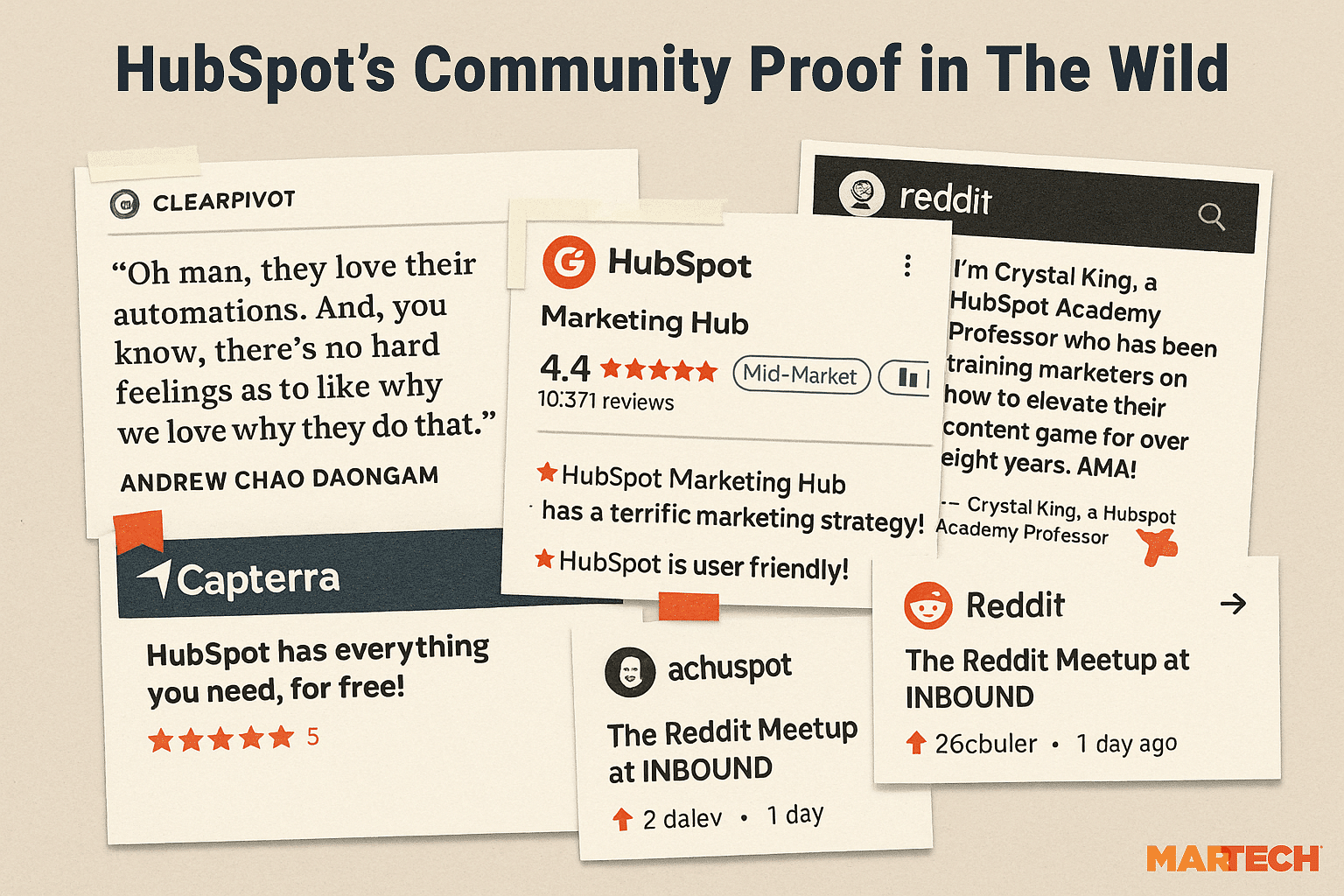
These proof points matter because they’re hard to fake. The Semrush study indicates that AI models often surface community-driven and third-party sources alongside or ahead of polished brand assets.
In the business and professional services vertical, for instance, Clutch.co accounts for 18% of cited sources in ChatGPT, and Yelp appears in 21% of Google AI Mode answers. The study also highlights Reddit as a key signal for ChatGPT and LinkedIn for Google AI Mode.
That means credibility in reviews and UGC is now critical. And it’s not one signal that makes the difference. Instead, it’s the combination of volume, recency, and credibility across multiple channels that gives AI models the confidence to name HubSpot alongside larger peers.
Build your multi-channel content flywheel via blog, YouTube, newsletter, podcast
HubSpot treats content as a system, not as separate silos. This means a single POV appears across channels and formats.
For example, an expert interview on YouTube might become a podcast chat. Then it might be repurposed into a blog and later featured as a segment in an email newsletter.
Each version links to the others. This repetition trains both people and models to associate the topic with HubSpot.
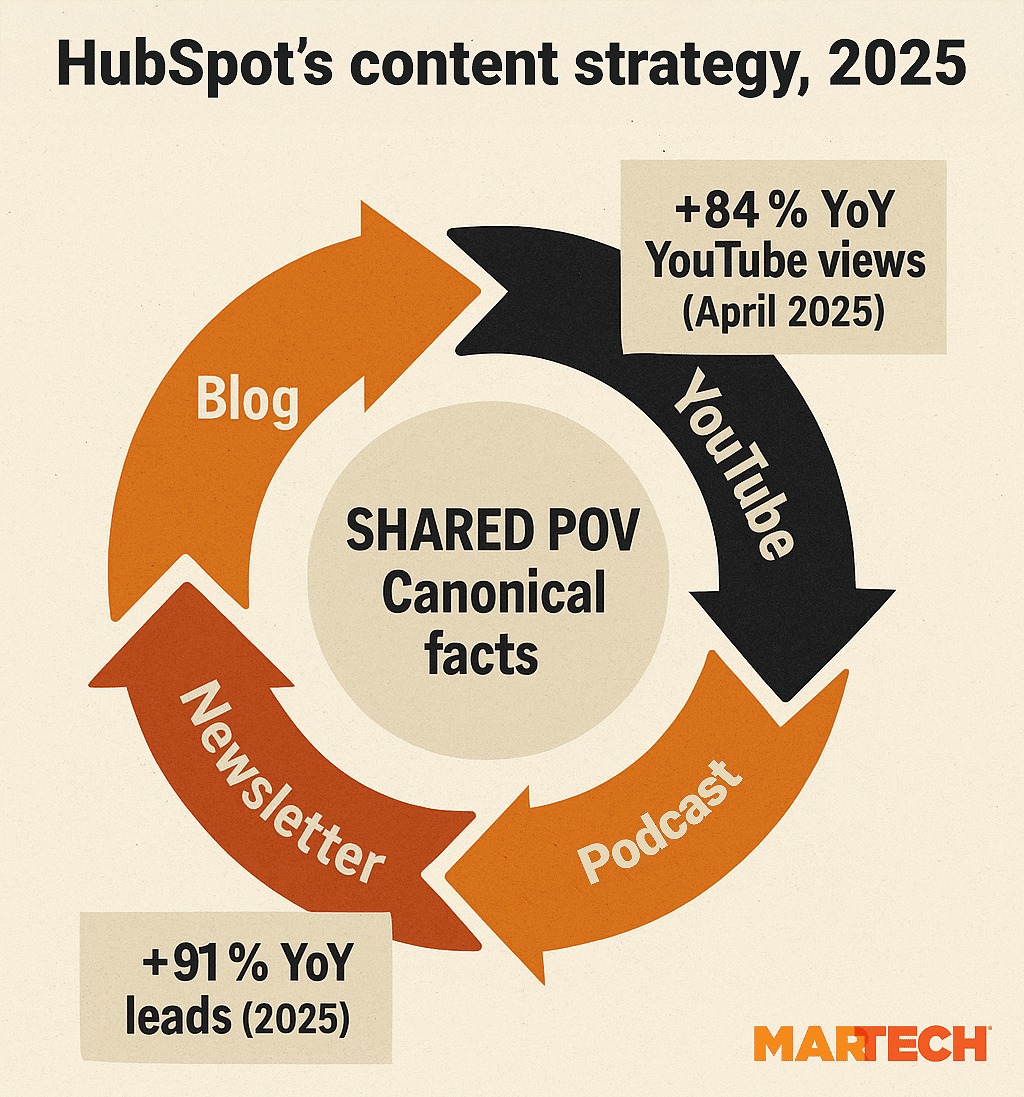
HubSpot’s consistency across channels doesn’t just expand reach—it strengthens entity recall. For AI, more consistent signals across channels (same facts, same language, same POV) mean fewer contradictions and higher confidence to cite HubSpot as a trusted source.
Consistent brand entity and voice
Before AI engines can recommend your brand, they first have to recognize it. One reason HubSpot wins visibility is that it keeps brand identity consistent across every channel.
Entity hygiene
HubSpot’s entity hygiene, structured HTML, and transparent pricing make it easy for AI to validate facts using owned properties. HubSpot keeps names, product messaging, taglines, and bios consistent across its own website, Wikipedia, LinkedIn, press kits, and media bios.
HubSpot also uses schema in blog content, which helps LLMs and search engines alike understand the brand and its products as associated entities. For example, the article “How HubSpot creates quality content in the age of AI” is tagged with NewsArticle schema, which connects the piece to HubSpot as the publisher (Organization) and to Amy Rigby as the author (Person).
This structured data helps LLMs and search engines understand not just the article itself, but also who wrote it and which brand published it. This reinforces HubSpot as a coherent, authoritative entity with identifiable products and experts behind its content.
Brand voice
“Experience Soup,” a term coined by HubSpot Content SEO Strategist Ivelisse Rodriguez, is a mix of practitioner insights, original data, and a clear POV that shows up in every format.
Together, these elements make the brand’s product guides, blog posts, and LinkedIn updates sound both recognizably “HubSpotty” and uniquely human.

Consistency across these surfaces reinforces entity recognition. Remember: If AI can’t recognize your brand, it can’t recommend your brand.

Monitoring, tracking, and adapting for AI visibility
HubSpot’s sustained presence in AI-generated answers requires continuously monitoring conversations, tracking visibility metrics, and adapting content. This ensures the brand’s content signals stay fresh and relevant.
Tracking AI visibility
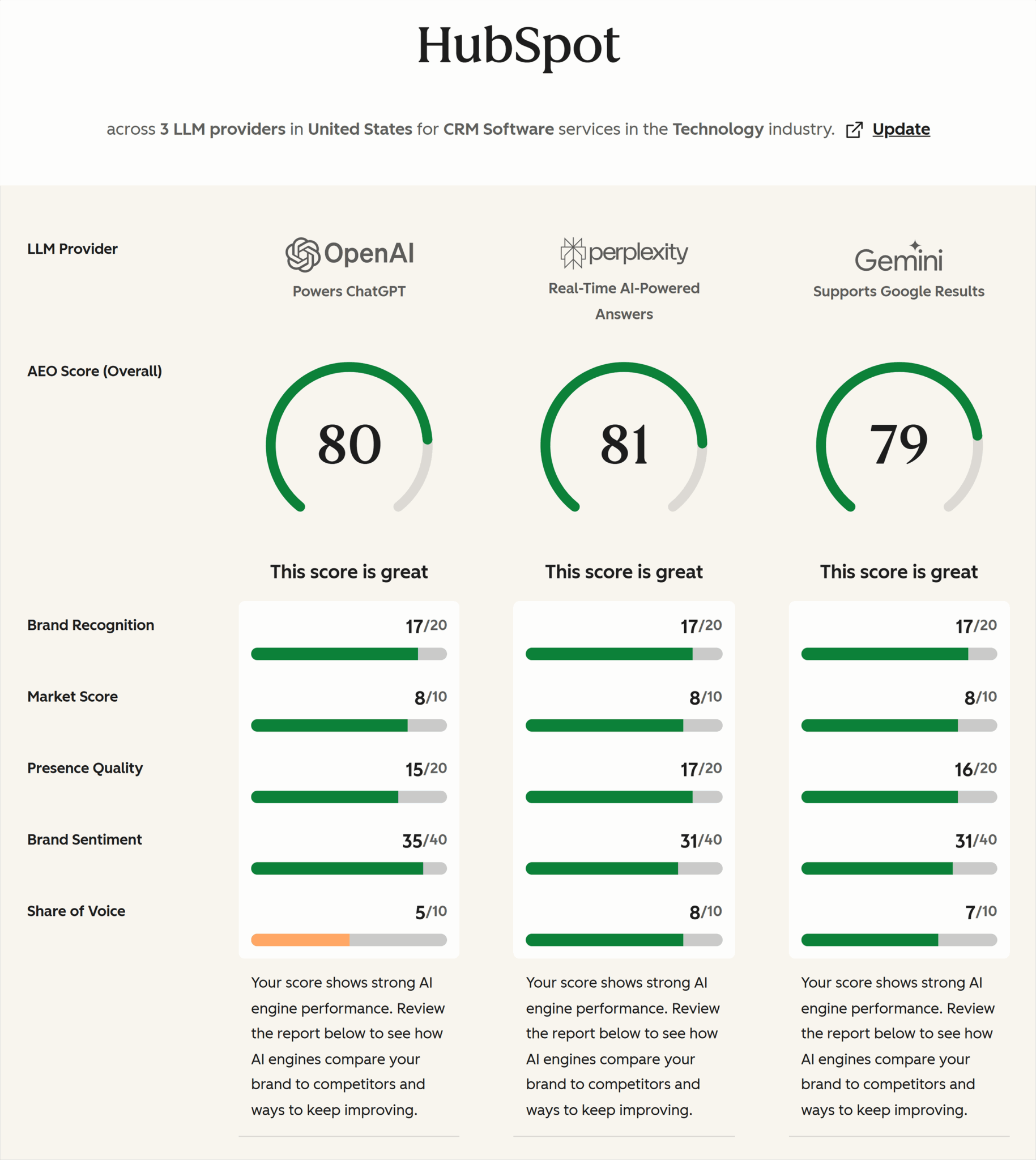
HubSpot uses its own free tool, AEO Grader, to measure mentions, citations, share of voice, and sentiment across ChatGPT, Perplexity, and Gemini. These metrics show how often HubSpot appears, in what context, and how its presence compares with competitors.
Checking competitor and sentiment insights
The AEO Grader’s SOV view reveals categories where competitors dominate or where HubSpot is underrepresented. Its brand sentiment analysis shows whether AI systems describe HubSpot in positive, neutral, or negative terms. These insights guide actions like reinforcing content where coverage is thin or adjusting messaging when sentiment drifts.
Conducting recurring audits
HubSpot also runs recurring audits to decide which pages to keep, optimize, recycle, or retire. These reviews prevent outdated or off-topic content from diluting authority and keep product-aligned signals strong.
Performing routine content audits
HubSpot runs recurring audits to decide which pages to keep, optimize, recycle, or retire. This ensures outdated or off-topic content doesn’t dilute authority. It also keeps product-aligned signals visible to AI systems.
The company also prunes stale content, strengthens entity signals, and invests in pages that competitors are overtaking. These structural updates reset the foundation that AI models draw from.
Creating timely content quickly
When new topics break, HubSpot moves quickly to publish relevant content.
For example, when DeepSeek V3 launched in the US, HubSpot’s SVP of Marketing published a YouTube explainer within three days. The video broke down how the model worked, why it was such a big deal, and what it all meant for marketers.
ChatGPT soon began citing the video in answers—proving that publishing early, authoritative explainers can translate into AI visibility.
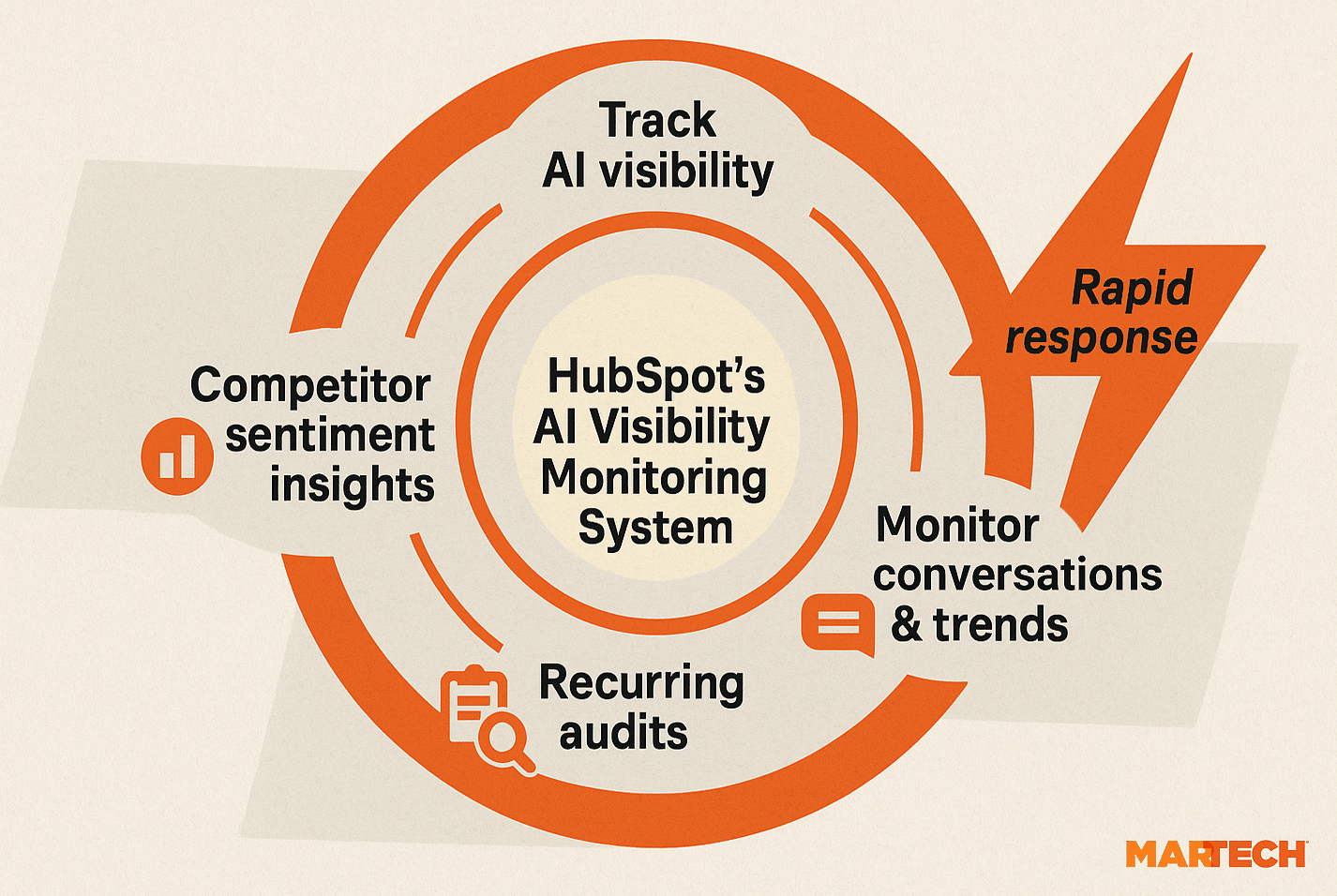
Each layer of HubSpot’s monitoring system serves a purpose, but their strengths come from how they work together:
- Dashboards prevent blind spots by showing how the brand appears today
- Competitor and sentiment checks reveal whether rivals are edging ahead or the tone is shifting
- Audits protect authority by removing or updating weak pages before they dilute stronger signals
- Conversation scans uncover new entry points into fast-moving topics
- And rapid responses capture those entry points with timely content that AI engines can cite
Tip: Build your own monitoring system to win AI visibility, one layer at a time. Start with weekly checks, then add on monthly reports, followed by quarterly audits. As your process matures, set up continuous monitoring and a rapid-response team.
How to win AI visibility for your B2B SaaS brand with our 4-part playbook
We’ve distilled what we learned from HubSpot’s success and Semrush’s study into a practical playbook. Each part includes a checklist of steps you can take to engineer AI visibility for your brand.
1. Own your topic clusters and prune the rest
Trying to prove authority with wide-ranging content is a losing battle. The goal is to ensure your brand is the most relevant and most reliable answer in the three to five areas you want to dominate.
Choose three to five core topics that match your product strategy and cover them in-depth. For each topic, create a pillar page that serves as the hub and support it with FAQs, explainers, comparison pages, and blog posts. Refresh supporting content with new data, expert input, and clear examples.
Checklist:
- Identify three to five core topics that align with your product strategy
- Define broad topics and related subtopics for each core topic, then build pillar pages and content clusters for each one
- Cover each cluster comprehensively so your audience finds complete, trustworthy answers on every subtopic
- Audit content to identify and merge thin pages, and archive or redirect off-topic content
- Refresh the top 20% of your highest-performing pages quarterly with new stats, subject matter expert quotes, a clear point of view, and original data

2. Engineer platform-specific signals
To be visible in ChatGPT and Google AI Mode answers, your brand needs signals for both platforms.
To increase your chances of securing ChatGPT mentions, show up where those signals are created: AMA threads, Reddit discussions, and explainer videos.
For Google AI Mode, prioritize LinkedIn, Google Business Profiles, and crawlable product and pricing pages. Keep company details consistent on LinkedIn and Google. Add schema to support docs and announcements so Google can cite them as facts.
Warning: If AI can’t crawl your content, answer engines can’t cite it as a source!
Since AI models struggle with dynamic content like JavaScript, ensure that your most important content (like product features, pricing, and descriptions) is in static HTML or embedded server-side. Make sure you aren’t blocking search engines or LLMs from crawling the content you want them to index.
Checklist:
- Implement and validate schema (Organization, Product, NewsArticle, FAQ, etc.) and confirm crawlability of pricing pages, help docs, and newsworthy content
- Standardize brand details (names, taglines, and logos) across LinkedIn, Wikipedia, and Google Business Profiles
- Target two to three neutral placements per quarter (e.g., Reddit answers, Wikipedia updates, industry explainers)
- Maintain an entity sheet (official names, one-sentence description, founding year, HQ, product lines, canonical URLs, and sameAs links)
- Review brand details quarterly (schema, Wikipedia entries, LinkedIn profiles, media kits) to catch inconsistencies (e.g., tagline drift) that can fragment identity in AI search

3. Publish with transparency and earn community validation
AI models trust what communities say about brands more than what brands say about themselves.
To embrace this, cultivate fresh reviews on G2 and Capterra, participate in Reddit discussions, and publish posts about your products and pricing.
Checklist:
- Incentivize detailed reviews on G2, Capterra, Yelp, and Clutch—ideally with mentions of features, outcomes, and implementation
- Share neutral, comparison-friendly data that third parties can cite, such as original research reports
- Publish transparent explainers about pricing logic, product trade-offs, or roadmap decisions in public channels (LinkedIn, YouTube, Reddit, support forums)
- Seed or participate in one to two community conversations per quarter (e.g., have your CEO announce a new product on LinkedIn or start an AMA thread on Reddit)
- Make a 1-to-3 repurpose rule for every flagship post (video, email, audio)
- Reuse the same statistics and definitions across formats to maximize consistency
- Embed transcripts and summaries so information is easy to crawl
4. Monitor, measure, and adapt continuously
AI visibility is never static. Models update, answers shift, and competitors step in when content goes stale.
To make sure your brand continues to provide the most reliable answers, build a system to monitor, measure, and adapt. Build it all at once or one step at a time.
Checklist:
- Weekly check: Review mentions and citations to ensure AI answers reflect current details with tools like Semrush’s AI Search Visibility Checker, BrightEdge’s AI Catalyst, or Otterly.AI
- Continuous monitoring: Track LinkedIn, Reddit, and industry sites for trending conversations
- Monthly review: Test a stable set of representative prompts, compare visibility and sentiment with competitors, and refresh content if needed
- Quarterly audit: Remove outdated pages, strengthen entity signals, and invest in content where competitors are advancing
- Rapid response: Publish explainers within days of breaking industry news
How to rise to the challenge (and boost your revenue)
Strong performance in generative AI answers doesn’t just affect brand visibility. It can also influence revenue outcomes. When ChatGPT or Google AI Mode cites your brand, buyers see you in their shortlist of options—which can open the door to sales and growth.
But if your brand is missing, you’re excluded from these conversations. Even if you rank at the top of Google search results.
Keep up with the latest developments you need to win the AI visibility game. Follow our dedicated AI coverage for marketing here: Marketing Artificial Intelligence (AI).