

What is search marketing? SEO, PPC & strategy explained
Search marketing helps you get found fast. Learn the difference between SEO and PPC, how they work together, and how to build a strategy that drives results.
You can’t afford to neglect a channel that drives two-thirds of your potential customers, can you?
That channel is search marketing—a combination of search engine optimization (SEO) and pay-per-click advertising (PPC) that maximizes your presence in the search results. And it drives 68% of all trackable website traffic, according to research by BrightEdge.
Get your search marketing strategy right and you’ll turn your SEO and PPC campaigns into more than the sum of their parts. You’ll capture more qualified traffic while spending less to acquire each customer.
In this guide, we’ll walk you through exactly what search marketing is—and why treating SEO and PPC as two halves of your search marketing strategy delivers much better results than running them as separate teams.
What is search marketing?
Search marketing is the practice of gaining traffic and visibility from search engines through both paid and unpaid efforts.
Let’s take HubSpot as an example of search marketing in action.
The sales customer relationship management platform (CRM) appears in the top sponsored and organic results on the search engine results page (SERP) when potential customers search for a free CRM template.

The top sponsored result and within the AI Overview when they search “CRM platform:”

And the top sponsored and organic spots when they search “HubSpot vs Monday.”

Thanks to its search marketing strategy, HubSpot has real estate in both the sponsored and organic results across all these SERPs. That means the tool is always at the front of mind when people are looking for solutions to problems it solves—no matter where they are in the sales funnel.
Why SEO and PPC work best together
As HubSpot shows, SEO and PPC work best together. But most businesses treat SEO and PPC as completely separate channels—with different teams, different budgets, and different goals. That’s a massive missed opportunity.
With SEO alone, you’re competing for organic visibility that takes months to build. Plus, you’re getting buried by sponsored results, SERP features, and AI Overviews.
But with just PPC, you’re paying for every click while missing out on the trust and authority that organic rankings provide.
Search marketing combines both approaches. You capture attention with targeted ads at the top of results while simultaneously building long-term organic authority.
The result? You’re the brand that stands out on the SERPs that matter most.
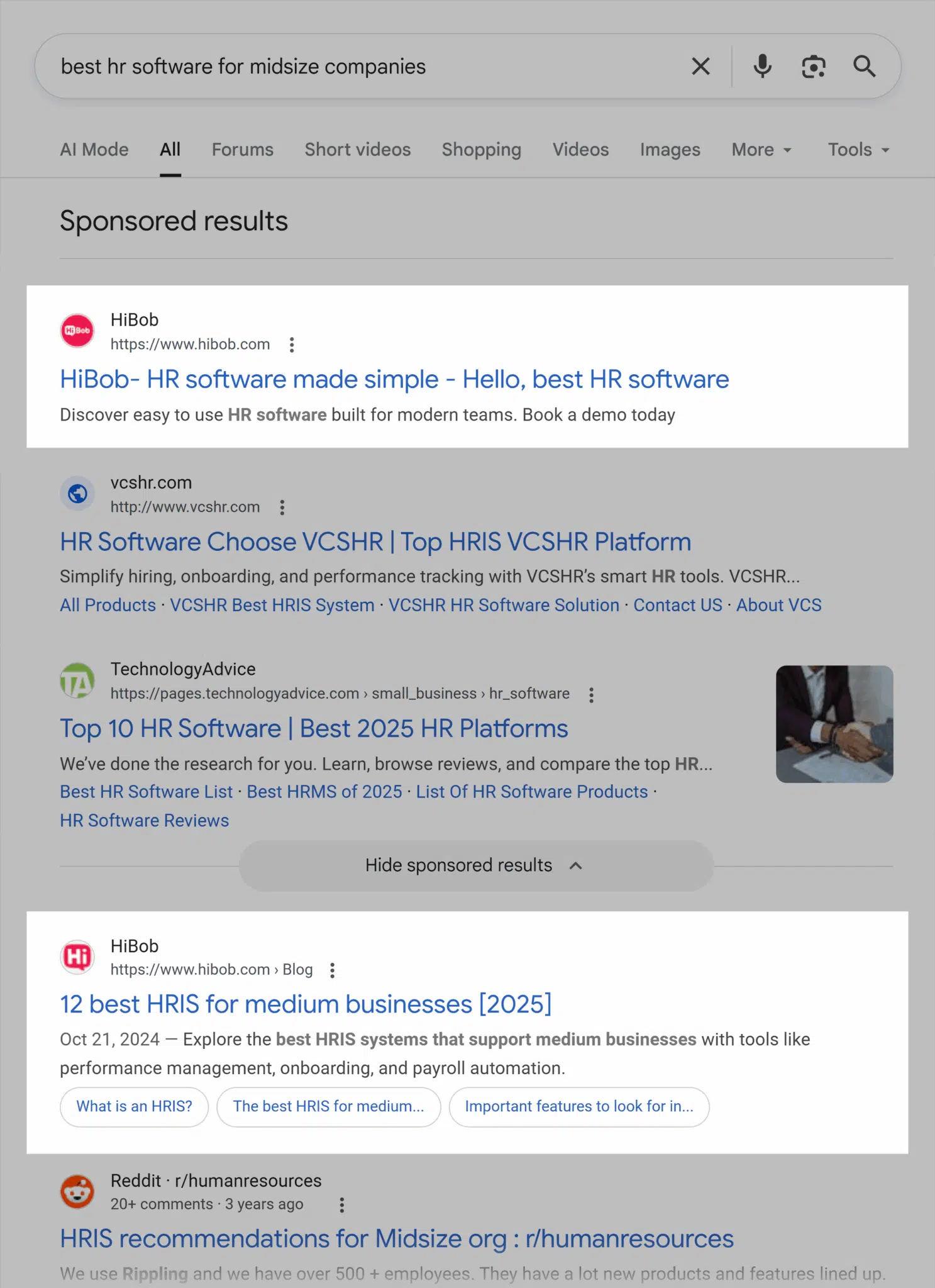
Optimizing for today’s SERPs
When searchers see your brand in multiple positions on the same page, you’re perceived as a market leader.
And it’s not just ads and traditional results that can help drive that perception. Today’s SERPs are visual, interactive, and incredibly competitive.
Depending on the query, you could be competing for real estate in:
- AI Overviews and featured snippets that answer questions directly on the results page
- Discussions and forums result in searches that drive users to sites like Reddit and Quora
- Image carousels and video results that catch searchers’ eyes
- Local map packs for location-based searches
- Shopping results with prices, reviews, and direct purchase options
A search marketing strategy that captures attention across all these result types will build your brand and drive more clicks.
For example, when someone searches “pool maintenance for beginners,” Swim University appears as the top organic result and in the video carousel just below it:

And that’s what search marketing success looks like today.
However, there’s an elephant in the room here: AI Overviews.
AI-powered results are driving more “zero-click” searches—where users get their answers without visiting websites.
You might think that sounds like bad news for marketers. But the reality is that the brands that understand how to optimize for AI summaries and knowledge panels are actually capturing more mindshare than ever before.
For example, Swim University also appears twice in the AI Overview for “pool maintenance for beginners:”

As well as in one of the SERP’s People Also Ask results:

Although these SERP features might reduce clicks, they can still help build your brand.
Pro tip: AI doesn’t eliminate the need for great content—it rewards it. The brands cited in AI-generated responses are those creating genuinely helpful, authoritative content that serves user intent.
Search marketing isn’t just a traffic driver—it’s a revenue engine that compounds over time as your organic authority builds and your paid campaigns become more targeted and efficient.
Let’s look at each side of the search marketing equation to learn how to dominate the SERPs across the user journey.
The SEO side of search marketing
SEO is one of the highest-ROI channels in marketing.
49% of marketers report that organic search has the best ROI of any marketing channel. That means SEO is the highest-performing channel for nearly half of all companies.
Why does SEO deliver such strong returns?
Once you rank for valuable keywords, you’re capturing qualified traffic month after month without paying for each click. So the more established your SEO strategy is, the lower your customer acquisition cost drops.
Let’s break down the core pillars that make SEO work:
Technical SEO
Technical SEO is the process of making sure search engines can easily find, crawl, and understand your website’s content.
Think of it as the infrastructure that makes everything else possible. If search engines can’t access your site efficiently, even the best content won’t rank.
Key focus areas include:
Crawlability: Run a site crawl, fix 404s/redirect chains, verify robots.txt and canonical tags, then submit an updated XML sitemap in Google Search Console.
Schema markup: Use the right type for the page to qualify for rich results: FAQPage for FAQs; Product (with Offer/AggregateOffer, AggregateRating, Review) or SoftwareApplication for software product pages; LocalBusiness for location pages; Article/BlogPosting for editorial; BreadcrumbList for nav; and reserve Organization for brand metadata (name, logo, sameAs), not FAQs/reviews/products.
Site speed: Faster pages convert better. Research by Portent found ~1s pages convert ~3× better than 5s pages. That means page speed directly impacts sales. Compress images, lazy-load below-the-fold media, minify CSS/JS, defer noncritical JS, and use a CDN. Aim to use a Content Delivery Network (CDN) to pass Core Web Vitals (LCP < 2.5s, INP < 200 ms, CLS < 0.1).
Content strategy
Gone are the days when you could rank with thin, keyword-stuffed articles. Today’s successful SEO strategies revolve around content that demonstrates expertise and provides genuine value.
Modern content strategies focus on:
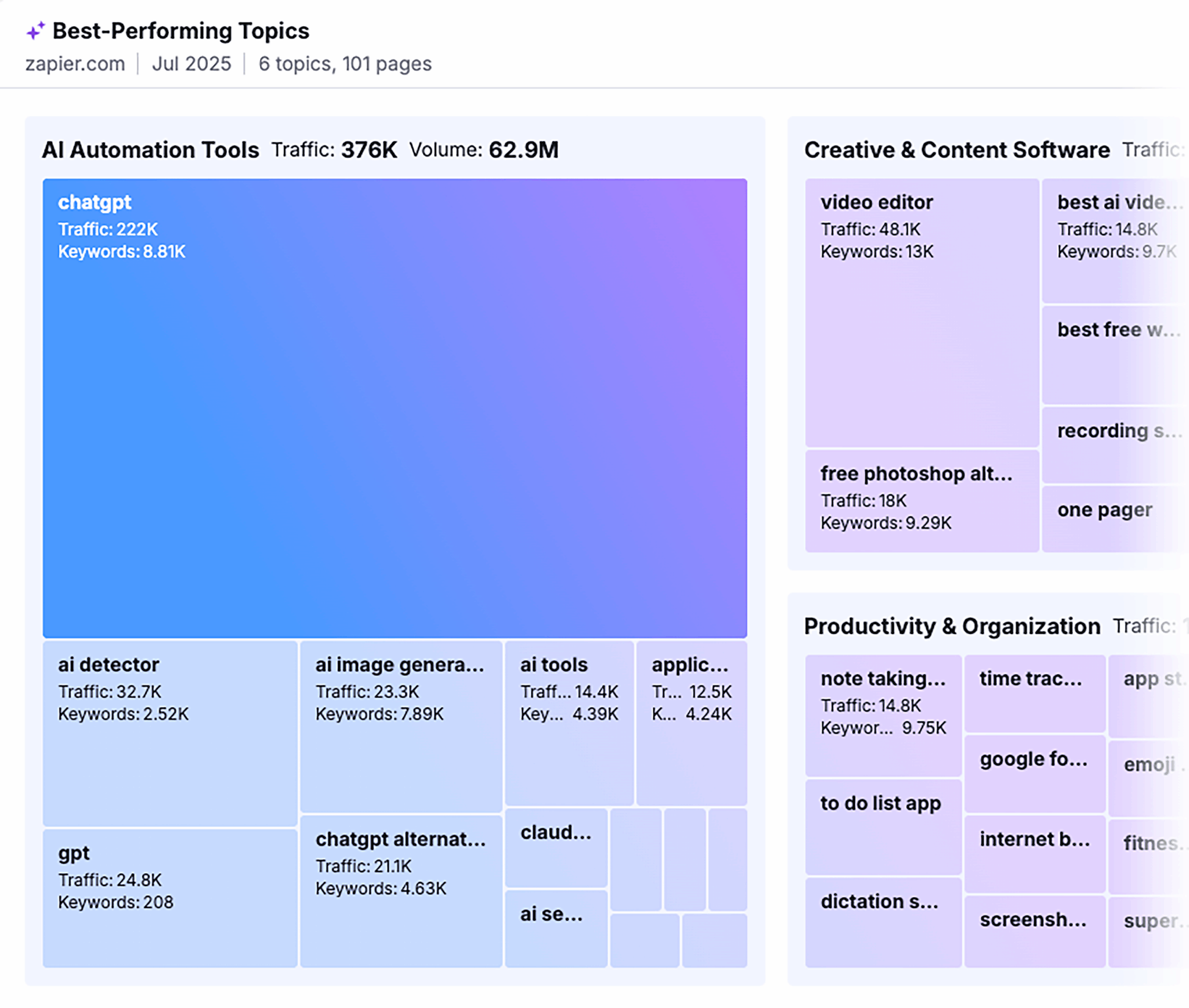
Topical authority: Instead of targeting isolated keywords, successful sites build comprehensive coverage around topics. Google rewards sites that display E-E-A-T (Experience, Expertise, Authoritativeness, and Trustworthiness) signals. To become an authority on a subject in Google’s eyes, map your content to topic clusters with internal links between pillar and subpages.
For example, Semrush’s topic overview reveals Zapier is dominating topics like “AI Automation” and “Productivity and Organization” —topics that directly tie to its product.
Content depth: Surface-level blog posts won’t cut it anymore. The content that ranks tackles topics thoroughly, answering related questions and addressing the intent behind the search.
Helpfulness: Google’s recent algorithm updates have prioritized content that genuinely helps users accomplish their goals, not content that exists solely to rank. Track average time on page and scroll depth to see if visitors engage with your content.
Link building
Backlinks remain one of Google’s strongest ranking factors. But forget about buying link packages—modern link building is about earning genuine endorsements from authoritative sites.
Today’s most effective link-building strategies include:
Original research and data studies: Conduct surveys, analyze industry trends, or conduct original research that provides new insights. Survey your audience, publish key findings, and pitch them to industry journalists.
Think of Semrush’s recent AI Overviews study, which has earned over 3,900 backlinks to date from authoritative sites like the BBC and The Content Marketing Institute.

Build relationships with industry publications: Connect with journalists, editors, and bloggers who cover your industry. Follow relevant editors and creators on LinkedIn, comment on their work, then pitch stories when appropriate.
Create valuable resources: Develop comprehensive guides, tools, or frameworks that solve real problems for your audience. Think interactive calculators, detailed templates, or step-by-step tutorials that others can’t easily replicate. Use tools like Google Search Console to find recurring user questions, then build evergreen resources around them.
Local SEO
Research by SOCi shows that eight out of 10 US consumers search for local businesses online at least once per week. So, if you serve customers in specific geographic areas, local SEO can be your secret weapon.
Local SEO revolves around:
Google Business Profile optimization: This free listing controls how your business appears in local search results and Google Maps. Complete your profile with accurate hours, photos, and services. Add at least five high-quality pictures and respond to all reviews within 48 hours.
Local citations and NAP consistency: Citations are mentions of your business name, address, and phone number (NAP) across the web. Consistent NAP information across directories like Yelp, Yellow Pages, and industry-specific sites builds trust with search engines. Use a service or manual checklist to update listings quarterly.
Location-specific content creation: Create dedicated pages for each location you serve, complete with local keywords, customer testimonials, and area-specific information. A dental practice might create pages like “teeth cleaning in downtown Seattle” or “emergency dentist near Capitol Hill”—content that directly matches how people search locally. Include a Google Map embed and local schema for each location page.
Measuring SEO success
Unlike paid search, where you can see immediate results, SEO requires different metrics and longer measurement windows.
Track these key indicators:
- Conversions: The most important SEO metric of all is how organic traffic converts to leads, sales, or other business goals. You can track this by setting up key events in Google Analytics 4
- Organic traffic and rankings: Monitor both overall organic traffic growth and rankings for your target keywords using Google Search Console and a rank tracking tool, such as Semrush
- Impressions and click-through rates: These metrics from Google Search Console show how often your pages appear in search results—and how often your content is receiving a click
Recommended Articles



The PPC side of search marketing
PPC can double your investment while delivering immediate visibility.
It delivers an average 200% ROI, with businesses making $2 for every $1 spent. And WordStream research shows that the average Google Ads conversion rate is 6.96%. That means nearly 7 out of every 100 people who click your ads take action.
That’s an immediate, measurable return on investment that you can scale up or down based on performance. Plus, instant SERP visibility lets you capture demand during competitive product launches or your own visibility when seasonal search spikes hit.
An effective PPC strategy hinges on these key areas:
Keyword match types and bidding strategies
Match types control when your ads appear and how much you pay per click. Get this wrong and you can either blow your budget on bad-fit traffic or miss out on customers because you’re being too restrictive.
Here’s how the three main types work in practice:
| Match type | How it works | Best for | Pro tip |
| Broad match | Casts the broadest possible net by showing your ads for any search Google considers relevant. A personal trainer bidding on “personal trainer” might show up for searches like “fitness coach,” “workout instructor,” or “get in shape help.” | Discovering new keyword opportunities. | Pair with negative keywords to control spend. |
| Phrase match | Keeps your core phrase intact but allows extra words before or after it. So, “personal trainer” would trigger for “personal trainer near me,” but not “trainer for personal development.” | Balancing reach and relevance. | Use for competitor brand names with high CTR. |
| Exact match | Only shows for your specific keyword (and close variants like plurals). For example, a personal trainer might bid on “personal training rates” and “PT prices.” | High-intent, high-converting terms where you want maximum control over spend | Bid aggressively on your top performers, since you have complete control over when ads show. |
Most successful PPC campaigns use a strategic mix of all three match types:
- Exact match for the highest-converting terms
- Phrase match for relevant variations
- Broad match for discovery
This helps capture demand at every stage of the funnel.
Bidding strategies and budget optimization
The right bidding strategy is essential for getting the biggest bang for your buck on your PPC spend.
And the most effective search marketing teams use a mix of bids to achieve their goals, including:
| Bidding strategy | How it works | Best for | Pro tip |
| Manual CPC bidding | Gives you complete control over individual keyword bids. | Use this approach when you want to bid aggressively on high-value keywords while limiting spend on experimental terms. | Avoid Manual CPC on low-volume keywords—you’ll underbid and lose impressions. |
| Target CPA bidding | Uses Google’s machine learning algorithm to analyze conversion data, user behavior, and auction dynamics to optimize your bids in real-time. | When you have plenty of data to feed Google’s algorithm. | Wait until you have at least 30 conversions in the past 30 days before switching to Target CPA. |
| Maximize conversions | Automatically sets bids to get the most conversions within your budget | Tends to work well for campaigns focused on lead generation rather than maximizing ROI. | Set a maximum CPC bid limit to prevent Google from overspending on expensive clicks. |
Ad extensions and campaign formats
Ad extensions and advanced campaign formats transform basic text ads into formats that capture attention and help drive conversions. They don’t cost extra, but they can dramatically improve your click-through rates and Quality Scores.
Key extension types include:
Call extensions allow mobile users to tap and dial your business directly from search results. These are perfect for local service businesses where phone calls convert better than website visits.
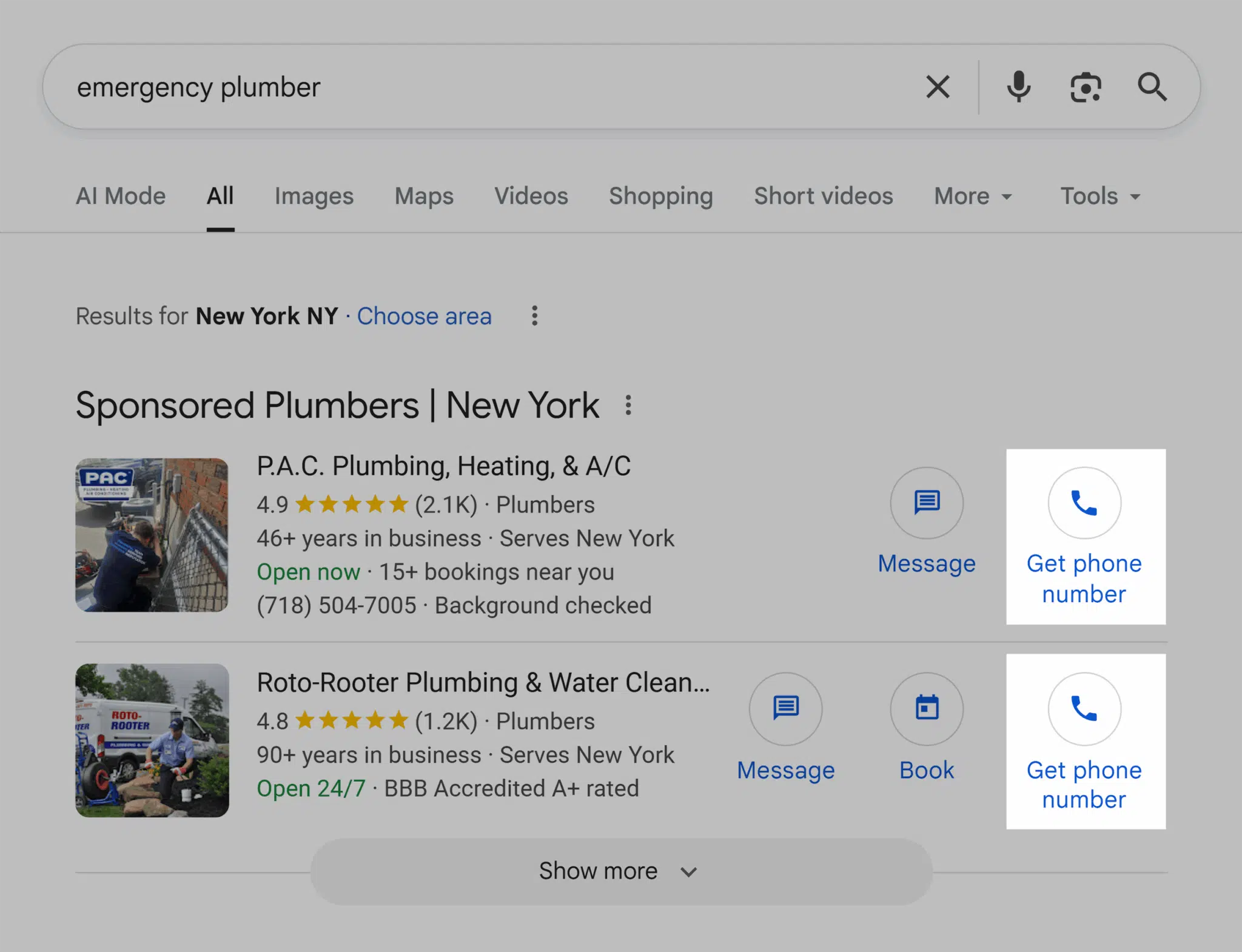
Schedule call extensions to appear only during business hours to avoid wasted calls
Sitelink extensions add additional links to specific pages on your website. This takes up more real estate in the SERPs and gives searchers multiple ways to engage with your business from a single ad.
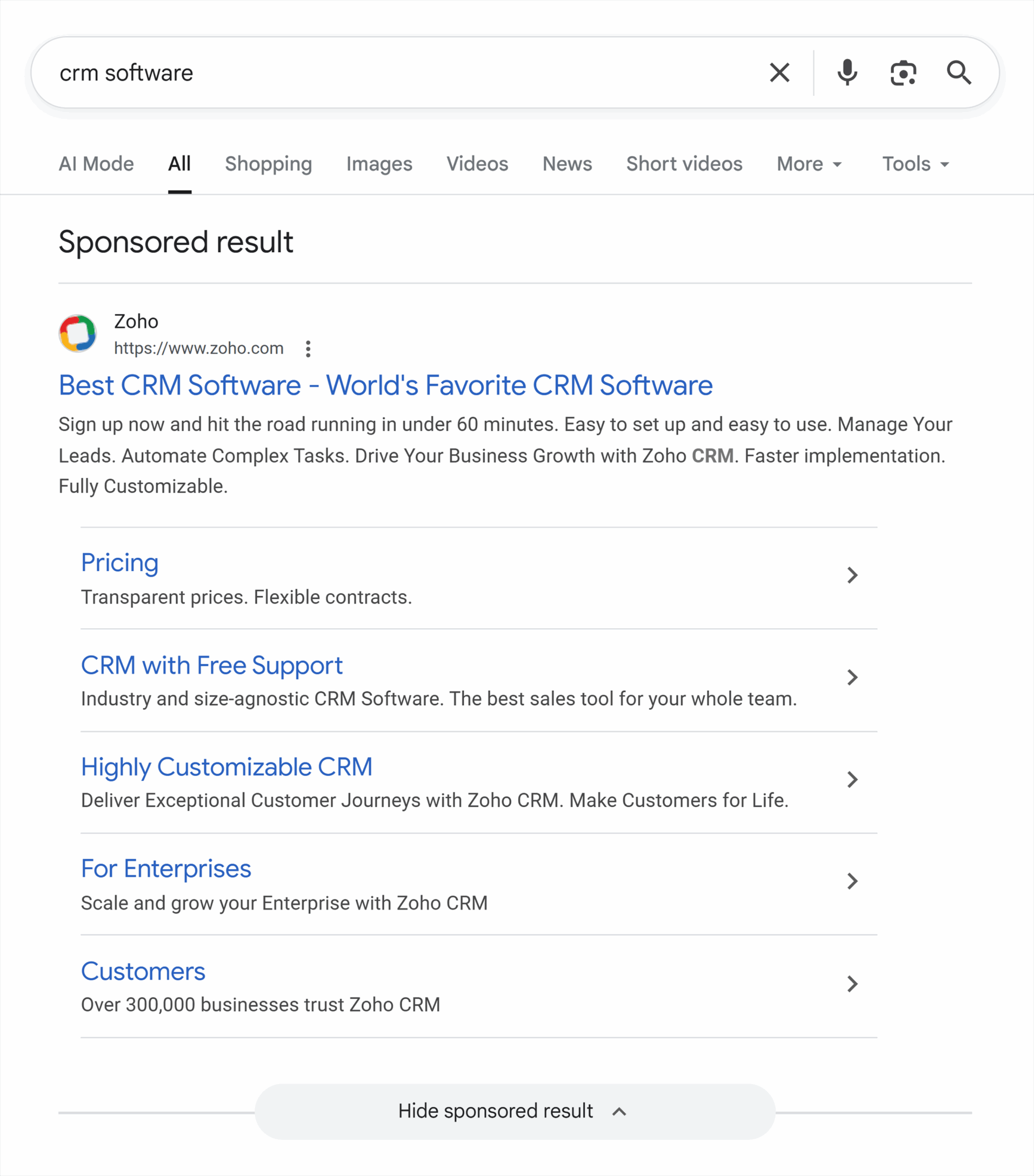
Use conversion-focused landing pages to boost your chances of making the sale.
Shopping ads showcase products with images, prices, and store information directly in search results. For the best results, optimize your product feed with titles that include target keywords.

Callout extensions appear below your ad text. You can use them to highlight your unique value propositions with short phrases like “Free Shipping” or “24/7 Support.” Unlike other extensions, these don’t link anywhere—they simply reinforce why searchers should choose you over competitors.

Use three to four callouts that address common objections or highlight competitive advantages like warranties, certifications, or service guarantees.
Structured snippets showcase specific aspects of your products or services in set categories like “Services,” “Brands,” or “Destinations.” These help searchers quickly understand what you offer without clicking through to your site.
Choose categories that align with high-intent search queries. So, if you’re a hotel, use “Amenities” to highlight features like pools or WiFi that travelers actively search for.
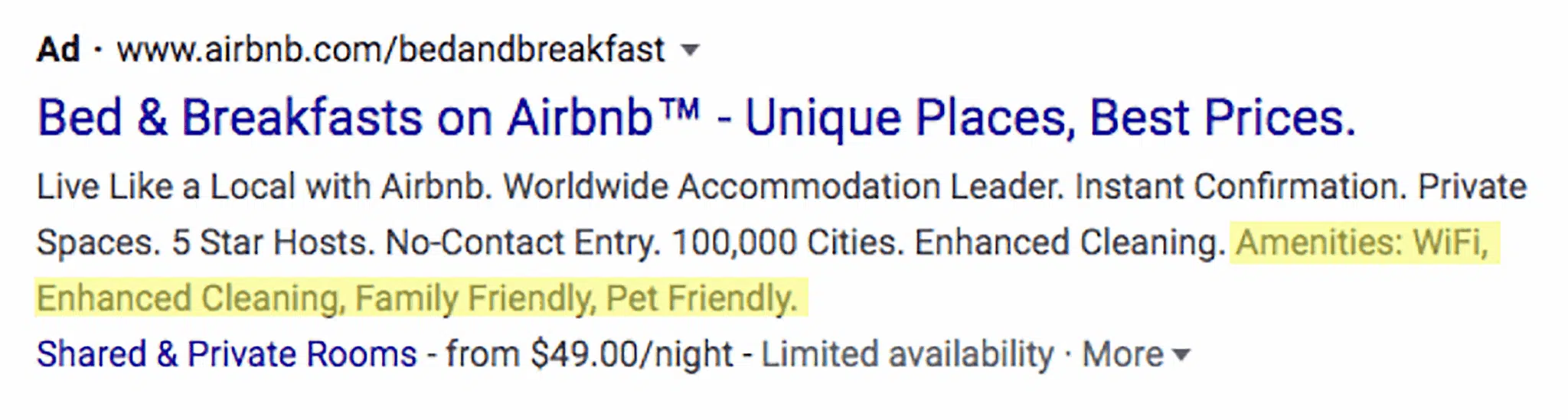
Image extensions add visual appeal to your text ads with images that make your ads stand out in crowded search results. You manually upload these images directly within your Google Ads campaign settings. Then Google will automatically rotate and test them to show the best-performing ones.
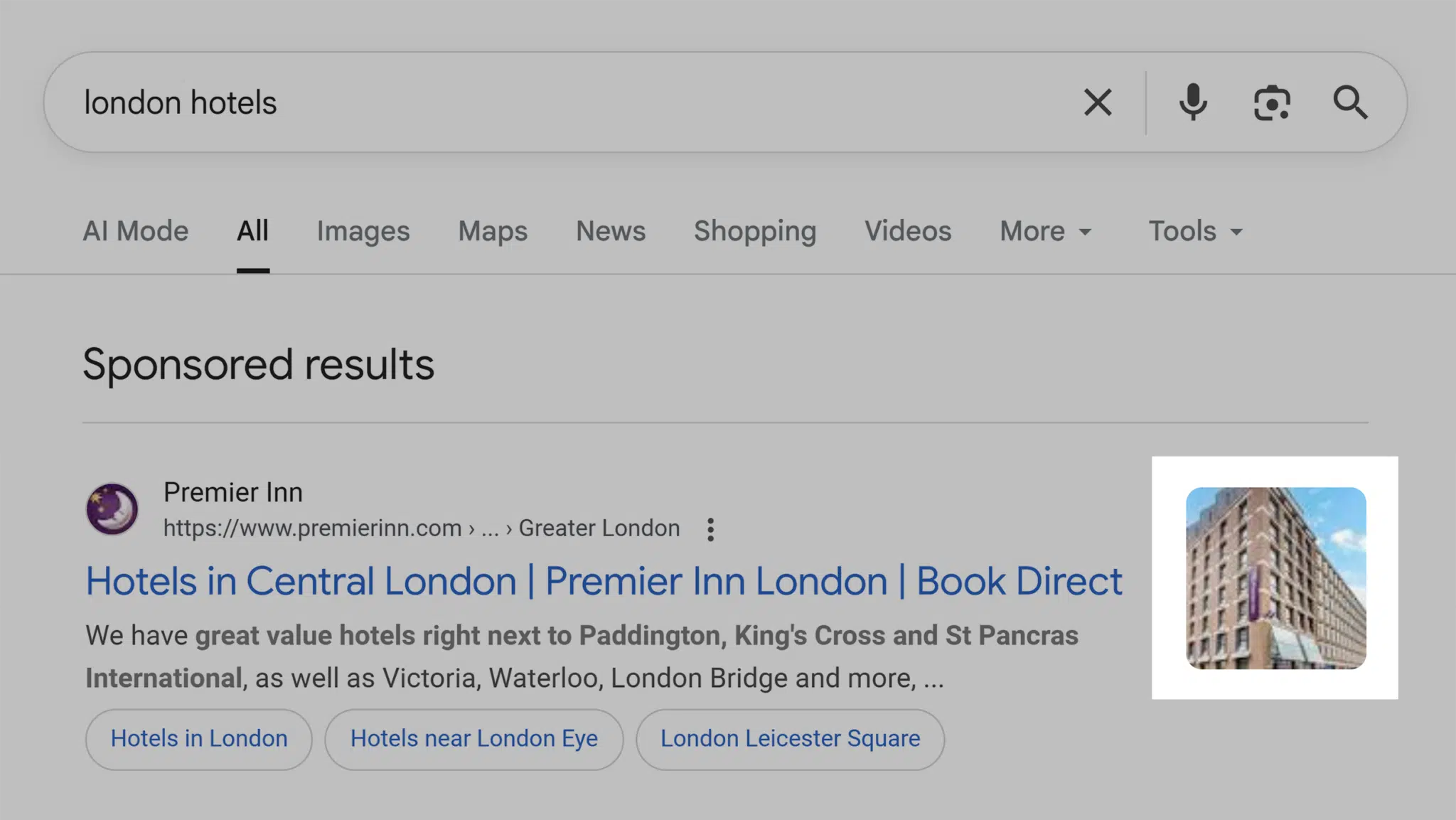
Upload high-quality photos that showcase your products in use rather than simple product shots—lifestyle images typically generate higher engagement rates.
Remarketing and audience targeting
Remarketing lets you target your most valuable prospects—the people who’ve already shown interest in your business but haven’t converted yet.
Smart audience targeting focuses on behavior, not just demographics:
Website remarketing lets you re-engage people who viewed specific pages on your site—like your pricing page—or took specific actions—like downloading a white paper—with tailored messaging.
Customer list targeting enables you to upload your existing customer email addresses, find similar prospects across Google’s platforms, and target “lookalike” prospects.
In-market audiences allow you to target users who Google identifies as being in “buy now” mode. Your ads will be displayed to people whose recent search behavior and website visits suggest they’re actively researching products or services like yours.
Custom intent audiences let you build audiences based on specific keywords and URLs related to your business. For example, an email marketing platform could target people who’ve recently searched for “email marketing automation” or visited a competitor’s pricing page—even if they’ve never landed on their website.
Measuring PPC success
Unlike organic search, PPC gives you immediate, granular performance data. You can use this data to refine your strategy in real-time:
- Return on ad spend (ROAS) shows the revenue generated for every dollar invested. This is your ultimate performance indicator.
- Cost-per-acquisition (CPA) measures how much you spend to gain each new customer or conversion. This metric directly ties your ad spend to business outcomes and helps you evaluate whether your campaigns are driving ROI.
- Click-through rate (CTR) measures how compelling your ads are to searchers. Low CTR? Your messaging might not match search intent.
- Cost-per-click (CPC) tracks your bidding efficiency and market competitiveness. Rising CPCs often signal increased competition or declining ad relevance.
- Quality Score indicates how Google rates your ads’ relevance and user experience. Higher scores mean lower costs and better ad positions.
Essential PPC tools include:
- Google Ads for campaign management
- Microsoft Ads for Bing traffic
- Optimization platforms like Optmyzr and Skai for advanced bid management and reporting
Integrating SEO and PPC for total SERP dominance
Most organizations run SEO and PPC in silos. But the reality is that PPC and SEO complement each other perfectly.
Here’s how:
The shared keyword universe advantage
One of the biggest advantages of running SEO and PPC together is that you can use keyword data from both channels to drive a higher ROI.
Your SEO data shows you which high-intent keywords drive organic traffic. Feed this data into your PPC strategy, and you can put budget toward terms with proven search demand instead of guessing which keywords might convert.
Plus, when SEO identifies high-volume keywords that are impossible to rank for organically due to competition, PPC can capture that traffic immediately while content builds long-term authority.
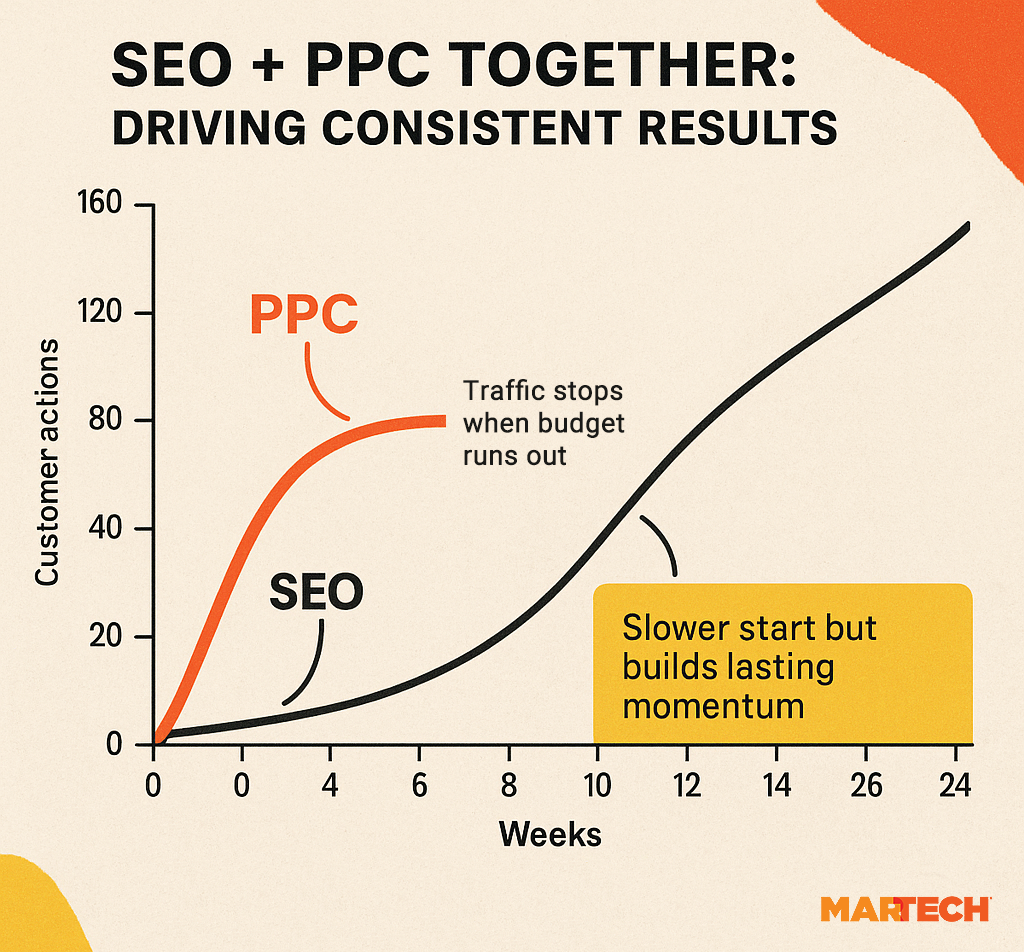
On the other side of the equation, PPC gives you real-time performance data that SEO alone can’t deliver. Click-through rates, conversion rates, and cost per acquisition data can help inform your SEO strategy.
This monthly joint keyword review workflow will help you drive the best results through both channels:
- SEO exports high-performing organic keywords from Google Search Console and Analytics. Focus on terms with strong conversion rates and search volume.
- PPC shares conversion data and CTR performance for all active keywords. Highlight which terms drive the lowest cost-per-acquisition and highest click-through rates.
- Both teams then run a joint keyword review where they identify keyword gaps, decide which high-competition terms deserve immediate PPC coverage, and plan content strategies around PPC’s best-converting keywords.
By aligning both channels each month, you’ll improve search visibility and create a more cost-effective, long-term strategy.
Use PPC to test before you invest
What if you could validate the demand for a topic—and your messaging around it—before spending months developing comprehensive guides or landing pages?
When a specific keyword drives high engagement and conversions in PPC, that’s a sign it’s a valuable keyword the SEO team should prioritize.
Look for these performance indicators:
- CTR benchmarks of 3-5% on search ads targeting your content keywords. Anything above your account average is a topic worth exploring as part of your SEO strategy.
- Conversion rate thresholds of 2-4% on content-focused landing pages. There’s an apparent demand for keywords that consistently hit these numbers.
Plus, ad copy testing in PPC provides a structured approach to analyzing which messaging, calls to action, and value propositions resonate best with potential customers. You can use this data to optimize your meta titles and descriptions for clicks and your on-page content for conversions.
Target audiences across the entire funnel
PPC ads give you immediate visibility on priority terms you can’t afford to miss out on. And they drive immediate conversions, too.
But as Devin Reed explains: “If you’re only marketing to buyers when they’re ready to buy, you’re too late. The real opportunity is to win mindshare with the 95% who aren’t ready yet.”
That’s where SEO comes in. Engaging content that solves your ICP’s biggest problems will rise up the SERPs for relevant keywords. And that will help build a brand that people will recognize next time they see one of your ads.
By using both channels strategically, you can reach potential customers at all stages of the funnel—from discovery and consideration to conversion and retention.
Best practices for a winning search marketing strategy
A winning search marketing strategy blends PPC’s speed with SEO’s staying power to capture customers across the funnel.
Here’s how to make sure you’re combining SEO and PPC for the best results for your business:
Map search intent across the funnel
Together, SEO and PPC can help you appear in the SERPs for your target terms across the sales funnel.
For example, Atlassian, the company behind the project management software Jira, uses SEO to appear at the top of the funnel searches like “stand up meeting:”

Ranking for these terms grows the Atlassian brand and increases its authority with its target audience. But ads on these terms would never deliver an ROI, so they save their budget for more valuable terms.
Atlassian uses a combination of PPC and SEO to dominate middle-of-the-funnel queries like “Jira vs Asana:”

When they’re making these kinds of searches, people are actively shopping for Atlassian’s solution. So it’s well worth investing in PPC and SEO to ensure they dominate the discussion around this term.
However, you should test what happens when you transition the PPC budget to other terms once you achieve consistent top three organic rankings in these MOFU terms.
When it comes to BOFU terms like “Jira pricing,” Atlassian uses a combination of SEO and PPC to completely dominate the search results—appearing in two sponsored results and five of the eight organic results on the first page for the term.

Given that no competitors are bidding against them here, there’s no need for them to pay for the sponsored results on this SERP, which goes to show how valuable taking up this much SERP real estate for these BOFU terms is to a brand like Atlassian.
Atlassian also uses PPC to appear in valuable BOFU terms they don’t have a chance of appearing in with SEO, such as “clickup pricing:”

Atlassian simply couldn’t dominate the SERPs across the funnel like this with SEO or PPC alone.
Segment branded and non-branded queries
The most effective search marketing strategies include a mix of affordable branded terms and expensive non-branded terms. That helps you get the highest ROI from your search marketing budget.
Here’s how you should think about splitting your budget across branded and non-branded terms:
Most brands dedicate 20-30% of their PPC budget to branded terms—intending to maintain 85%+ impression share on core brand terms. It’s a good idea to set automated rules to cap daily spend at this threshold so competitor bidding wars don’t spiral out of control.
That leaves 70-80% of the budget for non-branded growth campaigns targeting high-intent keywords that help expand your market reach. These campaigns drive new customer acquisition rather than just protecting existing demand.
Pro tip: Monitor your brand conversion lift by comparing periods when competitors bid against you versus when they don’t. If the conversion rate difference is less than 10%, reduce your spend on branded terms and reallocate budget to non-branded keywords.
Your approach to branded searches (think “your company name” or “your product vs. your competitor’s”) should be capturing existing interest in your products. People are making these searches because they want to find your solution, which means they’ll actively seek you out in the SERPs.
Branded searches can therefore often be captured with SEO alone, given your competitors aren’t going to be able to outrank you in the organic results for your brand name.

Just keep an eye out for competitors bidding on your brand searches:
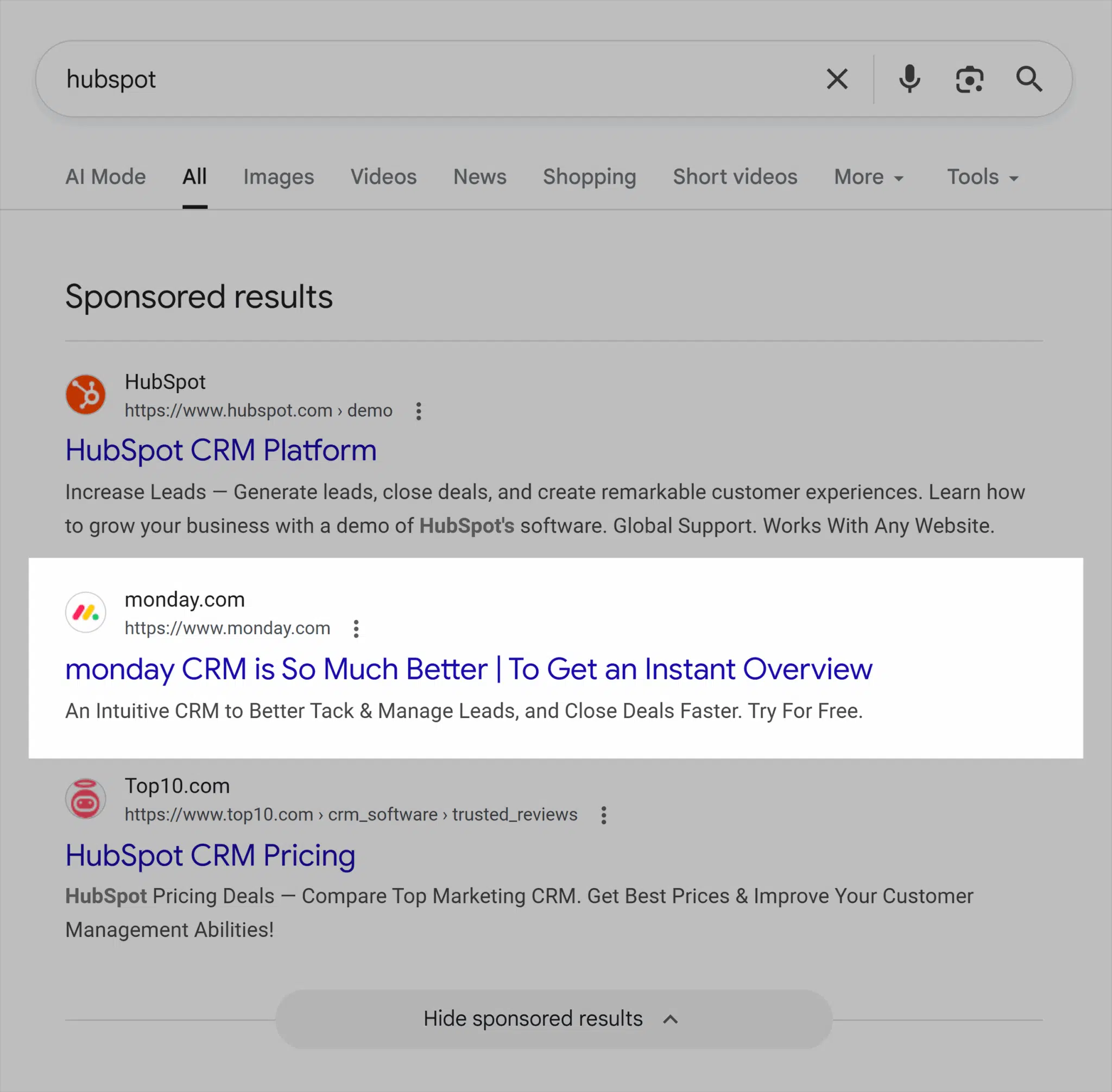
Monitor impression share for your brand terms weekly to identify when a competitor is bidding against your brand terms. And use ad copy that reinforces your brand’s differentiator to help make sure you’re still capturing the majority of clicks. Creating comprehensive sitelink extensions will also help you dominate more SERP real estate—and push competitor ads further down the results.
You can set up automated bidding rules that increase your bids by 20-30% when impression share drops below 90% on brand campaigns, too. That will ensure you maintain top ad positions even when competitors increase their bids.
Non-branded queries (think “best email marketing software” and “e-signature generator”) are a different story. You’re going head-to-head against your competitors to grab the attention of people who might have never heard of you.
Outbidding your competition to claim the sponsored results can therefore be a smart move here—especially in SERPs made up of third-party review sites:
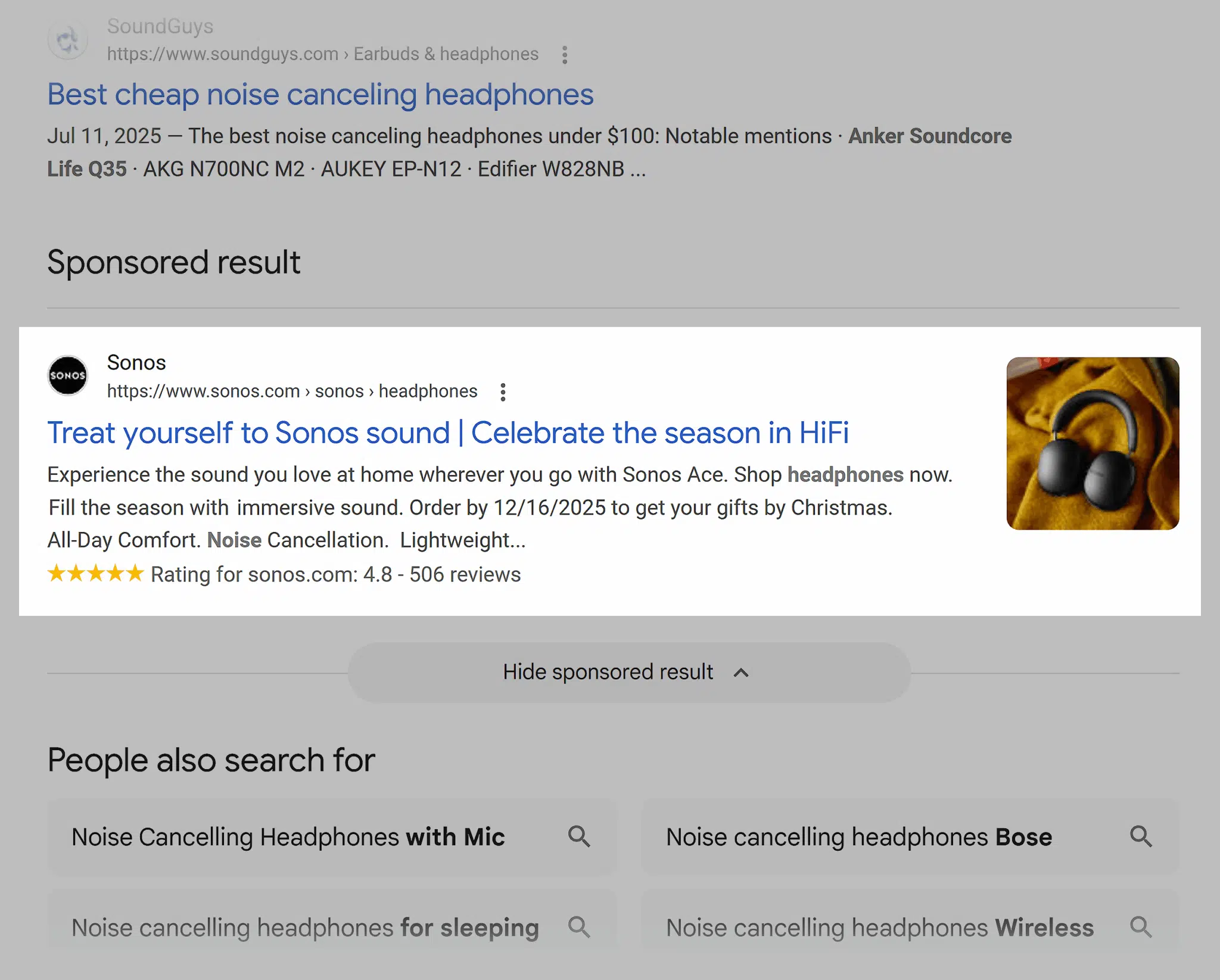
But that can get expensive, fast.
Stretch your budget further by:
- Layering in-market audiences on high-cost non-branded terms to improve your ROI
- Test “best [category] for [ICP]” queries, which often convert better than generic “best [category]” searches
- Target competitor and problem combinations like “[competitor name] alternatives” or “[competitor name] pricing issues” to capture switcher intent at lower costs
- Set up automated rules to pause campaigns when cost-per-acquisition gets too high to prevent wasting budget on a bidding war
Align with product, sales, and customer support goals
Your search marketing strategy should drive awareness around your business’s key products and features, not chase “easy” keywords. And the only way to do that is to collaborate with the other teams in your organization.
Arrange a quarterly roadmap meeting with the product team to identify upcoming features. You can then create content that addresses the features customers are asking for most often before competitors can respond.
You should also get a monthly sync with sales in the calendar to collect top objections and competitor intelligence. Those topics might be zero-volume keywords, but creating content around them is going to show your ICP how well you understand what they’re looking for from your solution.
Lastly, run a quarterly review of support ticket tags to identify content gaps and terms that should be added to your negative keyword list for PPC campaigns. Be sure also to ask the support team to clue you in on common customer misconceptions and unexpected use cases, which you can then create campaigns around.
Pro tip: Track which objection-handling content pieces lead to higher assisted conversions from organic and paid.
Continuous testing and iterative refinement
Search marketing has never been a “set it and forget it” channel. But that’s never been truer than today, when search engines are incorporating more AI features into their platforms every month.
You should constantly test and iterate your strategy to make sure you’re staying ahead of changing search behavior, the latest algorithm updates, and what your competitors are up to.
That might involve:
- Experimenting with new ad headlines each month
- A/B test the new landing page variations quarterly
- Running 30-day bidding strategy trials comparing Max Conversions vs. Target CPA
Even minor improvements can compound into significant wins over months of campaign optimization, especially when you create data feedback loops by integrating PPC conversion data into SEO keyword prioritization every quarter.
You should also use a tool like Semrush’s Position Tracking Tool to monitor your rankings for target keywords, spot opportunities where competitors are gaining ground, and identify when your SEO efforts start paying off—all crucial data for optimizing your combined SEO and PPC strategy.
Use Position Tracking to decide when to pull back PPC spend on keywords where you’ve moved into the top three organic results. Set alerts for SERP feature changes to respond to new PPC ad formats or shifts in organic results.
Common search marketing mistakes to avoid
There are numerous moving parts and stakeholders to manage in a search marketing strategy. Which means there’s a lot that can go wrong if you’re not careful.
Here are the biggest pitfalls that can drain your budget and sabotage your results.
Treating SEO and PPC as silos
Your search marketing strategy is going to live or die on how well you can get your SEO and PPC teams to work together.
Make it your priority to ensure both teams understand they’re playing for the same team. Give them a shared North Star KPI, like pipeline generated or blended CPA.
Track overall search marketing performance on a shared dashboard with KPIs across SEO and PPC. And set up joint quarterly planning sessions, where budgets are tied to combined performance.
It’s also a good idea to set a weekly sync meeting where both teams:
- Share performance data from their top five converting keywords—and flag any significant ranking drops or bid increases from the past week
- Identify keyword gaps where organic terms ranking 4-10 need PPC coverage, and high-converting PPC terms lack supporting SEO content
- Exchange actionable insights, with SEO providing Search Console data for PPC targeting, while PPC shares conversion rates and compelling ad copy for content optimization
- Review competitive threats like new competitor campaigns or ranking shifts that affect shared keyword strategies
- Allocate resources strategically by deciding which keywords get immediate PPC budget versus long-term content investment based on conversion potential
- Set next week’s priorities with specific keyword targets, content briefs, and campaign launches assigned to clear owners with deadlines
Your SEOs will quickly learn that their colleagues in the PPC team can help them hit their KPIs by uncovering keyword opportunities they might have missed. And your PPC team will be a lot friendlier with your SEOs when they pass on research into your competitors’ content gaps they can exploit with targeted ad campaigns.
Focusing on vanity metrics over ROI
If your search marketing deck leads with traffic graphs instead of revenue impact, you’re undercutting your case for budget.
Focusing on how your search marketing efforts are driving revenue will not only help you make more effective decisions but also drive revenue growth. It will also help you convince your leadership team to allocate a larger budget to you.
So model out the impact of your search marketing strategy. Forecast:
- Expected incremental traffic from both organic and paid channels
- How many customers that will bring in
- How much revenue will that generate
Then set clear milestones. Instead of asking the C-suite for a blank check, show what early signals you expect to see at three, six, and nine months. That might be:
- Three months: 15% increase in total search visibility and 10% boost in assisted conversions from organic traffic
- Six months: 25% growth in branded search volume and measurable reduction in cost-per-acquisition across paid campaigns
- Nine months: 40% increase in organic revenue contribution and 20% decrease in reliance on paid spend for target keywords
If you see those signs, it’s worth investing more budget in search marketing.
Every step of the way, ensure that everything is tied back to ROI. Effective search marketing will lower your company’s cost-per-acquisition over time. Show how organic growth will reduce your reliance on paid spend, meaning you can use your PPC budget more effectively as time goes on.
Targeting irrelevant terms
You could dominate the sponsored and organic results for a keyword that drives thousands of visitors to your site every month.
However, if none of those visitors ever convert or return to your site, it would be a waste of your budget.
Check out the sites appearing in the SERPs for the terms you’re thinking of targeting. What does that tell you about the intent behind the search?
For example, let’s say you’re marketing accounting software for enterprise businesses.
The query “free invoice template” might get a lot of searches. But it’s a term that design tools like Adobe, Microsoft Create, and Canva rank highest for.
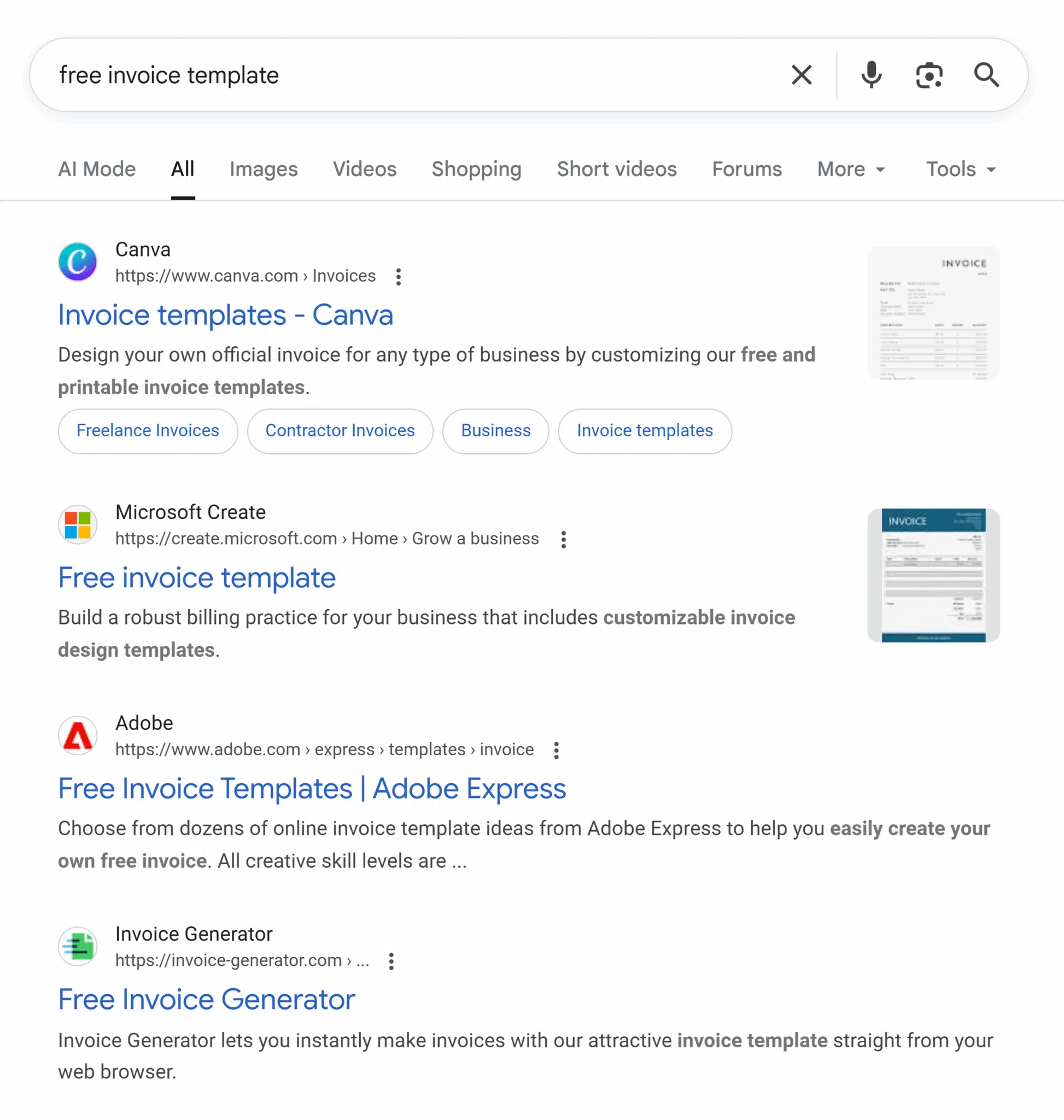
That’s a clear sign it’s not a term that will drive many leads for an enterprise accounting software.
The term “how to calculate markup” is a different story.
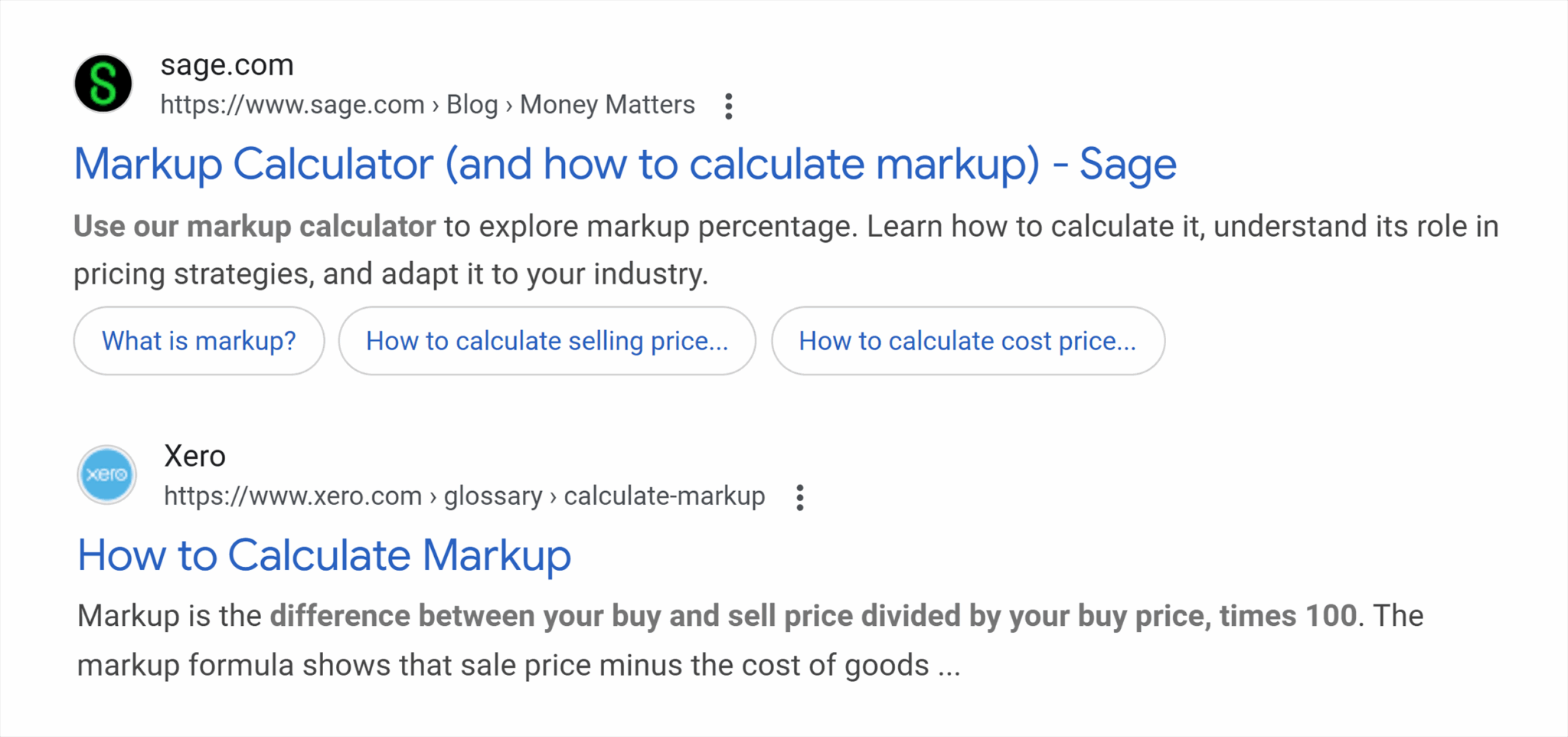
Sage and Xero’s potential customers are making this search. So it’s a keyword they’ve invested in ranking for—even though it receives less than 5% of the monthly searches “free invoice template” receives.
To find relevant terms to target, ask:
- What high-intent problems are searchers actively researching that your solution directly solves?
- What language do they use?
- How do they describe their challenges?
Match your content and ads to their actual intent, not just search volume data.
Ignoring landing page UX for ad campaigns
Your PPC ads should start a conversation that your landing pages continue.
According to research by Webility, ads that lead to custom landing pages drive a conversion rate of 8-20%—compared to a conversion rate of just 1-3% when they lead to a homepage.
For example, this Gong ad:
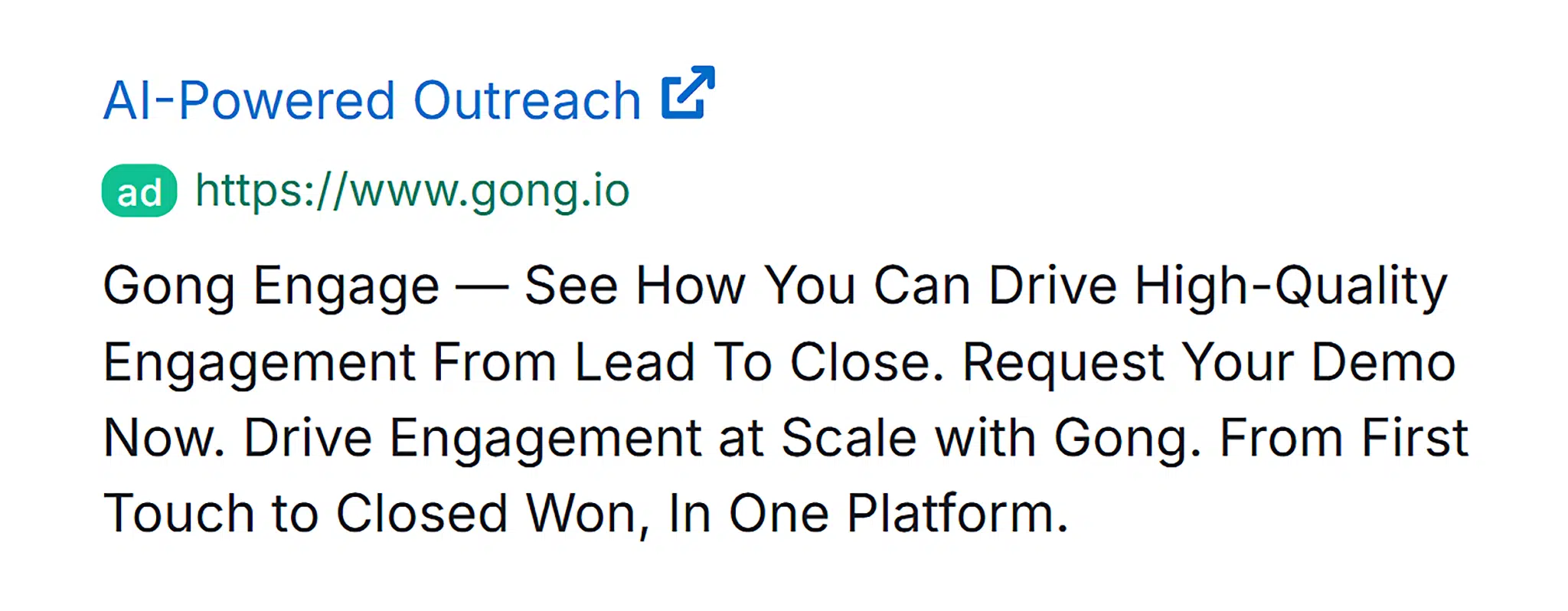
Leads to a landing page that leads with the platform’s AI features:
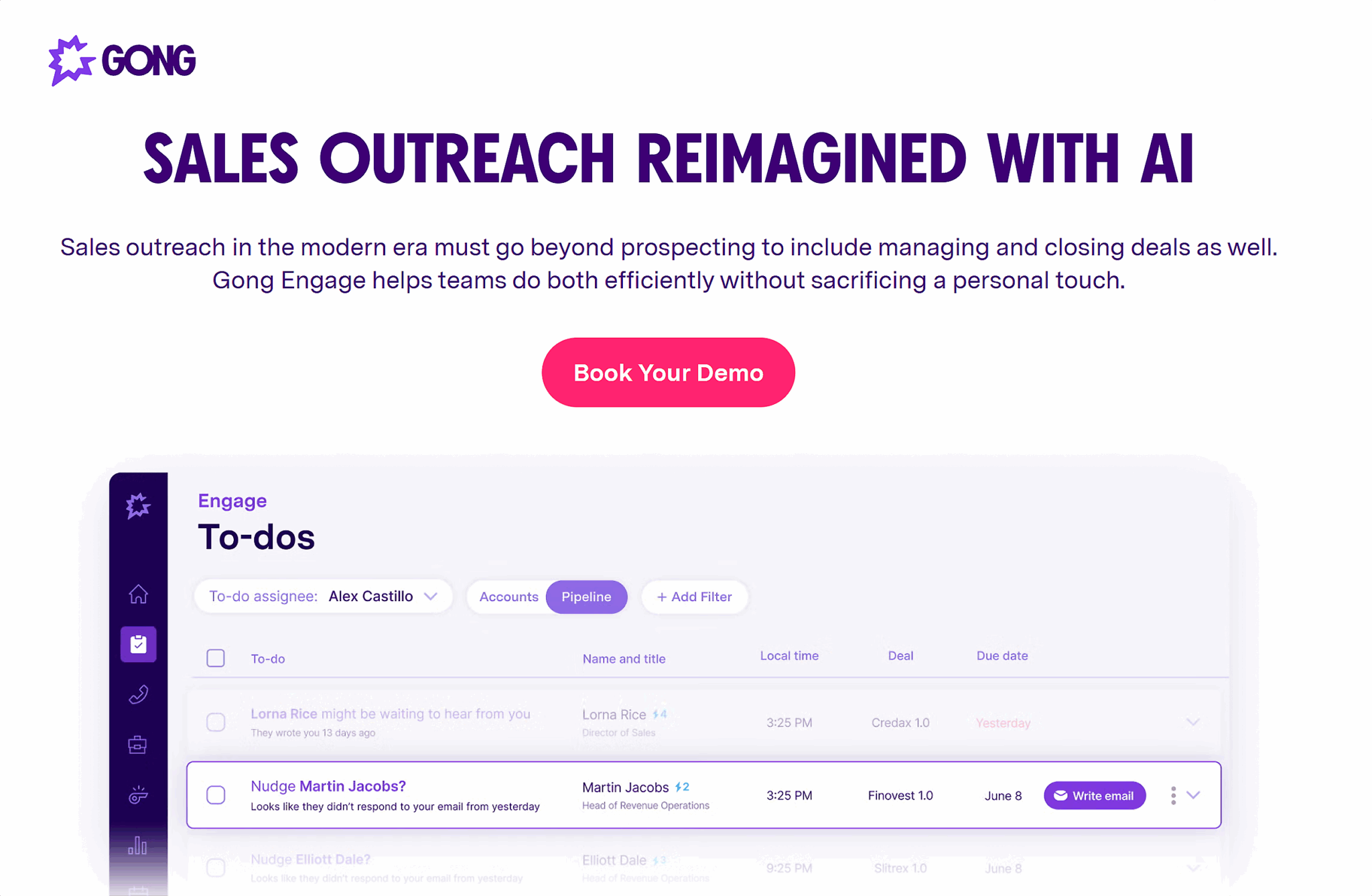
While this ad:

It is focused on the tool’s sales pipeline management features.
For the best results, create a dedicated landing page for each of your PPC campaigns. Matching up the messaging of your ads and landing pages will drive down bounce rates, improve your Quality Scores, and give you the best ROI on your ad spend.
Not adapting to changes in SERP layout or algorithm updates
Let’s face it: One algorithm update can wipe out half your organic traffic overnight.
Plus, search marketing is a zero-sum game. If your competitors unearth a valuable keyword or figure out how to optimize for a new SERP feature before you, your bottom line is going to take a hit.
Which means you can’t afford to take your eye off the ball when it comes to what’s going on in the world of SEO and PPC—especially while the marketing industry is figuring out the best practices for optimizing for generative engine optimization (GEO).
Set up consistent monitoring to catch changes to the search landscape before they start hurting your performance:
- A monthly SERP feature audit for your target terms will identify new opportunities like featured snippets or People Also Ask boxes
- A quarterly competitor movement review will make sure you spot when rivals gain ground on your key keywords or launch new campaign strategies
- Setting up alerts for sudden rank drops using tools like Google Search Console or Semrush will catch algorithm changes in real-time
That being said, it’s important you don’t spend too much time and budget chasing the latest trends. As search algorithms become more sophisticated, they’ll become better at surfacing valuable content created by genuine experts over generic articles that have been optimized for search.
A smart search marketing strategy strikes the balance between implementing the tactics that work today and laying foundations that build your brand’s authority with prospects and search engines alike.
How to measure success in search marketing
Measuring the impact of your search marketing campaigns isn’t as easy as pointing to a few metrics.
B2B buyers consume an average of 13 pieces of content before deciding on a vendor. They might discover your brand through organic search, return via a paid ad, and finally convert after reading a third-party review of your platform, then searching for your brand name.
The KPIs you use to measure the success of your strategy need to capture this complete customer journey as accurately as you can.
Your North Star metrics include:
- Conversions. Which traffic sources are driving the most sales? Setting up conversion tracking in GA4 will show you.
- Blended CAC. Blended CAC (customer acquisition cost) across SEO and PPC provides a better picture of search marketing performance than channel-level CPA.
- Cost per acquisition (CPA). This metric should be your leading PPC metric, as it tells you exactly how much you’re paying to acquire customers through paid channels.
- Return on ad spend (ROAS). This measures the revenue generated for every dollar invested in paid campaigns. A 2:1 ROAS ($2 generated for every $1 spent) is the industry standard.
While supporting data might include:
- Organic traffic. But don’t just count visits—segment by source, landing page, and user behavior to understand what drives quality traffic.
- Keyword rankings. Track your organic positions for target keywords to see which terms you’re ranking well for and which you need to invest more budget into.
- Content engagement metrics. Monitor time on page, scroll depth, and internal link clicks to identify which content keeps users engaged and drives them deeper into your funnel.
- Ad click-through rate (CTR). A low CTR usually means poor ad relevance or weak value propositions and suggests you should rethink your approach.
Google Analytics 4 (GA4) is an essential tool for tracking these core metrics. You can use it to set up conversion tracking, audience segments, and attribution models to understand how search traffic behaves on your site.
Looker Studio is also helpful for creating custom dashboards that combine data from multiple sources. You can pull in GA4 data, Google Ads performance, Search Console insights, and CRM information to get the complete search marketing picture.
Tools like Semrush will also help you to track your paid and organic visibility on your target keywords side-by-side. It can also help identify opportunities where competitors dominate organically but have weak paid presence—or vice versa.
The future of search marketing
Search is no longer one page of ten blue links. Your buyers now see classic listings, ads, local packs, shopping units, and AI-generated answers in the same journey. Winning search marketing means planning for all of those surfaces—and showing up wherever intent appears.
Google Search includes AI Mode (a dedicated tab with AI responses, follow-up questions, and links to the web) and AI Overviews in the main results. AI Mode is available in the US, UK, and India. AI Overviews is available in 120+ countries and territories and 11 languages. Optimize for standard listings and for AI surfaces that can cite and link to your content.
What to monitor
- LLM (large language model) visibility. Track brand mentions and links in AI Overviews and in AI Mode answers—attribute sessions and conversions from those links.
- Organic performance shift: Watch rankings and CTR where AI Overviews appear for your queries; compare before/after.
- Query behavior: Monitor growth in conversational, multi-part, and image-assisted queries that map to your topics.
Experiments to run
- AI Overviews inclusion tests: Publish or refresh pages with concise problem statements, clear steps, and cited sources. Add structured data (FAQPage, Product/SoftwareApplication, LocalBusiness, Article, BreadcrumbList where relevant)—track appearance in Overviews and downstream CTR.
- AI vs. classic traffic quality: Segment AI-referred visits vs. traditional organic. Compare bounce rate, conversion rate, and LTV.
- Conversational keyword coverage: Build “how to” and Q&A clusters that mirror multi-question prompts surfaced in AI results. Measure impressions and assisted conversions.
- Deep Search content fit (optional): For comprehensive topics, test long-form, well-sourced hubs. Deep Search in AI Mode generates fully cited research-style outputs for Google AI subscribers in Labs.
Operating cadence
- Annotate dashboards when AI Overviews begin appearing for priority terms.
- Review AI surfaces monthly in SEO–PPC syncs; reallocate PPC where organic or AI citations secure sufficient visibility.
- Maintain a change log for content updates related to AI inclusion, allowing you to correlate cause and effect.
Plan for listings, ads, and AI surfaces, measure outcomes, and use that data to rebalance your SEO and PPC continually.
Instant analysis of any domain’s authority, top keywords, and ranking pages across 808M domains.
It’s time to future-proof your search marketing strategy
Search will always exist in some form. Which means search marketing is here to stay.
And a combined SEO and PPC strategy is always going to outperform your organic and paid teams operating in silos.
SEO will build your organic authority over time, reducing your reliance on paid traffic and lowering your cost per acquisition in the long run. Meanwhile, PPC lets you rank for competitive, high-intent queries straight away, meaning you can capture demand in SERPs that your SEO strategy might never be able to extend to.
But as search engines incorporate more AI features, search marketers will have to spend more time—and budget—on GEO.
Luckily, if you’re already investing in SEO, then you’re on track for GEO. Check out our guide to turning SEO wins into GEO dominance to find out how to translate your SEO success into visibility within AI search results.
New on MarTech