

53 marketing personalization case studies and statistics you can use to justify investment
Looking for statistics to support investing in marketing personalization? Use this data-packed roundup to secure your next personalization buy-in!
Marketing success increasingly depends on relevance. Customers expect brands to recognize and understand them, delivering experiences that feel tailored instead of generic. Personalization plays a central role in that shift.
What marketers often need, however, is evidence. Instinct isn’t enough when timelines are short, and budgets are tight. Stakeholders need to see credible data that shows personalization drives conversions and revenue.
The SEO toolkit you know, plus the AI visibility data you need.

This roundup brings together statistics across the major areas of marketing personalization, including email, advertising, website experiences, AI, and omnichannel strategy. Each figure provides concrete evidence to justify investment and to make personalization a funded strategic priority.
The current state of personalization and its effects on ROI
Most buyers are unsatisfied with the personalized interactions they experience.
Many organizations’ personalization efforts fail to deliver real relevance or value. Instead, they tend to prioritize tactics that serve business goals, such as driving sales, rather than approaches that truly reflect customer needs and context.
This disconnect is reflected in the data:
- “Just 51% of decision-makers reported that fully understanding customer context is important or critical for their organization’s personalization strategies” (Adobe)
- At the same time, “consumers spend an average 54% more on brands that personalize experiences, yet only 16% of brands have the customer data they need to do so” (Twilio)
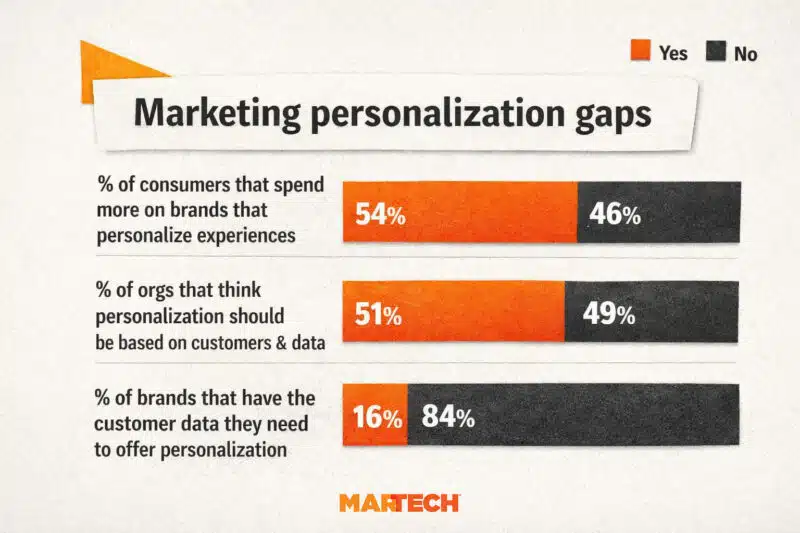
Despite these gaps, the upside is clear. Personalization improves ROI at every stage of the funnel, from cutting wasted ad spend during acquisition to increasing order value and supporting long term retention. When both conversion rates and average order value rise, the combined impact on revenue and return on ad spend can be significant.
The impact is not just theoretical. By using offline purchase data to deliver personalized product recommendations across omnichannel campaigns, a large grocery and retail group saw a 25% revenue increase within just five weeks and a 35% lift in revenue from recommendations (SAP).

Taken together, these statistics paint a clear picture. Organizations prioritize personalization in theory, however execution at scale remains complex, and there is still significant untapped potential.
These figures below give you the evidence needed to advocate for more effective personalization.
Dig deeper: Why context matters as much as data in personalization
Website content personalization statistics
Website personalization turns a static page into a dynamic experience. Every visitor arrives with context: where they came from, what they searched, and what they have seen before. That data shapes what they see next.
Content, navigation, CTAs, and offers can all adapt in real time. Signals like IP location, referral source, CRM data, and browsing behavior drive these changes. The result is a site that feels relevant to each visitor rather than built for everyone at once. The stats below show how personalizing webpage content can improve metrics.
- “Personalized call-to-actions perform 202% better than basic CTAs” (Hubspot)
- One brand found that using marketing automation tools to support dynamic message personalization on their website netted a 1.3x uplift in conversions (Braze)
- By optimizing its mobile homepage with personalization, an automotive brand saw a 166% increase in test drive applications (Insider One)
- 29% of marketers say personalized landing pages are among the most impactful touchpoints (Ascend2)
Recommended Articles


Product and ecommerce personalization statistics
Product recommendations are now a baseline expectation for online shoppers. Browsing history, past purchases, and engagement signals tell brands what a customer is likely to want next. The gap between a generic catalog and a personalized one is measured in revenue.
Similarity modeling and inferred intent take recommendations further. Digital and physical products alike can be surfaced at the right moment in the right context. The data below shows the results of ecommerce personalization.
- An online eyewear retailer serving personalized recommendations powered by deep learning algorithms saw a 68% uplift in purchases and an 88% increase in revenue from one widget (Dynamic Yield)
- One study showed that “personalized recommendations were 2.2x as effective as generic ‘best selling’ recommendations” (Barilliance)
- After segmenting visitors by behavior and tailoring on-site recommendations and content accordingly, an online home improvement retailer saw purchases completed from recommendations increase by 89% (Dynamic Yield)
- Adding personalization for product recommendations and mobile menus gave e.l.f. “a 4.2% increase in average revenue per user,” “a 17.6% uplift in customer engagement,” and an 8.5x return on investment (Dynamic Yield)
- 84% of consumers say “special discount offers or bundles have a medium or high influence on their purchase decisions” (Deloitte)
- 69% of consumers are satisfied with the personalized product recommendations provided by brands (Emarsys)
Web, mobile apps, and SaaS personalization statistics
Web and mobile app personalization adapts the product itself, not just the marketing around it. Features, dashboards, and workflows can shift based on user role, behavior, or subscription tier. The product a new user sees is not the product a power user sees.
In-app UI, content feeds, and notifications adjust based on usage patterns, device signals, and lifecycle stage. Personalization at this level reduces friction and increases retention. The data below shows how much it moves the needle.
- 57% of consumers want to access personalized customer support via a mobile app (Deloitte)
- 44% of customers say personalized messages encourage them to use a brand’s mobile app more frequently (Emarsys)
- When users switched from a social media app’s highly personalized feed to a less personalized feed for one week, average daily screen time on the app decreased by 40 minutes and app opening frequency dropped by five times per day (ScienceDirect)
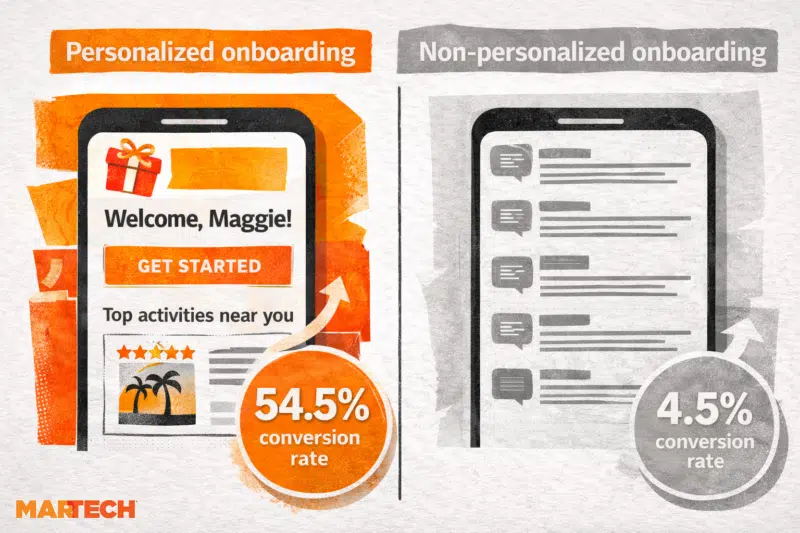
- In one case study, customers who completed a guided, personalized onboarding experience converted at 54.4%, compared to only 4.5% for those who didn’t engage with the in-app guides (Pendio)
SMS, text message and push notification personalization statistics
Personalized SMS and push notifications deliver messages when and where attention is highest. These channels carry some of the strongest engagement metrics in mobile marketing. Timing and context are everything.
Brands can trigger messages based on location, behavior, preferences, or inactivity. Each signal is an opportunity to move a customer closer to conversion. The statistics below show how personalization transforms these channels from interruptions into meaningful interactions.
- After unifying its messaging channels and using real-time customer data to deliver personalized, location-aware campaigns across email, SMS, push, and in-app, a national coffee chain saw a 230% increase in ROI from CRM campaigns (Braze)
- 86% of consumers now opt in to text messages — a 20% jump since 2021 — showing that audiences expect fast, personalized communication (EZTexing)
- One top reason consumers unsubscribe is messages that lack relevance (14%) (SimpleTexting)
- Delivering personalized messages is the most powerful way brands can increase notification open rates, driving an average lift of 37% (Airship)
- Effectively leveraging zero-party data for audience targeting can lead to a 91% increase in purchases attributed to push notifications (Airship)
- 96% of consumers “say they’re likely to purchase when brands send personalized messages” (Attentive)
- 16% of marketers say SMS is among the most impactful channels for personalization (Ascend2)
- 63% of consumers say relevant content encourages them to allow mobile app notifications (Emarsys)
Email marketing personalization statistics
Email remains one of the highest-leverage channels for personalization. Subject lines, send times, and dynamic content can all be tailored to the individual. Name, past purchases, browsing behavior, and declared preferences are the inputs that make it work.
The gap between a generic blast and a personalized email is measurable. Open rates, click rates, and conversions all respond to relevance. The statistics below show exactly how much personalization moves each metric.
- 71% of consumers say personalization influences whether they engage with marketing emails (Dynamic Yield)
- In North America, 75% of consumers say the email content they receive doesn’t feel personalized to them (Dynamic Yield)
- A majority of consumers feel email personalization falls short, with 63% in North America saying product recommendations lack relevance, while 55% worldwide want more targeted promotions and discounts, and 37% specifically want more personalized product recommendations (Dynamic Yield)
- Emails “personalized with dynamic content earned 17% higher average click rates and 40% higher average order conversion rates” than non-personalized messages (Klaviyo)
- One study showed that segmented email campaigns performed markedly better across metrics, by achieving 14.31% higher open rates and 100.95% higher click-through rates than non-segmented ones (Mailchimp)
- A personalized email campaign that digitally imprinted recipients’ company names on a product image nearly doubled revenue per thousand emails sent (from just over $10 to nearly $20), drove 85% more orders, and saw a 7% lift in average order value compared to the non-personalized version (Email Optimization Shop)
- Emails with personalized subject lines achieved an average open rate of 35.69%, more than double the 16.67% open rate of non-personalized subject lines (Klenty)

Advertising personalization statistics
Personalized advertising matches the message to the moment. Demographics, interests, location, and funnel stage all inform what a user sees. The result is spend that works harder and waste that shrinks.
Retargeting data and lookalike audiences take targeting further. Brands can re-engage past visitors or reach new ones who behave like their best customers. The statistics below show what personalized advertising delivers at scale.
- 15% of marketers say paid social is among the most impactful channels for personalization, and 13% say the same about paid search (Ascend2)
- Using dynamic creative optimization to personalize video ad content based on audience segments, time of day, and weather signals, a brand achieved a 2.4x better click-through rate than benchmark, a 4.3x increase in campaign click-throughs, and a 79% decrease in cost per click (Innovid)
- Dynamic creative optimization enabled a consumer health company to build and deploy personalized ad experiences across video and display at scale, resulting in a 94% increase in video click-through rate versus brand benchmarks and a 12% improvement in spend efficiency (Innovid)
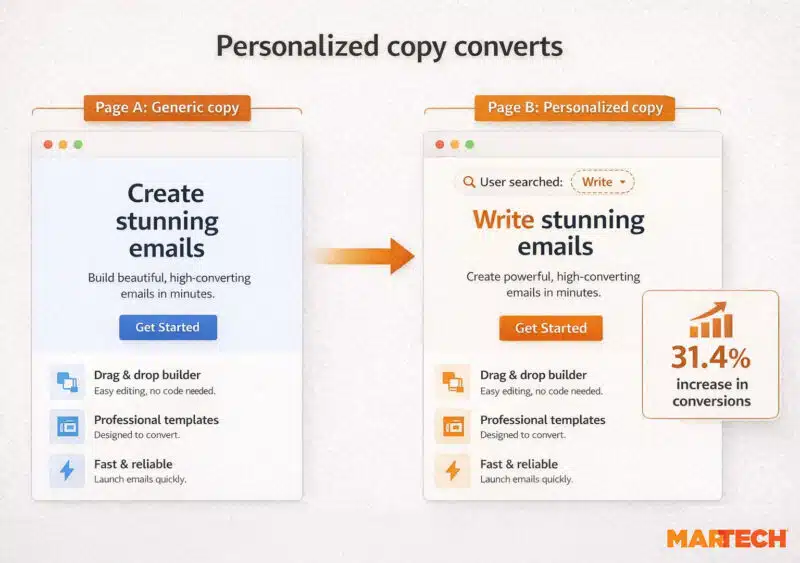
- By dynamically matching landing page copy to the exact verb used in a visitor’s search query, an email marketing platform saw a remarkable 31.4% increase in conversions, with signups for its software trial significantly outperforming the original (Unbounce)
AI-powered personalization statistics
AI has changed what personalization can do. Machine learning models predict intent, content, and next-best action without fixed rules or manual segments. The experience optimizes itself continuously.
Track, optimize, and win in Google and AI search from one platform.
Real-time and historical data across channels power these decisions. Timing, offers, and content all adjust based on what the model learns. The statistics below show what that level of precision produces.
- Using AI-powered product recommendations and personalized suggestions, a high-end jewelry brand specializing in custom-designed pieces achieved a 30% increase in online sales and a 25% reduction in cart abandonment (Diginyze)
- A large retail chain partnered implemented AI-powered personalization and a hybrid recommender system across its wine segment, resulting in a 4x increase in email click-through rates and a 92% reduction in content curation costs (WNS)
- Using AI to deliver one-to-one email personalization at scale, a CRM platform’s demand gen team achieved an 82% increase in conversion rates, 30% improvement in open rates, and over 50% increase in click-through rates (HubSpot)
- An online luxury retailer, used AI-powered recommendations and personalized triggered campaigns to drive a 35% increase in purchase conversion rates and a 7% increase in add-to-cart rates (Braze)
- Leveraging AI-powered personalization tools, a major insurance provider reached nearly 14 million prospects and converted more than 1.3 million of them into known customers through targeted paid search and personalized web experiences (Salesforce)
- 25% of consumers want brands to use AI to make the shopping recommendations more personal (Emarsys)
- Over 70% of brands say AI adoption will fundamentally reshape personalization and marketing strategies (Twilio)
- 98% of marketers expect AI and machine learning to impact data-driven personalization (ICUC Social)
Dig deeper: AI’s personalization magic starts with the data you can’t see
Omnichannel personalization statistics
Omnichannel personalization connects every touchpoint into a single experience. Web, apps, email, ads, chat, and in-store interactions all draw from the same customer data. The result is a journey that feels continuous rather than fragmented.
Shared data and real-time context make coordination possible. A customer is recognized and responded to consistently, regardless of where they engage. The statistics below show what becomes possible when the experience holds together across channels.
- By unifying its customer data and replacing coupon-based campaigns with personalized omnichannel experiences across its website, app, email, push notifications, and SMS, a fast-growing fashion brand achieved a 25% increase in customer lifetime value and a 72x ROI in 12 months (Insider One)
- An international online broker with over one million customers implemented an omnichannel messaging strategy using personalized web and mobile push notifications and in-app messaging, resulting in a 12% increase in conversions to real account registrations and a 16% jump in signups for educational webinars (Pushwoosh)
- Using generative AI to personalize messaging across email, SMS, and Facebook, a crafts and home décor retailer scaled email personalization from 20% to 95% of campaigns, driving a 25% CTR increase on email and a 41% increase on SMS (Persado)
- An established sports brand used personalized, behavior-based omnichannel messaging to re-engage cart abandoners and target shoppers with price drop alerts across email, web push, and onsite channels, achieving a 49x ROI in eight weeks and a 700% lift in customer acquisition (Insider One)
- Companies that are able to personalize the customer experience across physical and digital channels — omnichannel personalization — “can achieve a 5 to 15 percent revenue increase across the full customer base” (McKinsey)
- 66% of consumers say personalized, frequent, and relevant communications across channels increase their loyalty and purchasing frequency (Emarsys)
Miscellaneous personalization statistics
Not every personalization statistic fits neatly within a specific channel or tactic. Some reflect broader shifts in consumer expectations, emerging technologies, or cross-channel behavior that influences how brands approach personalized marketing. The data below highlights additional insights shaping personalization strategies across industries.
- “Companies with faster growth rates derive 40 percent more of their revenue from personalization than their slower growing counterparts” (McKinsey)
- 23% of global consumers are “more loyal to brands offering the best personalized deals” (Emarsys)
- “57% of consumers say they’re willing to share personal data in exchange for personalized offers or discounts, and 62% say it’s acceptable for companies to send personalized offers or discounts based on items they’ve already purchased” (Salesforce Retail)
Personalization in the age of AI discovery
Personalization now extends beyond owned platforms into AI-driven discovery environments, where customers compare options and form perceptions before ever reaching a brand’s website. This creates a new strategic priority: understanding how AI-generated responses represent your brand and how competitive your presence is within them.
Semrush Enterprise AIO supports this direction by tracking brand mentions and citations across LLMs, monitoring competitor visibility, and connecting AI search presence to traffic and revenue data.
Its AI Visibility Research feature surfaces emerging prompts and user behaviors, giving marketers a clearer picture of what their audience is asking and searching for across AI platforms. Those insights can directly inform personalization strategy, ensuring the content and messaging brands invest in is aligned with how customers are actually discovering them.
For teams investing in personalization, this is the next frontier: ensuring relevance extends into the systems that now shape customer discovery.