

Agentic AI use cases: 24 examples from marketing to IT
See how agentic AI can scale, automate, and optimize workflows across marketing, sales, IT, and compliance with 24 real-world use cases.
You already use AI-powered tools like ChatGPT or Gemini to generate drafts or analyze data. But you still have to manually log into your ad platform to adjust budgets or check IT systems to respond to security threats.
Agentic AI closes the gap between insights and action.
These systems take a defined goal, such as reducing customer churn, and act across connected tools to streamline data collection and take action. It monitors live signals, makes adjustments, and continues optimizing without waiting for another prompt.
In this guide, you’ll learn 24 real-world agentic AI use cases across marketing, digital performance, content lifecycle, revenue operations (RevOps), IT, and compliance.
How quickly are companies adopting agentic AI?
Nearly a quarter (23%) of organizations are actively scaling agentic AI systems, with another 39% experimenting with AI agents in at least one business area, according to McKinsey data.
But usage remains relatively limited. Fewer than 10% of respondents are scaling agentic AI in any individual business function.
The takeaway: Companies are testing and piloting agentic AI widely, but only a minority have moved into multi-function, scaled deployments.
However, adoption will likely increase with time. By 2028, Gartner predicts that 60% of brands will use agentic AI for streamlined one-to-one interactions.

What agentic AI actually means and why it’s different
Agentic AI is an autonomous, goal-driven framework that can plan actions, execute tasks across tools, evaluate results, and adjust its approach over time without constant human input. An agentic AI system:
- Breaks a goal into steps
- Executes those steps across connected systems (customer relationship management (CRM) tools, ad platforms, analytics tools, etc.)
- Measures results against the goal
- Adjusts decisions based on new data
You may have seen terms like agentic AI, rule-based automation, single-task AI, or AI agents used interchangeably. However, they aren’t the same.
Let’s look at how agentic AI differs from all these terms:
| AI technology | What this is | How agentic AI is different |
| Rules-based automation | Fixed if/then workflows that execute the same steps when conditions are met | Agentic AI adapts its decision-making based on new inputs, changing goals, and evolving context instead of following static logic. |
| Single-task AI | Large language models (LLMs), generative AI, copilots, and other systems that generate text, code, or recommendations in response to a prompt | Agentic AI acts across systems and time. It autonomously initiates actions, retrieves data, updates tools, and reevaluates results. |
| AI agent | Individual autonomous system that completes a defined workflow | Agentic AI uses a multi-agent approach, coordinating multiple agents toward a broader objective, maintaining shared memory and iterative feedback loops. |
Recommended Articles



Benefits of agentic AI
Instead of adding more tools or more people, agentic AI improves how existing systems execute. Agentic AI:
- Scales without increasing headcount: Executes and optimizes workflows automatically, so teams can manage more campaigns, pipeline, or support requests without hiring additional staff
- Operates continuously: Monitors signals, detects issues, and takes corrective action 24/7 to reduce response time and prevent performance gaps
- Aligns teams across connected tools: Works across CRMs, ad platforms, analytics tools, and support systems so teams can coordinate effectively
- Reduces manual intervention: Handles monitoring, reporting, and adjustment tasks with minimal human oversight, allowing teams to focus on higher-impact initiatives
- Improves speed to optimization: Shortens the time between detecting a performance shift and acting on it
Dig deeper: 6 common agentic AI pitfalls and how to avoid them
Agentic AI use cases for marketing
Marketers can use agentic AI to improve revenue performance, increase search and paid visibility, and respond faster than competitors to market changes.

1. Autonomous campaign optimization
Agentic AI can automatically manage and optimize marketing campaigns to reach a defined performance goal.
You set a target, such as lowering cost per acquisition (CPA) or increasing return on ad spend (ROAS). The system monitors live performance signals across platforms — including conversion rates, audience performance, and budget pacing.
When campaign performance crosses certain thresholds, agentic AI adjusts bids, reallocates budgets, or shifts targeting. It continues testing and reallocating until performance stabilizes against the goal.
This changes how optimization cycles work. Instead of reviewing performance weekly and making batch adjustments, agentic AI acts continuously. This allows marketers to spend campaign budgets more efficiently across channels.
2. Market and demand sensing
Agentic AI can analyze external signals like search trends or social conversations to identify emerging customer interest and competitive movement.
This involves monitoring real-time signals across search engine results pages (SERPs), AI-generated answers, social conversations, product reviews, competitor content, and pricing changes.
Instead of relying only on historical performance data or forecasting from last quarter’s conversions or past campaign results, it detects patterns that signal rising demand before they fully appear in revenue reports.
For example, the system can connect signals like:
- Search volume for a specific feature rising
- Competitor messaging shifting toward a new value proposition
- Social mentions increasing around a related pain point
It can then alert your marketing team to focus on new content topics to align with the emerging demand. This helps you act before your competitors do, improving your go-to-market (GTM) timing.
3. Product recommendations
You can use agentic AI to decide which products to show each customer based on real-time behavior. The system analyzes browsing history, purchase patterns, cart activity, and engagement signals.
It then surfaces the products most likely to drive a conversion. As consumer behavior changes, recommendations automatically update across the website.
Say a customer repeatedly views a winter top but doesn’t purchase. The system may highlight similar tops at different price points or suggest complementary items like a matching necklace.

This personalized approach increases the chance of a conversion because the recommendations reflect the customer’s current intent instead of static logic. It also boosts revenue and average order value (AOV) when surfacing complementary items at the right moment.
Agentic AI use cases for digital and performance leadership
Digital and performance leaders can use agentic AI to improve how they measure marketing impact, allocate budgets, and validate results.

4. Adaptive attribution and measurement
Agentic AI can continuously recalculate how much each marketing channel contributes to a conversion as customer behavior changes. The system:
- Analyzes conversion paths in real time
- Reviews first-party tracking data
- Evaluates user interactions across channels
- Models customer journeys when privacy limits or tracking gaps limit visibility
Based on updated patterns, it adjusts how much credit each channel receives.
Suppose customers first discover a product through organic social but complete the purchase after a paid search click. The system recognizes both interactions instead of overvaluing only the final click.
This more accurately reflects how marketing efforts contribute to revenue, providing clarity into channel ROI. In turn, this can improve confidence in your marketing and advertising budget allocation.
5. Signal-based performance monitoring
Agentic AI helps you identify performance problems before they impact revenue. It watches for early shifts, tracking measurable signals like:
- A sudden drop in click-through rate (CTR) on a high-budget campaign
- Rising cost per click (CPC) without increased conversions
- A steady increase in cart abandonment
- A decline in demo bookings from a key traffic source
- A fall in rankings for high-intent keywords
These signals often appear days or weeks before revenue starts to decline.
When the system detects an unusual deviation, it identifies the source and either recommends or applies corrective actions. For example, it might adjust the budget, pause ads, or escalate the issue to the responsible team.
This saves time and revenue. Instead of reacting after revenue declines, you respond confidently when the first indicators begin to signal.
6. Personalized upselling
Instead of presenting the same upgrade offer to every customer, agentic AI analyzes real-time indicators like browsing activity, feature usage, purchase history, contract tier, and price sensitivity. Based on those signals, it decides:
- Which upgrade or add-on to offer
- When to present the offer
- Where to present it (website, email, in-app prompt, or retargeting ad)
Say a SaaS user repeatedly reaches their usage limit or exports reports at the maximum threshold. The system can trigger an in-product upgrade offer at the moment the customer reaches the limit.
Or suppose a customer compares premium features multiple times but doesn’t convert. Agentic AI may present a limited-time upgrade incentive via email.
The system tracks how users respond to each offer. If acceptance rates drop, it automatically adjusts timing, pricing, or messaging. This replaces static cross-sell rules with dynamic offers that reflect real intent. As a result, customers see relevant offers at the moment they’re most likely to convert
This creates multiple benefits:
- Conversion rates improve because the offer matches current behavior.
- AOV increases through relevant add-ons.
- Revenue grows without requiring constant manual segmentation or campaign adjustments.
The SEO toolkit you know, plus the AI visibility data you need.

Agentic AI use cases for marketing and revenue operations
Marketing operations (MOps) and RevOps teams can use agentic AI to scale process automation while maintaining consistency and protecting integrity.

7. Cross-platform workflow orchestration
Agentic AI coordinates how tasks and data move across your CRM, marketing automation platform (MAP), ad platforms, and analytics systems. It continuously monitors workflow triggers and data flows.
When a defined condition occurs, the system automatically executes the next step instead of waiting for manual intervention.
Agentic AI can work across platforms to:
- Route new leads to the correct sales queue based on territory or qualification score
- Trigger a nurture sequence when a CRM field changes
- Sync updated audience segments to ad platforms
- Track service level agreement (SLA) response times and flag overdue follow-ups
- Escalate stalled deals when deadlines pass
If a system connection fails, it retries the integration and alerts the responsible team. This increases execution speed because most tasks move forward without manual handoffs.
It improves consistency across teams and platforms because workflows follow the same defined logic. And it supports operational scalability since processes continue running reliably even as lead volume, campaigns, or system complexity grow.
8. Autonomous data hygiene and quality assurance
Agentic AI continuously monitors your data, continuously validating inputs and flagging changes. Instead of relying on periodic audits, it checks data quality in real time and intervenes when it identifies failures or inconsistencies.
It detects:
- Schema changes that rename or alter data fields
- Data drift that degrades performance
- Missing or malformed tracking parameters (UTMs)
- Duplicate records or mismatched IDs
- Pipeline failures between connected systems
When the system detects a problem, it can quarantine corrupted data, restore previous settings, or retry failed integrations. It also validates inputs and outputs before they reach dashboards or attribution models, preventing inaccurate reporting from propagating downstream.
This keeps your conversion tracking intact, so reports reflect real customer journeys. It also improves reporting trust because leadership can rely on stable, consistent datasets.
9. 24/7 sales outreach
Agentic AI can optimize sales outreach by connecting to CRM systems, email platforms, and website analytics tools. It monitors behavior like email opens, link clicks, pricing page visits, demo requests, and deal stage updates.
When intent increases, the system triggers the appropriate follow-up. When engagement slows, it adjusts timing, channels, or messaging. If an opportunity moves stages, it updates the outreach sequence automatically.
Because agentic AI reacts to live signals instead of scheduled batch workflows, its outreach feels timely and relevant:
- If someone visits your pricing page, they receive follow-up information about pricing.
- If they download a case study, they receive related proof points.
- If they stop engaging, the timing and messaging adjust.
This leads to more replies and keeps conversations active, instead of letting deals fade due to generic or poorly timed follow-ups.
10. Sales meeting preparation
To do sales meeting prep, agentic AI connects to CRM records, email threads, call transcripts, product usage data, support tickets, and competitive intelligence tools.
It then pulls information from these systems and consolidates it into a structured brief with:
- Stakeholder roles
- Recent engagement signals
- Open objections
- Competitor insights
- Contract history
- Tailored talking points aligned with the current deal stage
- Potential risks
This supports sales enablement, letting your team walk into the meeting with a clear, organized plan. Instead of spending time collecting data across accounts,background information, you focus on preparation: what questions to ask, which objections to address, and how to guide the conversation toward the next step in the sales process.
11. Creating close plans
Along the same lines, Agentic AI can help you set up a clear path to close each active opportunity. It analyzes deal stage, stakeholder engagement, pricing discussions, contract status, and historical win patterns to recommend next steps.
The system generates a structured close plan tailored to the account so your team doesn’t have to rely on scattered notes. It outlines required milestones, responsible stakeholders, and suggested actions based on similar successful deals.
Say if a deal is entering late-stage negotiation. Based on the data it collects, the system may recommend:
- Securing executive sponsorship before final pricing discussions
- Addressing unresolved legal clauses before procurement review
- Aligning on implementation timelines to remove operational objections
It also monitors your progress and updates the plan as conditions change.
This brings much-needed structure and reliability to RevOps. Instead of reacting to tasks, you follow a coordinated, data-informed path to move the opportunity toward closed-won.
12. Team communications
An Agentic AI system can automate internal updates, summaries, and task routing by connecting directly to your CRM, marketing platforms, project management tools, and communication systems.
It listens for specific events — like a deal changing stage or a campaign missing a performance target.
When one of these events occurs, the system extracts relevant account data, performance metrics, and recent activity logs. It then generates a summary explaining what changed, why it matters, and what action to take next.
Then, the system automatically communicates the summary to the appropriate person through Slack, email, or your task management system. It also assigns follow-up tasks.
Say a high-value deal moves into the negotiation stage. The system can notify legal and finance with a brief outlining the account context and next steps. This eliminates manual status tracking and improves operational efficiency.
13. Autonomous customer service
Agentic AI can manage customer inquiries from intake to resolution within your existing support workflow. It connects to your ticketing system, CRM, billing platform, and knowledge base to process requests automatically.
When a customer submits a ticket, the system identifies the issue, triages it, retrieves account data, and determines whether the request matches a predefined service scenario. If it does, the AI executes the resolution directly. That may include:
- Sending an automated response with relevant information
- Resetting credentials after verifying identity
- Generating and sending invoice copies
- Issuing refunds within approved policy limits
- Updating account permissions
If the request falls outside defined rules — like a billing dispute that exceeds refund thresholds — the system routes the case to the appropriate human agent with full transaction history and summarized context attached.
This shortens response times for routine issues. It also frees up human agents to focus on more complex customer support and service issues.
Agentic AI use cases for content and lifecycle operations
Agentic AI can improve content distribution and personalization across the customer lifecycle.

14. Modular content assembly
Agentic AI dynamically assembles content by selecting and combining reusable content blocks based on user intent, industry, lifecycle stage, and behavior.
Instead of creating separate versions of every asset, it stores structured components like headlines, value propositions, product descriptions, proof points, case studies, compliance notes, and calls to action (CTAs).
When a user accesses the content, the AI selects the appropriate blocks and builds a tailored version in real time. It can generate variations across web pages, email campaigns, in-app messages, and paid ads.
For example, a B2B software company targeting healthcare, finance, and ecommerce audiences can maintain a single modular content library.
When a healthcare prospect visits the company’s website, the system assembles industry-specific messaging, relevant case studies, and compliance language. When a finance lead arrives, it automatically swaps in financial proof points and security-focused positioning.
This approach:
- Encourages content reuse because teams work from structured building blocks instead of recreating full pages
- Improves speed-to-market because updates are made once and reflected everywhere
- Enables personalization at scale by adapting messaging across channels without manual rework
15. Autonomous lifecycle and journey management
Agentic AI manages how customers enter, move through, and exit your marketing journeys based on their own engagement signals. Instead of locking users into fixed sequences, it dynamically adjusts timing, sequencing, and messaging.
It connects to your CRM and continuously evaluates engagement signals — like email opens, clicks, website visits, product usage, purchases, inactivity, and churn risk — against defined thresholds and business goals.
When patterns shift, it updates journey logic automatically. For example:
- If engagement drops, it reduces message frequency.
- If purchase intent increases, it shifts the user to a conversion-focused sequence.
- If signs of fatigue appear, it temporarily pauses messaging.
- If a customer converts, it removes them from promotional flows and moves them into onboarding or upsell tracks.
Customers receive more relevant messaging that matches their current intent and stage. This improves engagement quality, which naturally increases conversion rates.
Over time, agentic AI creates a more consistent customer experience across channels, with timely messaging and offers guiding them toward conversions.
16. Intelligent document processing
Agentic AI can ingest documents automatically, extract essential information, and trigger the next operational step without manual oversight.
For example, your organization might regularly process documents like:
- Contracts
- Invoices
- Onboarding forms
- Compliance reports
- Support attachments
- Customer submissions
Some of these documents are structured with labeled fields. Others are free-text PDFs or scanned files that would usually require manual input.
Agentic AI parses these documents using pattern recognition and natural language understanding. It identifies key fields, validates them against existing records, and updates connected systems such as CRM tools or enterprise resource planning (ERP) platforms.
It then triggers downstream workflows, which may include approving requests or activating a billing cycle.
Suppose a new customer signs a contract. The system extracts the contract value, renewal date, and term length; updates the CRM automatically; and notifies finance of the activation date.
Instead of copying data from documents into systems by hand, information moves directly from the document into the correct workflow. This reduces manual errors and speeds up the time between receiving a document and triggering the next workflow.
Agentic AI use cases for IT and data engineering
IT professionals and data engineers can use agentic AI to automate infrastructure decisions, improving reliability, security, and scalability.

17. AI-led stack integration and monitoring
You can use agentic AI to monitor and manage the connections between tools in your tech stack.
Most organizations rely on APIs to connect these tools and move data continuously between systems. But if an API fails or times out, downstream processes may fail.
To prevent these issues, agentic AI monitors API health in real time. It tracks whether:
- APIs respond within normal latency ranges
- Requests fail or retry at an abnormal rate
- Data formats change after a system update
- Fields stop mapping correctly between systems
When it detects an integration failure, it can:
- Retry failed API calls
- Throttle or queue traffic to prevent overload
- Normalize unexpected data formats
- Alert engineering teams with precise diagnostics
Say an API call from your billing platform starts returning incomplete payloads. The system can detect the anomaly, retry the request, and prevent partial data from being written into your CRM. If latency spikes across a marketing automation API, it can queue requests to avoid cascading failures.
By monitoring API health and validating data flows continuously, agentic AI increases system resilience and adaptability, making integrations more reliable. That means engineering teams spend less time troubleshooting sync issues and more time improving architecture, which reduces operational overhead.
18. Data pipeline optimization
An agentic AI system can monitor how your data pipeline performs in real time. By connecting to your data sources, such as your data warehouse and cloud environment, it evaluates performance metrics against standard ranges.
It tracks:
- Ingestion rates from source systems
- Transformation job execution time
- Query latency in the data warehouse
- Storage growth and compute usage
Based on those signals, it adjusts data pipeline behavior. It increases compute when query demand rises and reduces batch frequency during low-usage periods. If latency crosses a defined threshold, it reallocates resources automatically.
If you launch a campaign and dashboard traffic doubles, the system can scale compute capacity to prevent reporting delays. When usage stabilizes, it can scale resources down to control unnecessary spending.
As a result:
- Infrastructure costs remain controlled because resources aren’t over-provisioned
- Data remains available during high-demand periods
- Analytics performance stays stable even as usage patterns change
19. Real-time cybersecurity threat mitigation
You can rely on Agentic AI to monitor your tech stack and detect and contain security threats before they cause downtime or disrupt daily operations.
It analyzes live signals across your infrastructure, including:
- Login attempts and spikes in failed authentication
- Access from unusual locations or unfamiliar devices
- Sudden privilege escalations
- Large or abnormal data transfers
- Activity that deviates from a user’s normal behavior pattern
When behavior crosses a defined risk threshold, the system acts immediately depending on the situation.
Say your employee logs in from a new country and attempts to download large volumes of sensitive data within minutes. The system can suspend access and alert the security team before the data leaves the environment.
This agentic approach reduces the time between detecting a threat and stopping it. Because actions follow predefined security policies, responses stay consistent across systems and access controls.
You don’t have to wait for a cybersecurity team member to review alerts. Instead, the system acts immediately when it detects risk.
20. Summarizing similar cases
Agentic AI aggregates historical deal and case data across systems surfacing relevant past examples when a new situation arises.
The system connects to CRM records, support tickets, contracts, call transcripts, billing history, and internal documents. It consolidates relevant information and analyzes patterns across attributes like industry, deal size, product mix, objection type, contract terms, or resolution path.
When a new deal, dispute, or customer satisfaction issue appears, the system retrieves comparable past cases and summarizes actions and resolutions.
Suppose your sales team encounters a pricing objection from a mid-market healthcare client. The system can surface previous healthcare deals with similar objections, revealing pricing structure to help your team close the deal.
Because agentic AI aggregates data across platforms, it surfaces relevant history instantly. This saves time and helps your team close deals or achieve resolutions faster.
21. IT helpdesk automation
An agentic AI system can automatically handle routine internal IT tickets, including password resets, access requests, and common troubleshooting tasks.
When a team member submits a ticket, the system reads the incoming request, identifies the intent, verifies user identity and permissions, and executes the appropriate action. It can reset credentials, grant or revoke access, or guide the user through troubleshooting steps.
If the issue involves unusual behavior or incomplete information, it escalates to a person for human intervention.
This reduces the volume of repetitive tickets IT teams have to process manually. Because routine issues are resolved faster, response queues shrink. Technical staff can focus on more complex infrastructure and security work instead of handling basic requests.
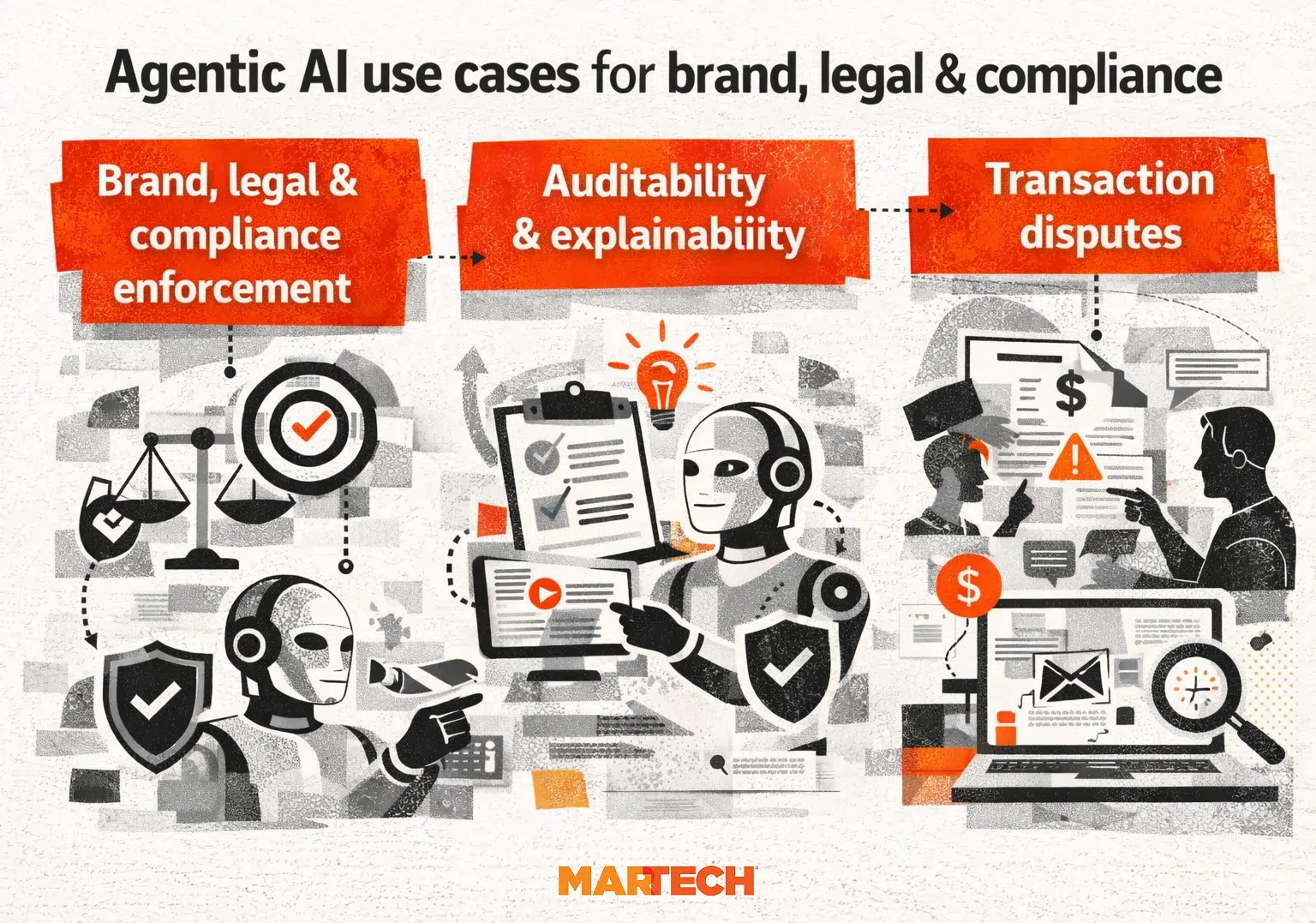
Agentic AI use cases for brand, legal and compliance
Agentic AI strengthens governance by enforcing policies, maintaining audit trails, and reducing regulatory risk across marketing and operational workflows.
22. Brand, legal and compliance enforcement
Agentic AI can review your content and campaigns automatically before they go live to ensure they meet brand guidelines, regulatory requirements, and compliance guardrails.
It reviews assets against predefined standards, including:
- Brand tone and voice guidelines
- Required disclosures and disclaimers
- Restricted product claims
- Pricing transparency rules
- Industry-specific regulatory language
If it detects a violation, the system can:
- Block publication
- Flag the issue with a clear explanation
- Route the asset to the appropriate reviewer
Say a financial services campaign omits a required disclosure. An agentic AI system can identify the missing language and prevent the ad from going live.
This reduces compliance risk and protects brand consistency without relying entirely on manual approval workflows. It also limits regulatory exposure, effectively reducing risk.
23. Auditability and explainability
Agentic AI logs every decision it makes and every action it takes so your organization can trace, review, and, if necessary, reverse decisions.
When the system executes an action, it records the data inputs that informed the decision, the rules or thresholds it considered, and the exact outcome. It also logs timestamps, system access events, user permissions, and any configuration changes.
For example, if a campaign is blocked due to a compliance issue, the system stores the:
- Specific language that triggered the violation
- Policy rule it applied
- Reason it restricted the asset
This improves transparency and builds trust in AI-driven workflows. It can also strengthen governance practices and increase organizational accountability.
24. Transaction disputes
When a customer questions a contract term or any aspect of the transaction, agentic AI can automatically retrieve and validate transaction logs, payment records, contract clauses, email history, and prior case notes.
Say a customer disputes a renewal charge. An agentic AI system can pull the signed contract, renewal notice history, payment confirmation, and related communications. Then, it can identify whether your organization met the notice requirements and if the charge aligns with the agreed terms.
This reduces investigation and resolution time. It also increases policy adherence and reduces risk since agentic AI evaluates disputes against relevant terms every time.
Operationalize agentic AI
Begin deploying agentic AI in areas that directly affect revenue: campaign optimization, attribution, lifecycle management, or sales execution. Then, build the monitoring and governance layer that keeps those systems transparent and accountable as they scale.
Track, optimize, and win in Google and AI search from one platform.
If you’re ready to move from testing AI tools to rolling out agentic AI across your organization, explore Semrush Enterprise AIO.
This enterprise platform provides visibility into market signals, performance shifts, cross-channel data, and AI-driven workflows so you can operationalize agentic AI without losing control over measurement or governance.
New on MarTech