

How to rank for SaaS in AI search
Want more AI-driven leads? Learn how SaaS brands can influence AI recommendations, improve sentiment, and increase visibility across leading LLMs.
AI chat is the number one source B2B buyers use to shortlist software. Not review sites. Not vendor websites. Not salespeople. AI chat. SaaS buyers are “one-shotting” their research with prompts like “Give me CRM solutions for a large gym that work on iPads.”
If your product doesn’t show up when buyers ask AI to recommend solutions in your category, you’re losing deals before they begin.
This guide shows you exactly how to change that. We’ll walk you through:
- How AI visibility works for SaaS
- Why some brands dominate AI answers
- What you can do to make sure AI recommends you
The SEO toolkit you know, plus the AI visibility data you need.

The 3 types of AI visibility for SaaS brands
There are three ways your brand can show up in AI search:
- Brand mentions
- Citations
- Recommendations

Type 1: Brand mentions
Brand mentions mean your brand appears in the AI’s answer. It’s not always an endorsement. It’s simply the AI recognizing your brand as relevant to the topic.
For example, when asking ChatGPT, “How can remote teams stay aligned on projects?” ChatGPT outlines a few tactics and lists several tools, naming specific brands as examples with no extra context about any of them:

At this level, how AI talks about your brand is super important. A positive tone builds early trust while a negative one sets bad expectations.
For example, asking ChatGPT, “What do marketers on Reddit say about top reporting dashboards” results in ChatGPT summarizing Reddit’s discussions, listing a few tools, and including criticisms about some products.

If you were evaluating dashboards, the negative details about AgencyAnalytics and Looker Studio would create a subtle bias and negative brand sentiment that would follow you as you continued your research.
How do you make sure sentiment around your mentions leans positive? Easy. Use Semrush AI Visibility Toolkit.
Just go to “AI Visibility” > “Perception” and you’ll see key sentiment drivers surrounding your brand. The tool will show you Brand Strength Factors (positive influence on sentiment) and Areas for Improvement (negative sentiment factors).

Type 2: Citations
Citations are instances of AI using your content as a source. It’s a strong signal that the AI trusts your brand and is using your content to build its answer. In Google AI Mode, citations show up as clickable links on the right-hand side of the response.
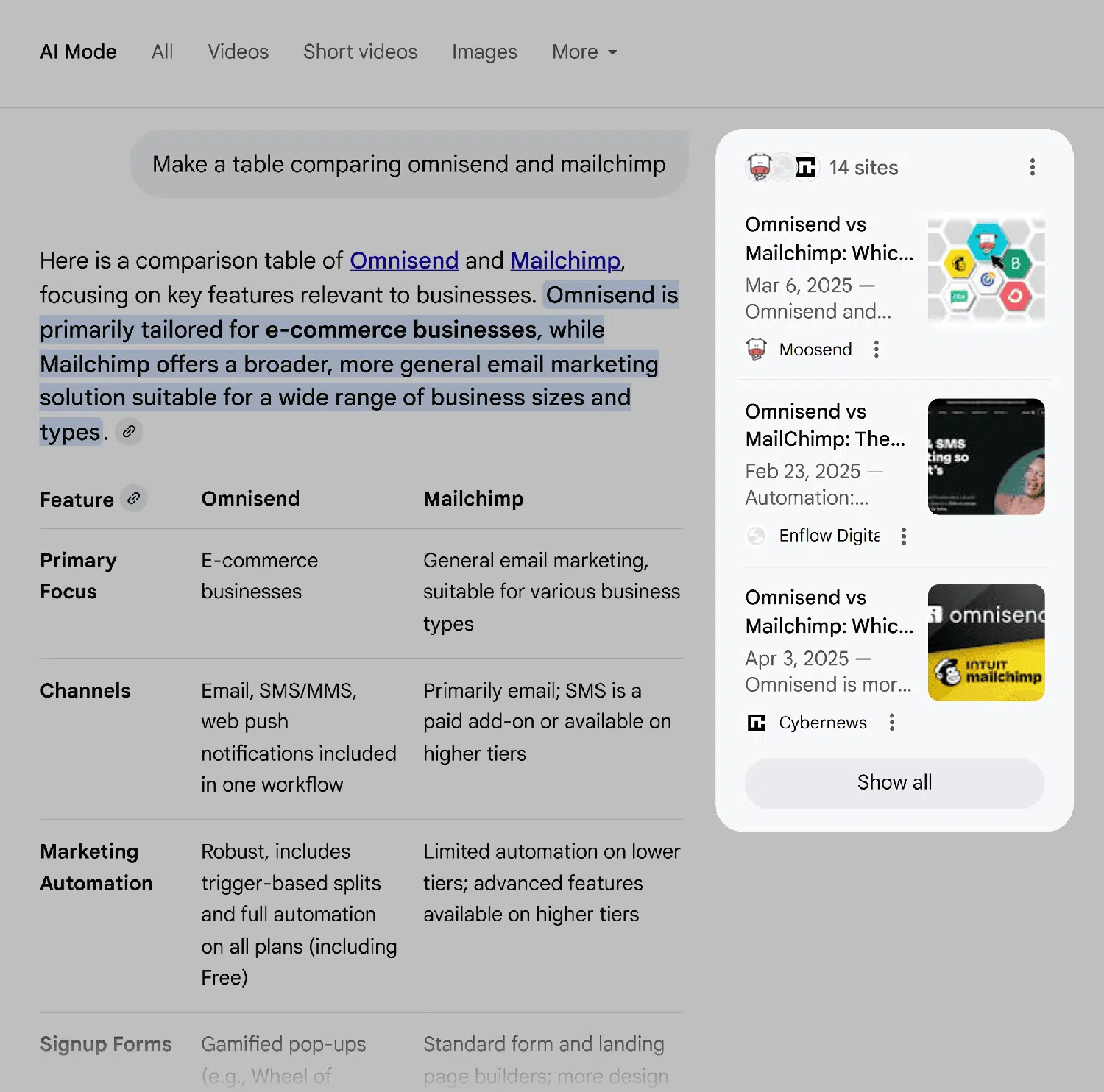
In ChatGPT, they appear as footnotes or small inline links.

Citations come with two complications.
- They’re not as visible as brand mentions. The footnote-style links are easy to miss, which means you probably won’t get meaningful traffic from these citations.
- Second, citations don’t always create brand awareness. The AI can use your content, but not mention your brand.
Semrush’s AI Visibility Index report calls this the “Zapier Paradox.”
In the Google AI Mode dataset, Zapier was the most-cited domain in the entire software category. It appeared in around 21% of the analyzed prompts.

Yet it ranked only #44 for brand mentions. That means the AI trusts Zapier’s content enough to use it constantly. But that trust hasn’t translated into more visibility for the brand itself.
That doesn’t mean citations are useless. Far from it, since they’re still the only method of sending users directly from AI search to your website.
But if you’re cited for an answer that recommends other brands (like Zapier often is), the citation isn’t super useful for your brand.
That’s why you want the third type of AI visibility.
Type 3: Product recommendations
Product recommendations are where the AI moves from “here are some options” to “here’s what you should choose.”
To get recommended, your brand typically needs two things working in your favor:
- Positive sentiment
- Enough verified facts for the AI to feel confident putting your name forward
For example, the prompt, “Which CRM is best for small businesses?” results in ChatGPT recommending six CRM platforms:
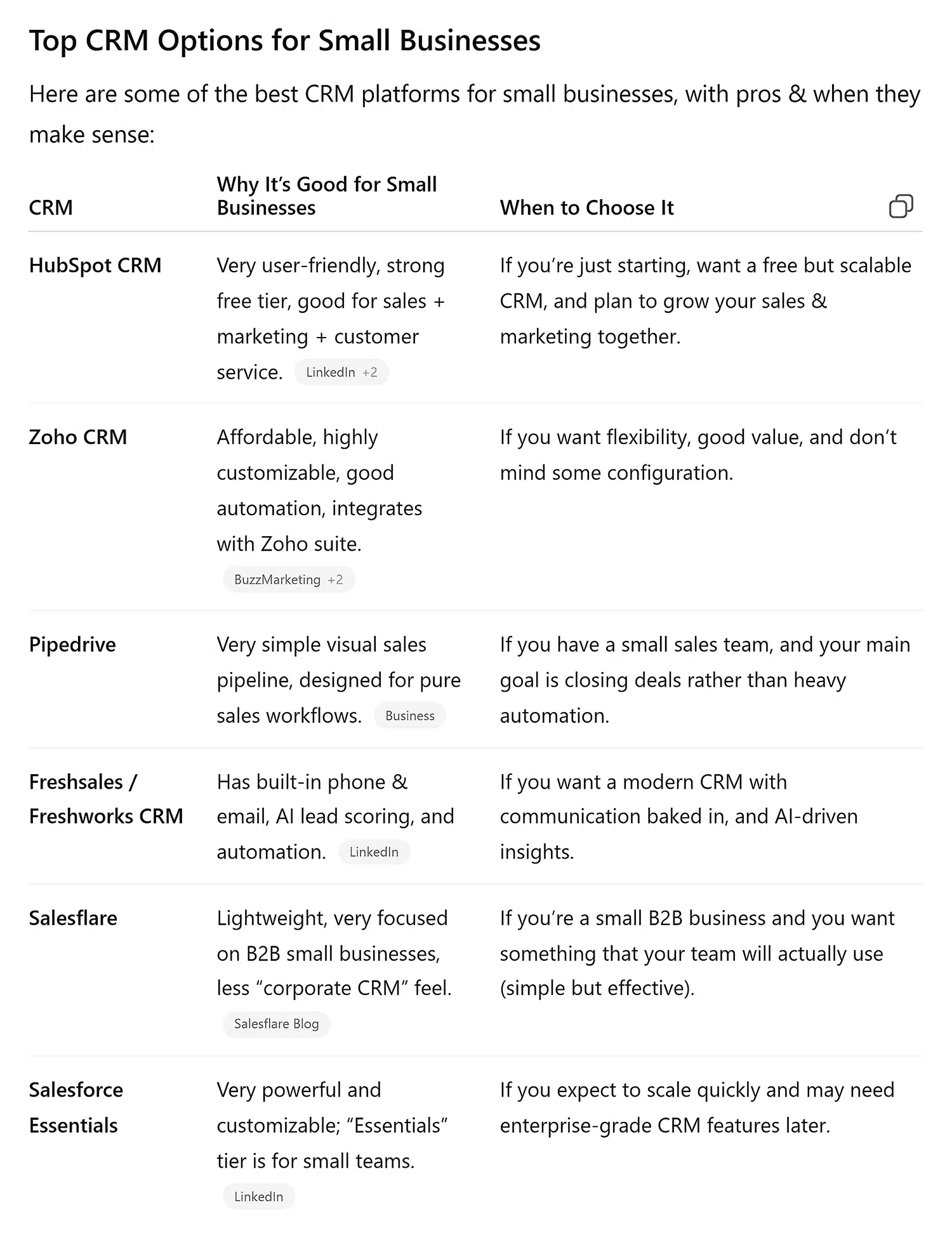
Each one shows a breakdown of strengths.
That’s the AI directly influencing your consideration set. And when the AI wraps up the answer with the top three CRMs, these three brands stay top of mind.

As the reader, you might be thinking, “Alrighty. These are the tools I should probably compare.” That’s the power of SaaS product recommendations in AI search.
The AI isn’t just helping your prospects explore the category. It’s shaping the shortlist they walk away with.
How AI models choose which SaaS brands to surface
When AI answers a query, it cross-checks sources. It compares what you say about your product with its training data. Along with what the rest of the internet says about you. If the details line up, you’ve got consensus and consistency: two forces that drive visibility in AI search.
Consensus
Consensus happens when many credible places describe your product in the same way.
In practice, the AI is looking for alignment across sources like:
- Review sites (G2, Capterra, TrustRadius)
- Industry blogs and SaaS publishers
- Expert posts on LinkedIn or in public newsletters
- User communities like Reddit and Quora
- Your own website and documentation
Basically: anywhere your product is being talked about in a credible context.

Take Asana, for example. It routinely appears in AI answers about project management tools.And you can see why when you look at its footprint online. Across multiple places, you’ll find the same core description repeated from their website to Capterra to Reddit.

All of these brand mentions alone help boost Asana’s potential visibility.
But when they also all point to the same story, that’s consensus. This helps AI feel confident surfacing the brand repeatedly.
Consistency
Consistency means the details match everywhere they appear.
When AI scans the web, it’s looking for verifiable facts. If those specifics line up, it trusts them. But, if those signals don’t match, the model becomes unsure, just as you would if five people gave you five different versions of the same “fact.”
For example, let’s say:
- Your pricing page says your Standard plan includes unlimited reports
- Your help center says Standard users get 50 reports a month
- Recent reviews say they hit limits after a week
Now you’ve got three conflicting stories.
When the AI sees that, it can’t tell which one is true. It might use the right one, or it might use the wrong one. Or it might not use any of them.
That’s why data hygiene matters in AI search. The key facts about your brand should be consistent everywhere your brand is described.

Recommended Articles


The content that dominates SaaS AI search
Not all content carries the same weight in SaaS AI search. Some formats show up repeatedly because they help models verify what’s true about a product.
Review platforms
Review platforms are some of the most heavily cited sources in SaaS AI search.

These sites, including G2, Capterra, and TrustRadius, give AI unfiltered, third-party proof about your product. The platforms help the model validate:
- Who you are
- What your product actually does
- How reliable it is
- How users feel about it
In other words, this is where AI goes to separate your claims from real user experience.
And the data shows how influential they are. According to Semrush’s AI Visibility Index, G2 is the 4th most-cited source for ChatGPT and 6th for Google AI Mode across the entire tech and SaaS category.

That tells us that review platforms aren’t just buyer research hubs, they’re part of an AI’s verification layer. What people say about you in these places becomes part of the material the AI uses when describing your brand.
Community and user-generated content (UGC)
Community conversations are another major source LLMs lean on in SaaS AI search. They cite from places like:
- Quora
- Industry forum threads
- Product community boards
- Niche groups where users compare experiences
For example, after asking ChatGPT, “Why do people switch from ActiveCampaign to Klaviyo?” ChatGPT cited two Reddit threads in its answer:

That’s why your presence in these community spaces matters. Not in a “go spam Reddit” way. But in a “be part of the conversations that shape how people talk about your product” way.
Because those public, unscripted conversations can become part of your brand’s source of truth inside LLMs.
Further reading: Marketing on Reddit: What you need to know
Best-of listicles and tool roundups
Best-of listicles and tool roundups give LLMs structured, pre-sorted information that they can easily digest. These articles hand the AI a ready-made map of a category, including:
- Who the key players are
- How the tools differ
- Which products consistently show up together
The AI regularly pulls from a mix of major publishers, niche SaaS blogs, and established industry media.
For example, when asked for the top AI SEO tools, Google AI Mode’s citations included a bunch of best lists:

Every roundup, comparison post, or “best tools for X” mention becomes one more anchor AI tools can grab when they’re trying to answer a question about your category.
Pro tip: Don’t ignore your own media. AI models also use company-owned content as reference material. So create your own well-structured roundups and comparison pages in the niches where your product plays.
For example, when asking ChatGPT whether Omnisend or Mailchimp is better for ecommerce, one of the citations was Omnisend’s own blog post comparing the two tools.
In other words: Their own content helped shape the AI’s narrative.

Documentation and product knowledge bases
AI also uses your product documentation to understand how your product works: what it does, who it’s for, and what its technical capabilities are.
For example, when Google AI Mode was asked, “Is Semrush good for enterprise?” the model pulled from several Semrush-owned pages:
- The Enterprise landing page
- A press release on the enterprise platform
- A blog on “What Is Enterprise SEO”
- An enterprise client case study

Together, those pages gave the model context to understand Semrush’s enterprise offering.
One more thing: Make sure your content is well-structured, clear, and complete. If it’s vague or lacks key details, the AI might look elsewhere to fill the gaps.
The Semrush study shows this clearly with pricing. When SaaS brands don’t publish transparent pricing, AI models fill the blanks using community speculation. This speculation is often tied to negative sentiment.
So, how do you structure your content for better AI visibility? Use:
- Clear, explicit content using conversational language
- Clean formatting that makes details easy to extract
- Tables, charts, and Q&A blocks that package information neatly
- Headings that signal hierarchy

Want the full breakdown? Our article on how to optimize your website for AI search walks you through the full process.
Video content
Text may fuel most AI answers, but video (especially YouTube) is becoming a meaningful signal, too.
In August 2025 data from Semrush, YouTube ranked among the top 10 most-cited sources in Google AI Mode for SaaS prompts.

This means AI isn’t just reading the web. It’s also learning from what people show and say on camera.
For SaaS brands, that’s a real visibility lever. If your product appears in YouTube reviews, tutorials, comparisons, or walkthroughs, the AI can pull those details straight into its explanations.
For example, when asking Google AI Mode whether the paid version of HubSpot is worth it, one of the citations was a YouTube review:

If you don’t have a YouTube presence yet, it’s worth planning for.
Start by getting your product included in other creators’ reviews and tutorials. Then build out your own YouTube channel to control the narrative long-term.
What this shift means for your SaaS brand
If you’ve already put in the work on your SaaS SEO basics, you’re already in a good position.
But G2’s 2025 survey of 1,000+ B2B software buyers found that 87% say AI tools like ChatGPT, Perplexity, and Gemini are changing how they research software. Which means AI search adds a new layer, and it requires a few more steps to stay visible.
Make AI visibility a company-wide effort
AI search visibility isn’t something Marketing can brute-force on its own since consensus and consistency play such a major part. Multiple teams need to keep their corners of the internet aligned in your brand story.
This means:
- Marketing keeps claims factual and up to date
- Product Marketing ensures documentation, changelogs, and feature pages match what’s actually live
- Customer Success helps maintain accurate review-site profiles
- PR/Comms monitors media mentions so nothing drifts off-message

To make that doable, create a simple internal “source of truth” every team can follow. This doesn’t need to be a 100-page brand bible. Start with:
- Exact product names, tier names, and feature labels
- The approved value props and phrasing you want repeated everywhere
- Performance claims or metrics that should stay consistent across your site, docs, and press
- Integration names and technical terms written the same way across all surfaces
Start with your website
Your website is the part of your presence you fully control, so this is where to start making optimizations. Make sure your content is clear, crawlable, and structured so AI can easily parse it.
Here’s where to focus first:
- Put all content in HTML: AI reads HTML far more reliably than JavaScript
- Use clear headings and hierarchy: They help both users and models navigate the page
- Add schema markup: It gives AI models a structured way to understand your data exactly the way you want

(We don’t know how heavily AI tools lean on schema right now. But given it’s an SEO best practice, it’s still worth doing anyway.)
Next, create content that covers the full customer journey. The more touchpoints you cover, the more chances you have to show up as users explore your category.
Your goal isn’t just to appear when someone searches for your brand — it’s to appear whenever they search for anything related to your category.
For example, Semrush publishes content for every stage:
- Top of funnel (awareness): Guides like “AI SEO tips: How to earn citations & mentions in AI search”
- Mid-funnel (consideration): An extensive FAQ category answering the most common SEO questions people search before choosing a tool
- Bottom of funnel (decision): A fully crawlable knowledge base explaining product features, workflows, and how the platform actually works

Expand beyond your site
Once your website is solid, the next step is to build credibility in the external sources AI cross-references.
The same core facts — your features, use cases, pricing signals, customer proof — should show up consistently on sites like:
- G2, Capterra, TrustRadius (user validation)
- Niche media and publisher sites (authority)
- Partner blogs and integrations (ecosystem relevance)
- Community spaces like Reddit or LinkedIn (real-world use and sentiment)

When all of these places tell the same story about what you do and who you’re for, you build consensus. And once that consensus forms, AI can surface and confidently recommend your brand.
Getting your brand into all these places takes time. So, stack your efforts in layers:
- Lock down key review sites first
- Join conversations already happening in communities like Reddit
- Pitch niche SaaS sites, journalists, and publishers
Track the signals that show you’re gaining ground
It’s not as easy to track AI visibility right now as it is to track SEO visibility. But there are a few indicators that reveal whether you’re becoming part of the model’s go-to answers.
These are worth checking monthly or quarterly:
- Share of voice: How often your brand appears in AI-generated results for your category
- Brand sentiment: The tone of the mentions
- Citation frequency: How often your domain is used as a source in AI answers
Use Semrush’s AI Visibility Toolkit to track these metrics.

Example of a brand that’s winning in AI search (Slack)
Slack ranks ninth overall in the Digital Technology/Software category for AI visibility.

That visibility isn’t tied to one use case or category, as Slack shows up everywhere for various queries, from prompts about remote work to team communication and the best tools for small businesses:

Here’s what they’re doing that you can steal:
Slack owns their category (not just brand-specific prompts)
Slack doesn’t only show up when someone searches for “Slack.” They show up for everything inside their category, in prompts about:
- Use cases: “team chat for remote work”
- Features: “tools with shared channels”
- Problems: “how to align remote teams”
- Price: “team communication tools”

Showing up in these various category prompts builds early recognition. This then affects what happens next as the user goes deeper into their buying journey.
For example, a user might start an AI conversation with, “Which is better, Slack or Teams?”

Slack shows up in the citations because they’ve published content that answers that question.
Now, let’s say the user sees a drawback in the AI’s answer.

The user might follow up with, “What are Slack’s security concerns?” And Slack again shows up in the citations, this time through their own blog content.

Slack is actively shaping the conversation. As the user moves from comparison to evaluation to decision, Slack’s content keeps appearing in the AI’s reasoning.
In short: Slack gets to influence the story at every step of the buyer journey.
Slack’s messaging is clear
One thing Slack absolutely nails is message consistency.
Everywhere you look — their website, their docs, their review profiles, their blog — you get the same story about what Slack does and who it’s for. Go to their site and you’ll see pages laying out features, use cases, and integrations. All in plain, straightforward language. Even their blog posts break down new features in that same accessible tone.

That clarity matters because it makes it incredibly easy for AI to learn what’s what.
When your content follows a simple structure of “Here’s the feature, here’s what it does, here’s how it works,” the model can easily classify information.
But Slack doesn’t just do this on their site. Jump over to their review profiles and you’ll find the exact same messaging — the same features, same categories, same positioning.

That consistency is a big plus.
When your messaging stays the same across every channel, you give the AI reliable information to work with.
Slack is present everywhere LLMs go for answers
Slack has a footprint across every layer that large language models pull from.
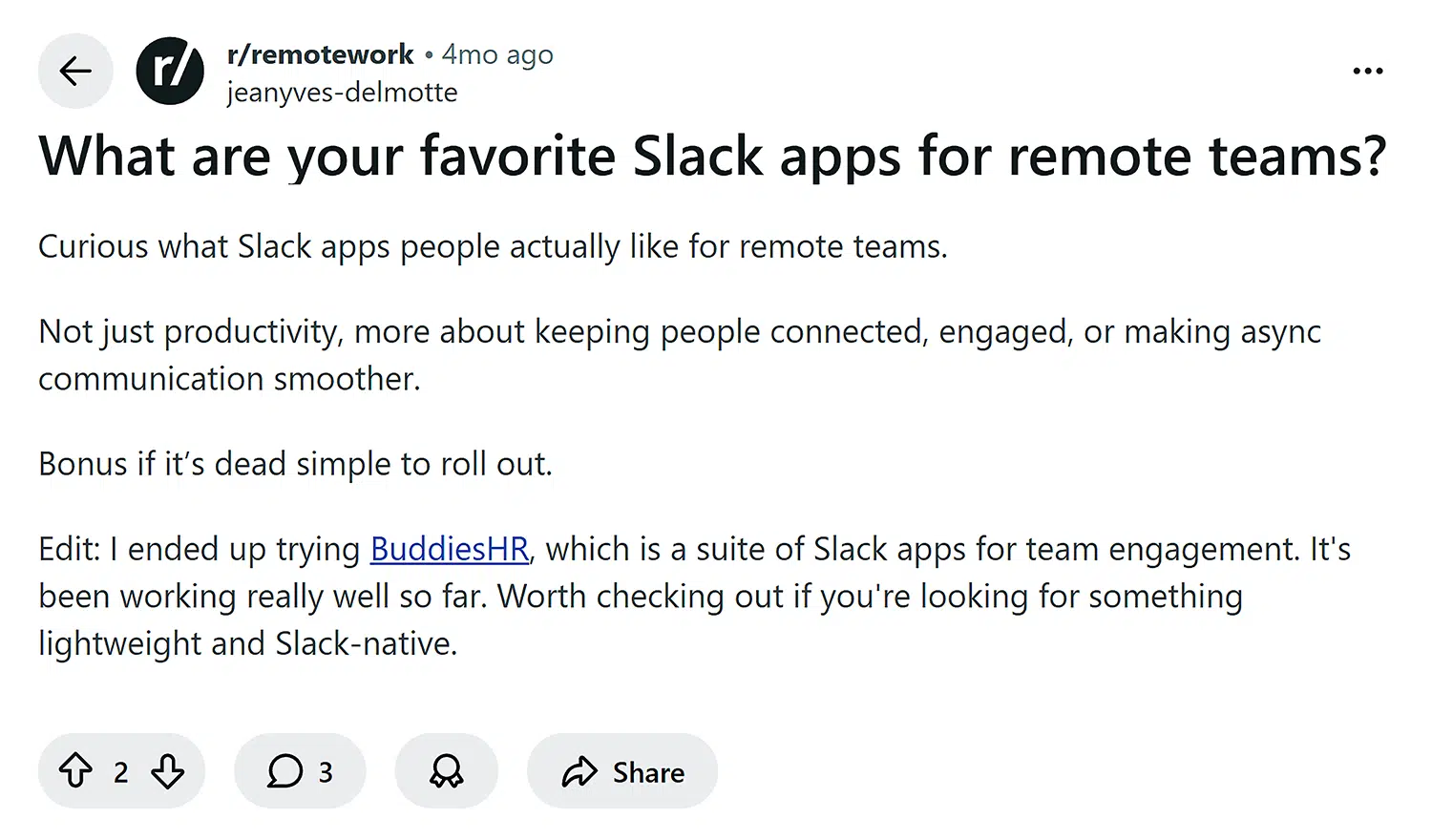
The community layer: Reddit threads, Quora discussions, and YouTube reviews:
The expert layer: SaaS tutorials, niche SaaS blogs, and trusted industry publishers:

The verification layer: G2, Capterra, and TrustRadius:

This breadth matters because it helps LLMs find patterns. When Slack’s value prop, features, and positioning appear the same way across all three layers, the AI treats that agreement as “high-confidence” information.
This gives the AI zero doubts about what Slack does and what it offers — and therefore what kinds of queries the AI should recommend Slack for.
Help AI find and feature your SaaS brand
For SaaS AI search, the game is simple: Show up everywhere the AI looks.
Track, optimize, and win in Google and AI search from one platform.
For software companies, that means being intentional about what you publish, how you structure it, and where you show up across the web.
You don’t just need to “write more content.” You need to create the right content, in the right places, in the right formats that AI models rely on.
It’s a big shift, for sure, but you can plot a strategic course with our playbook on engineering discoverability in a multimodal world.
New on MarTech